

The Hidden Cost of Cheap Medicine
Why do generics seem to have more issues than brand-name drugs? It mostly comes down to money. Generic manufacturers operate in a brutal price-war environment. While a branded company might spend 15-18% of its production budget on quality assurance, generic firms often slide that down to 8-10%. When you cut the budget for quality, you usually end up with older equipment and fewer eyes on the assembly line. This financial pressure creates a dangerous ripple effect. Many generic plants use aging infrastructure that simply can't keep up with modern standards. According to FDA data, generic facilities fail inspections at nearly double the rate of branded ones-about 57% versus 28%. When a facility is outdated or overcrowded, the risk of cross-contamination increases, and the likelihood of a batch failing a quality check sky-rockets. This is why we see a staggering 66,000 defects per million opportunities in some pharmaceutical sectors, compared to the gold-standard 3.4 defects seen in other high-precision industries.Physical Red Flags: What Actually Goes Wrong?
If you've ever seen a tablet that looks like it's peeling or has weird splotches, you're seeing a manufacturing failure in real-time. These aren't just ugly pills; they are signs that the physics of the production process failed.- Capping and Lamination: This happens when the tablet literally splits horizontally or separates into layers. It usually occurs when the compression force is too high (often exceeding 15 kN) or the mixture is too dry (moisture below 2%).
- Sticking: This is when the drug material clings to the punch heads of the machinery. It's common with ingredients that have low melting points (under 120°C) or when the humidity in the plant gets too high.
- Mottling: This is that uneven, splotchy coloring. While it looks like a cosmetic issue, it can sometimes signal that the active ingredients aren't distributed evenly throughout the batch.
- Weight Variation: This is the most critical defect. If the granules don't flow smoothly into the press (below 0.5 g/s), some pills end up with too much drug and others too little.
| Defect Type | Primary Cause | Technical Trigger | Impact |
|---|---|---|---|
| Capping | Excessive compression / Low moisture | Force > 15 kN; Moisture < 2% | Structural failure / Tablet splitting |
| Sticking | High humidity / Low API melting point | Moisture > 4%; Melting point < 120°C | Surface damage / Dosage inaccuracy |
| Lamination | Fast turret speed / Poor pre-compression | Speed > 40 RPM | Layer separation |
| Weight Variation | Poor granule flow | Flow rate < 0.5 g/s | Dose uniformity failure |

From the Factory Floor to the Pharmacy Shelf
These defects don't stay in the factory. They manifest as CGMP deficiencies (Current Good Manufacturing Practice), which are essentially the rules for how a drug must be made to ensure safety. When a company ignores these, the result is a recall. In fact, 63% of generic drug recalls are traced back to manufacturing defects, compared to only 41% for branded drugs. For the patient, this can be confusing. You might get a bottle of Metformin one month that looks perfect, and the next month, you get tablets that crumble the moment you touch them. Pharmacists see this constantly. A survey of over 1,200 pharmacists found that nearly 70% had encountered quality issues with generics in a single year. It's not just about looks; some patients report that a generic drug simply doesn't work as well as the brand, which can be linked to those manufacturing inconsistencies in dose uniformity.The Danger of Complex Generics
Not all generics are created equal. A simple aspirin tablet is easy to make. But "complex generics"-things like inhalers or modified-release tablets-are a different story. These require precise engineering to ensure the drug is released slowly over 24 hours rather than all at once. Because these are so hard to produce, they have much higher defect rates. Inhalers, for example, see a defect rate of around 18.2%, while simple immediate-release tablets sit closer to 9.3%. When these complex processes fail, it doesn't just result in a chipped pill; it can result in a medication that is therapeutically ineffective, leaving a patient untreated despite taking their medicine.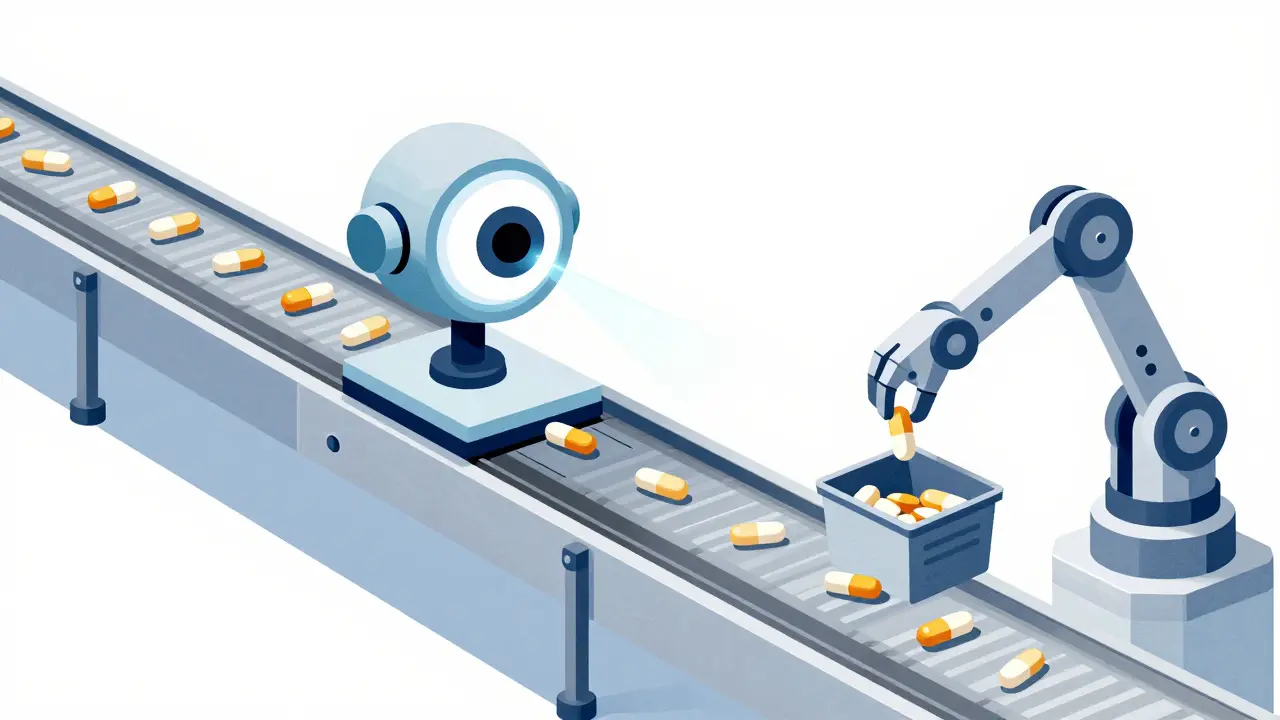
How the Industry is Trying to Fix It
To stop the cycle of recalls and shortages, the FDA is pushing for Quality by Design (QbD), which is a systematic approach to development that builds quality into the product from the start rather than testing for defects at the end . Instead of just checking a few pills at the end of the day, companies are starting to use in-line monitoring. Imagine a sensor that checks the weight of 1,200 tablets per minute and automatically kicks out any pill that is off by more than 5%. We're also seeing a shift toward "continuous manufacturing." Instead of making drugs in giant batches (where one mistake ruins the whole lot), continuous manufacturing flows the product through a constant stream. This method can reduce defect rates by up to 65%. Companies like Sandoz and Dr. Reddy's are even piloting AI systems that can spot a 0.1 mm defect on a tablet-something a human eye would almost always miss.The Road Ahead: Can We Trust Generics?
Despite the issues, generic drugs are essential. They make healthcare affordable for millions. The goal isn't to stop using them, but to demand better oversight. The industry needs a massive investment-estimated at nearly $29 billion-to bring all facilities up to modern standards. Until then, the risk of shortages will likely persist, as quality failures are the primary driver of drug shortages in the US. If you are a patient, the best thing you can do is stay observant. If your medication changes color, texture, or seems to be working differently, don't ignore it. Report it to your pharmacist or through systems like MedWatch. Your observation is often the first trigger for a regulatory investigation that protects thousands of other people.Why are generic drug recalls more common than branded ones?
Generic manufacturers often face intense price competition, which leads to lower investments in quality assurance and the use of aging manufacturing equipment. This results in a higher frequency of CGMP deficiencies and production errors, making them more susceptible to recalls.
Does a chipped or discolored tablet mean the drug is dangerous?
Not necessarily. Some defects are purely cosmetic (minor defects). However, visible flaws like capping or mottling can sometimes indicate deeper problems with dose uniformity or stability. If you notice significant changes in appearance, you should consult a pharmacist.
What is "weight variation" and why does it matter?
Weight variation occurs when the amount of material pressed into each tablet differs. If the weight varies beyond pharmacopeial limits (like USP <905>), it means some patients may receive too much of the active ingredient and others too little, leading to therapeutic failure or toxicity.
What are complex generics and why are they more prone to errors?
Complex generics include medications like inhalers, injectables, and modified-release tablets. They are harder to produce because they require precise delivery mechanisms and chemical structures to control how the drug enters the body, leaving less room for manufacturing error.
How is AI being used to reduce drug defects?
AI-powered visual inspection systems can analyze tablets at high speeds, detecting microscopic flaws (as small as 0.1 mm) that human inspectors would miss. These systems increase detection accuracy to around 92%, significantly reducing the number of defective pills that reach patients.