
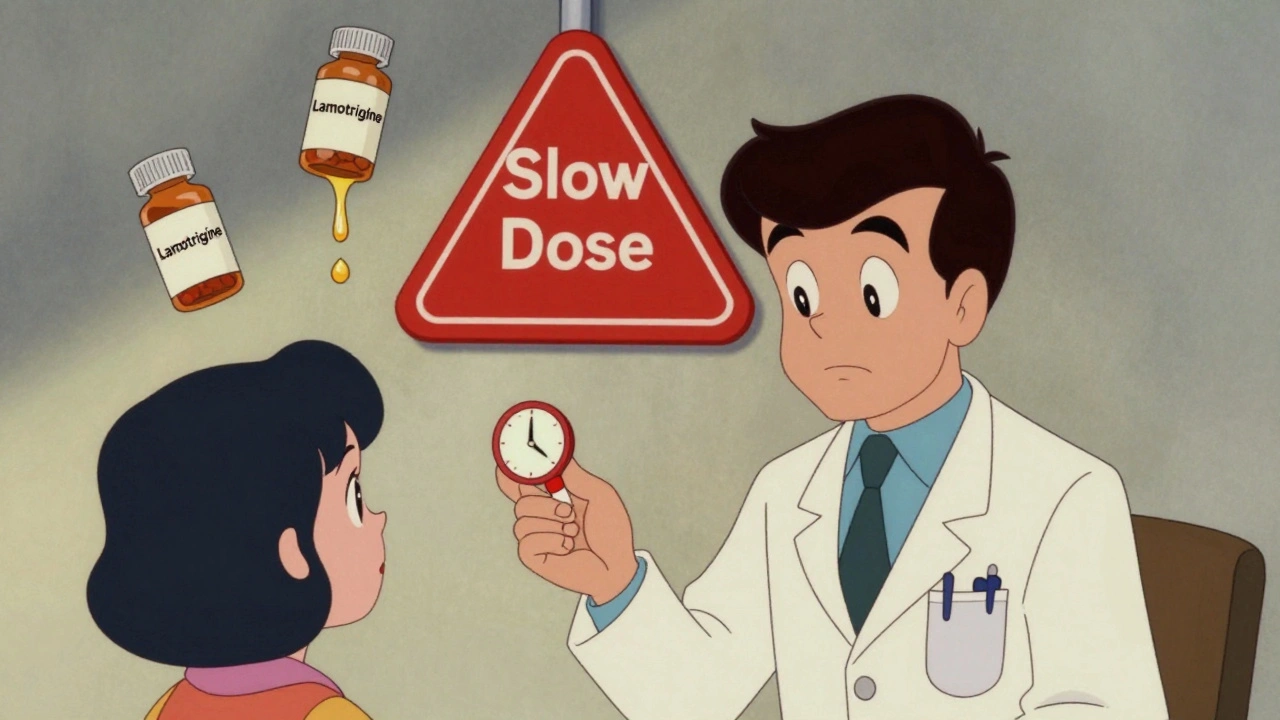
Lamotrigine-Valproate Dosing Safety Calculator
Dosing Safety Guide
This tool helps determine if your lamotrigine dose is safe when taken with valproate. Proper dosing is critical to reduce risk of severe skin rash and life-threatening reactions.
Your Safety Assessment
Please enter your dose and time on medication to see your safety status.
Key Safety Information
- With valproate, lamotrigine should start at 25 mg every other day and increase slowly
- Most serious reactions occur within the first 8 weeks
- Rashes may appear as small pink spots, itching, or fever - don't wait
- Children and teens have higher risk and often start at 12.5 mg every other day
When you’re prescribed both valproate and lamotrigine, the real danger isn’t the drugs themselves-it’s how they interact. This combination is common for epilepsy and bipolar disorder, but if the doses aren’t adjusted correctly, you could develop a serious skin rash. In rare cases, it can turn into Stevens-Johnson syndrome or toxic epidermal necrolysis-conditions that can be life-threatening. The good news? These severe reactions are now rare, not because the drugs changed, but because doctors learned how to dose them properly.
Why This Interaction Is So Dangerous
Valproate doesn’t just sit beside lamotrigine-it slows it down. Specifically, valproic acid blocks the liver enzyme that breaks down lamotrigine. This cuts lamotrigine’s clearance by nearly half. So if you’re taking both, lamotrigine builds up in your blood faster than expected. That buildup is what triggers the rash. It’s not an allergic reaction in the traditional sense. It’s a dose-dependent toxicity. The higher the lamotrigine level, the higher the risk.This wasn’t always understood. In the early 1990s, reports of severe rashes spiked. One German registry recorded 5 cases of Stevens-Johnson syndrome in just 4,450 patients taking lamotrigine. By 1999, after new dosing guidelines were introduced, that number dropped to 3 cases in over 17,000 patients. The change? Slower, lower dosing. The lesson was clear: speed and dose were the problem, not the drugs.
What the Dosing Rules Actually Are
If you’re starting lamotrigine while already on valproate, you start at 25 mg every other day. That’s half the usual starting dose. Then you wait two weeks before increasing by another 25 mg. You might think that’s slow-but it’s necessary. Without valproate, the typical starting dose is 25 mg daily, with increases every week. With valproate, you need to go slower because your body can’t clear lamotrigine the same way.Here’s what that looks like in practice:
- Week 1-2: 25 mg every other day (12.5 mg/day average)
- Week 3-4: 25 mg daily
- Week 5-6: 50 mg daily
- Week 7-8: 75 mg daily
- Then increase by 25-50 mg every 1-2 weeks, depending on tolerance
Compare that to lamotrigine monotherapy, where you might hit 100 mg by week 4. With valproate, you’re lucky to reach 75 mg by week 8. That’s not a mistake-it’s the safety protocol.
Rash Isn’t Always Just a Rash
Most people think of a rash as itchy, red patches on the skin. But with lamotrigine, especially when combined with valproate, the reaction can go deeper. In a 2023 case report, an 18-year-old woman developed not just a rash, but swollen lymph nodes and systemic inflammation. Her symptoms worsened even after she stopped taking lamotrigine. That’s unusual-and it shows the immune system can keep reacting even after the drug is gone.That’s why doctors don’t just say, “Stop the medicine if you get a rash.” They say: “Stop it immediately at the first sign.” That means even a small pink spot, mild itching, or unexplained fever. Don’t wait. Don’t assume it’s a virus. Don’t take antihistamines and hope it goes away. Discontinue lamotrigine and contact your prescriber right away.
Who’s at Highest Risk?
Children and teens are more vulnerable. The FDA requires a black box warning for lamotrigine in pediatric patients, especially when used with valproate. In one study of 80 young patients on both drugs, only two developed rashes-but those two cases were serious enough to require hospitalization. The rest had mild side effects like fatigue or drowsiness. Still, the risk is real.Another big risk factor? Having had a rash from another antiepileptic drug before. If you reacted to carbamazepine or phenytoin, your odds of reacting to lamotrigine jump by over three times. Your history matters. Tell your doctor every rash you’ve ever had from any seizure or mood medication.

What About Other AEDs?
Lamotrigine has one of the highest rash rates among antiepileptic drugs-around 2.8% overall in outpatient studies. That’s higher than levetiracetam, gabapentin, or oxcarbazepine. But here’s the twist: when dosed correctly, serious rash rates drop to 0.13% in combination therapy and 0.08% in monotherapy. That’s a 95% reduction from the early 1990s. The drugs aren’t riskier now-they’re just used smarter.Valproate alone rarely causes rash. It’s the combo that’s dangerous. So if you’re on valproate and your doctor wants to add lamotrigine, push for the slow titration. If they start you at 50 mg daily, ask why. That’s not standard. That’s risky.
What If You’ve Already Been on Both for Months?
If you’ve been on lamotrigine and valproate together for more than two months without a rash, your risk drops sharply. Most rashes appear within the first 8 weeks. After that, the chance of a severe reaction is very low. But don’t get complacent. If you develop a new rash-even months later-stop lamotrigine and get checked. The reaction can still happen, just less often.What Happens If You Get a Rash?
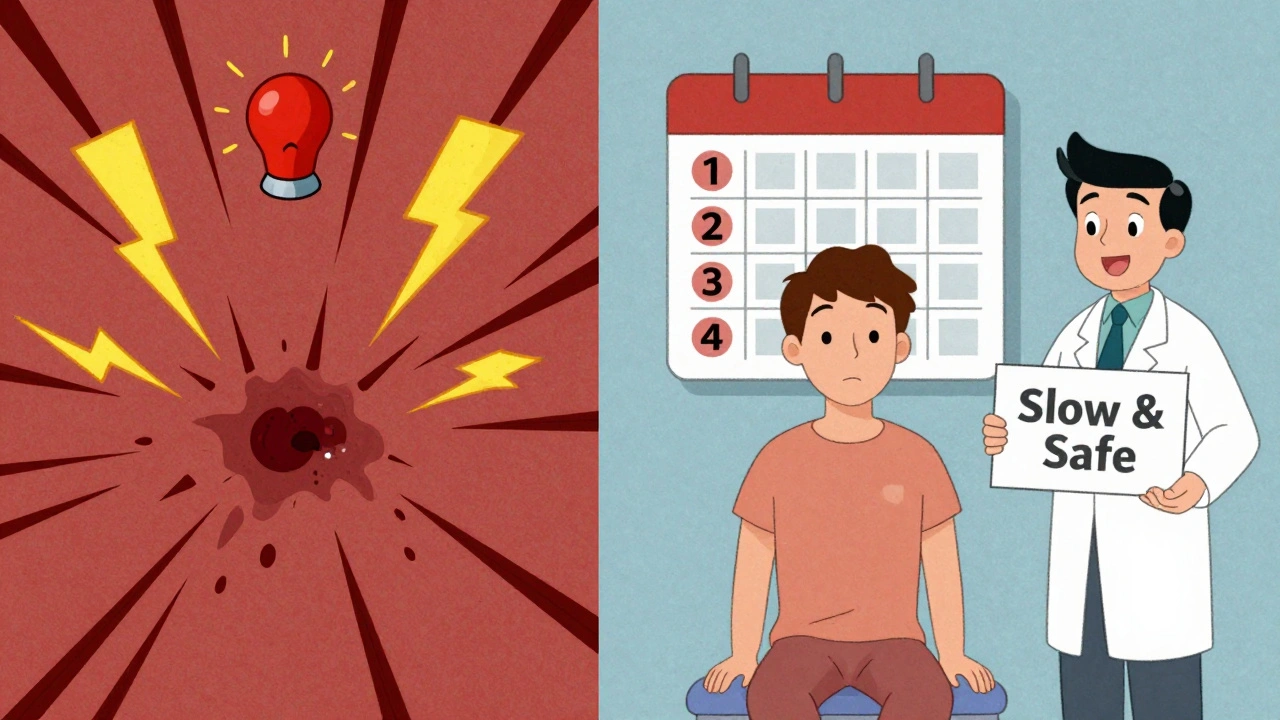
If you get a rash, the first step is always stopping lamotrigine. No exceptions. Valproate usually stays on unless there’s clear evidence it’s also involved. Most rashes resolve with supportive care: antihistamines, moisturizers, and sometimes a short course of steroids. One patient in a case report needed two weeks of oral steroids. Another got relief with antihistamines in a few days.But if the rash spreads, blisters, affects your mouth or eyes, or you develop fever or swelling-go to the ER immediately. These are signs of Stevens-Johnson syndrome or toxic epidermal necrolysis. These aren’t skin problems. They’re full-body immune crises. Mortality rates can be as high as 35% for toxic epidermal necrolysis.
Can You Ever Rechallenge?
Reintroducing lamotrigine after a rash is rarely recommended. Even if the rash was mild, the chance of a worse reaction next time is too high. There are no safe protocols for rechallenge. If you need another mood stabilizer or seizure medication, your doctor will pick something else-like carbamazepine, oxcarbazepine, or lithium. Don’t try to restart lamotrigine just because you feel better.What’s New in 2025?
Recent research is looking at genetic markers that might predict who’s at risk for severe reactions. Some studies suggest HLA-B*15:02 and HLA-A*31:01 alleles might be involved, similar to how they predict carbamazepine reactions. But right now, those tests aren’t reliable enough for routine use. Until they are, the best tool remains the slow titration schedule.Some clinics now start children on 12.5 mg every other day instead of 25 mg. That’s extra caution. It’s not required, but it’s a growing trend in pediatric psychiatry, especially for autism or bipolar disorder.
Bottom Line: Safety Is in the Schedule
Valproate and lamotrigine work well together. Many people live stable lives on this combo. But it’s not a casual pairing. It’s a high-stakes one. The difference between safety and danger comes down to patience. Rushing the dose? That’s the mistake. Ignoring early symptoms? That’s the risk.If you’re starting this combo, make sure your doctor follows the 25 mg every other day rule. If they don’t, ask why. If you develop any skin change, stop the medication and call your provider. Don’t wait. Don’t Google it. Don’t assume it’s nothing. This interaction is well-known, well-studied, and completely preventable-with the right dosing.
Can I take lamotrigine and valproate together safely?
Yes, but only if the lamotrigine dose is adjusted. Starting at 25 mg every other day and increasing slowly every two weeks reduces the risk of rash dramatically. Never start lamotrigine at a normal dose if you’re already on valproate.
How long after starting lamotrigine does a rash usually appear?
Most rashes appear within the first 8 weeks, especially during the titration phase. The highest risk is in the first 2-4 weeks. But rare cases have occurred months later, so stay alert even after you’ve been on the medication for a while.
Is lamotrigine more likely to cause a rash than other seizure meds?
Yes, among commonly used antiepileptic drugs, lamotrigine has one of the higher rash rates-especially when combined with valproate. But with proper dosing, serious rash rates are now under 0.15%, making it safer than many older drugs when managed correctly.
What should I do if I notice a rash while on these drugs?
Stop taking lamotrigine immediately and contact your doctor. Do not wait to see if it gets worse. If the rash is spreading, blistering, or you have fever or mouth sores, go to the emergency room. These can be signs of life-threatening reactions.
Can I restart lamotrigine after a rash goes away?
No. Reintroducing lamotrigine after a rash-even a mild one-carries a high risk of a much more severe reaction. Doctors strongly advise against rechallenge. Choose a different medication instead.
Are children at higher risk than adults?
Yes. Children and adolescents have a higher risk of severe skin reactions with lamotrigine, especially when combined with valproate. That’s why the FDA requires a black box warning. Starting doses in kids are often lower (12.5 mg every other day) and titration is even slower.
Does valproate cause rashes on its own?
Rarely. Valproate is not typically associated with serious skin reactions. The danger comes from its interaction with lamotrigine, which raises lamotrigine levels and increases rash risk. Valproate alone is generally safe in this regard.
What are the signs of a serious reaction beyond a rash?
Look for fever, swelling of the face or tongue, blisters in the mouth or eyes, peeling skin, or swollen lymph nodes. These are signs of Stevens-Johnson syndrome or toxic epidermal necrolysis. These are medical emergencies-go to the ER immediately.
If you're on this combo, your safety depends on one thing: following the slow titration schedule. No shortcuts. No assumptions. Just careful, step-by-step dosing-and knowing when to stop. That’s how you keep the benefits without the risks.
Yatendra S
This is why I love med forums 🙏 Slow titration = life preservation. I’ve seen too many people rush this and end up in the ER. Patience isn’t boring-it’s sacred.
kevin moranga
Man, I wish more doctors actually followed these guidelines. My cousin was started on 50mg of lamotrigine while on valproate and got a full-body rash within 10 days. They thought it was "just allergies" until she started blistering. Now she’s on lithium and doing way better. Please, if you’re on this combo, don’t let your doc cut corners. It’s not worth the risk.
Lara Tobin
I just want to say thank you for writing this. My sister had a near-miss with SJS last year, and this is exactly what her neurologist should’ve told us. I’ve been sharing this post with every parent I know whose kid is on mood meds. 💙
Keasha Trawick
The pharmacokinetics here are *fascinating*. Valproate’s inhibition of UGT1A4 isn’t just a footnote-it’s a pharmacological grenade. Lamotrigine’s half-life balloons from 30h to 60h+ when co-administered, creating a perfect storm for HLA-mediated immune dysregulation. And yet, clinicians still treat this like it’s a "common side effect." It’s not. It’s a systemic cascade waiting to detonate. We need mandatory titration protocols, not just recommendations.
Alvin Montanez
People think medicine is about convenience. No. It’s about discipline. If you’re too lazy to wait two weeks between dose increases, you don’t deserve to be on this combo. I’ve seen patients who treated their meds like caffeine-"I’ll just double it since I feel blah." And then they wonder why their skin peeled off. Wake up. This isn’t TikTok. Your life isn’t a demo.
Tom Zerkoff
I appreciate the thoroughness of this post. As a clinical pharmacist, I’ve reviewed hundreds of lamotrigine/valproate regimens. The most common error isn’t ignorance-it’s inertia. Clinicians know the guidelines, but they default to "standard" dosing out of habit. I always print out the titration schedule and hand it to the patient. Knowledge is power, but distribution is responsibility.
Bruno Janssen
I’ve been on both for 3 years. No rash. But I still check my skin every morning. Like, literally. I stare at my arms like they’re a crime scene. I’ve had nightmares about this. I don’t sleep if I see a red dot. I know it’s irrational. But I’d rather be paranoid than dead.
Himmat Singh
The data cited here is cherry-picked. The 2023 case report you mention involved a patient with underlying autoimmune dysregulation and concurrent viral infection. To generalize this as a pure pharmacological interaction is misleading. The true incidence of severe rash remains negligible. This post is fearmongering disguised as education.
Ronan Lansbury
Let’s be honest-this entire protocol was invented by Big Pharma to sell more monitoring kits and lab tests. The real reason rash rates dropped? Because the FDA forced them to slow titration after lawsuits. They didn’t suddenly become smarter-they got sued into compliance. And now they profit from your anxiety. Don’t be fooled.
Scott Butler
If you’re American and you’re not following these guidelines, you’re just being irresponsible. Other countries have better systems. In Germany, they start kids at 12.5mg every other day by law. Here? We let doctors wing it. That’s why our hospitalization rates are higher. Fix the system, not just the dose.