
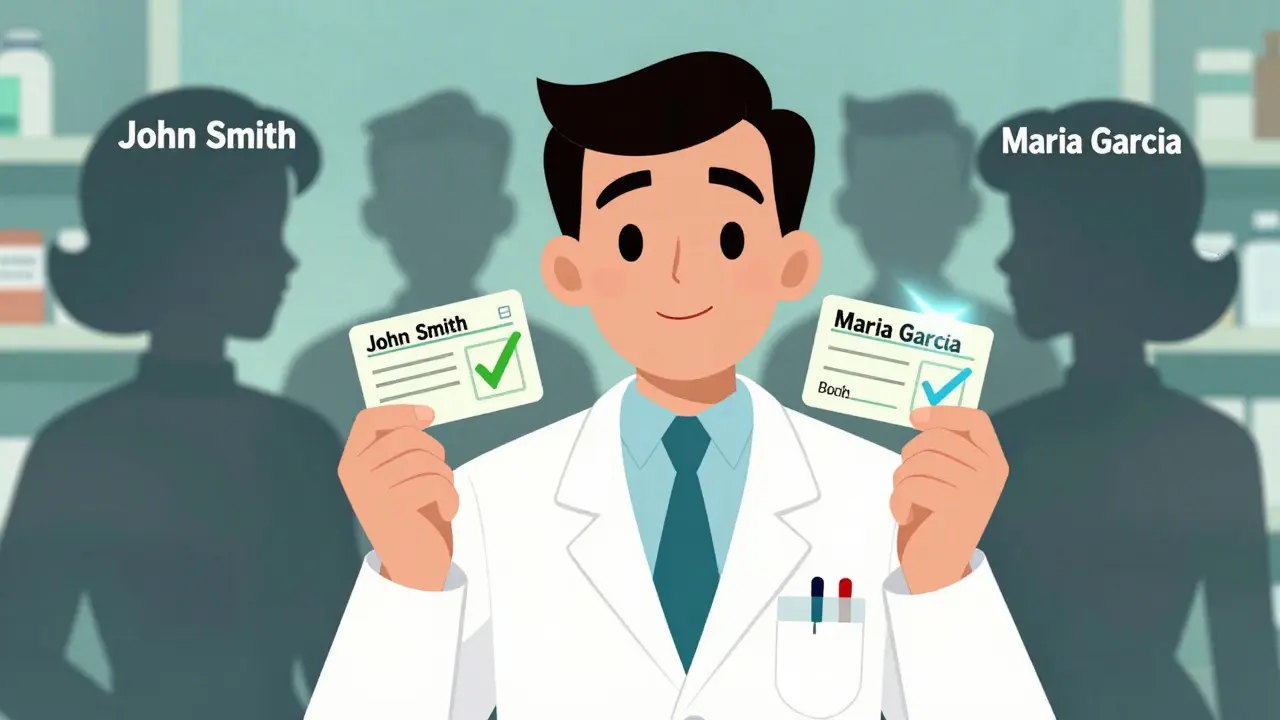
Every year, thousands of patients in the U.S. receive the wrong medication-not because a pharmacist made a careless mistake, but because someone was misidentified. It sounds impossible, but it happens. A woman gets antibiotics meant for another woman with the same last name. An elderly man receives a high-dose opioid because his record was mixed up with someone else’s. These aren’t rare accidents. They’re preventable failures-and they start with skipping one simple step: using two patient identifiers.
Why Two Identifiers? The Real Risk
The Joint Commission, the main organization that accredits U.S. hospitals and pharmacies, made this rule official back in 2003. It’s called NPSG.01.01.01. And it’s not optional. You must use two pieces of information to confirm a patient’s identity before giving them any medication. Not one. Not sometimes. Always two.Why? Because names alone are dangerously unreliable. Think about it: how many people do you know named John Smith or Maria Garcia? In a busy pharmacy, you might see three patients with the same first and last name in a single hour. Add similar birth dates or addresses, and the chances of mixing them up rise fast.
According to a 2020 study in JMIR Medical Informatics, up to 10% of serious drug interaction alerts go unnoticed simply because patient records are mismatched. That means someone could be given a drug that causes a life-threatening reaction-and the system doesn’t even blink. In 2023, the Emergency Care Research Institute ranked patient misidentification as one of the top 10 threats to patient safety. That’s not a minor concern. It’s a systemic flaw.
What Counts as a Valid Identifier?
Not every piece of information you have is acceptable. The Joint Commission is very clear: room number and location don’t count. Why? Because a patient can move rooms. A person in Bed 302 today might be in Bed 310 tomorrow. Relying on location is like trying to identify someone by the chair they’re sitting in.Acceptable identifiers include:
- Full legal name
- Date of birth
- Assigned medical record number
- Phone number
- Address (in some cases, if unique and verified)
The key is that both identifiers must be unique to the individual and directly tied to their record. So, if you’re checking a prescription, you don’t just ask, “Are you John Smith?” You ask, “What’s your date of birth?” and cross-check it against the screen. Then you verify the medical record number on the bottle matches the one on the chart.
Manual Checks Aren’t Enough
Many pharmacies still rely on staff asking patients for their name and DOB. It sounds simple. But human memory is fallible. Fatigue, distractions, and time pressure make mistakes inevitable.A 2023 survey by the American Society of Health-System Pharmacists found that 63% of pharmacists admitted to occasionally cutting corners on verification-especially during peak hours. In community pharmacies, 42% of staff said they often verify identity verbally without writing it down. That’s a problem. The Joint Commission requires documentation. If you don’t record that you checked both identifiers, you’re not compliant. And in a survey of non-compliant facilities in 2023, 37% failed because they didn’t document the checks.
Even double-checking by two staff members doesn’t guarantee safety. A 2020 review in BMJ Quality & Safety found no strong evidence that having two people verify a prescription reduces errors. Why? Because if both people are looking at the same wrong record, they’ll both miss the mistake.
Technology Makes the Difference
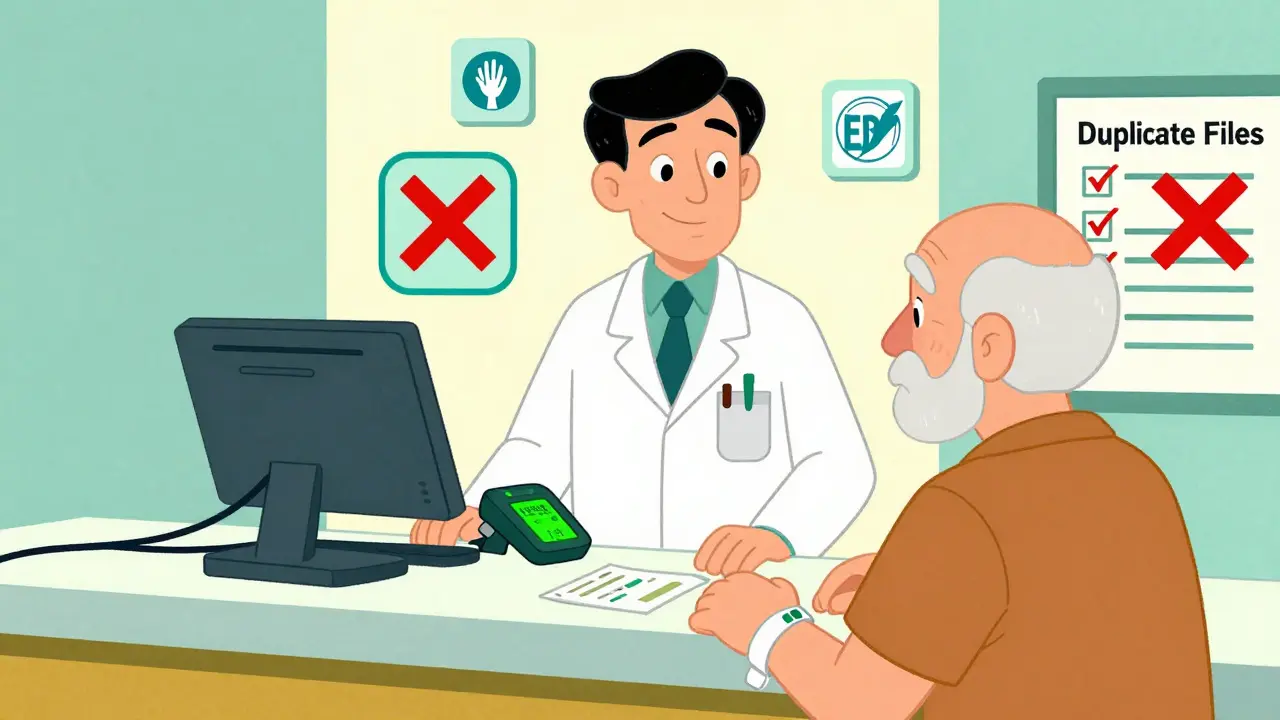
The most effective way to prevent these errors isn’t more staff. It’s better technology.Barcode scanning systems have proven to cut medication errors by 75%, according to a 2012 study in the Journal of Patient Safety. Here’s how it works: the pharmacy prints a barcode on the medication label that includes the patient’s name, DOB, and medical record number. The pharmacist scans the label and the patient’s wristband-both must match. If they don’t, the system blocks the dispensing process.
Even better? Biometric systems. Hospitals using palm-vein scanners (like Imprivata PatientSecure) have seen a 94% accuracy rate in matching patients to their records. Compare that to the 17% accuracy rate in hospitals without a central patient index. That’s a five-fold improvement.
Enterprise Master Patient Index (EMPI) systems are the backbone of this. They link all a patient’s records-across clinics, hospitals, and pharmacies-under one unique ID. Without EMPI, duplicate records are common. One case from Altera Health in 2024 showed a woman receiving conflicting medications because her records were split between three different departments under three slightly different names. She didn’t even know she had two records. But her body paid the price.
What Happens When You Don’t Follow the Rules?
Ignoring the two-identifier rule isn’t just risky-it’s costly.In 2023, non-compliance with this rule was the third most common violation in hospital surveys, making up 28% of all patient safety goal failures. That’s not a small footnote. It’s a major red flag. And when a facility fails accreditation, it risks losing Medicare and Medicaid reimbursement. That’s not a fine. That’s a financial crisis.
Plus, there’s the human cost. The Office of the National Coordinator for Health IT estimates that duplicate records cost large hospitals $40 million a year in wasted time, retesting, and error correction. And that’s just the money. The real cost is the patient who gets the wrong drug, the family that loses trust, the pharmacist who wakes up wondering if they caused harm.
How to Implement It Right
If you’re setting this up in your pharmacy, here’s what works:- Start with policy. Write down exactly which two identifiers you’ll use and when.
- Train everyone-pharmacists, technicians, front desk staff. Don’t assume they know.
- Use technology. Barcode scanning on dispensing and administration is the gold standard.
- Integrate EMPI if possible. Even if you’re a small pharmacy, connect to a regional health network.
- Document every check. If you don’t write it down, it didn’t happen.
For high-alert medications (like insulin, blood thinners, or chemotherapy), add a “timeout” step. Before handing over the drug, pause. Say the patient’s name. Say their DOB. Confirm the barcode. Look the patient in the eye. Make it a habit.
The Future Is Unique Identifiers
Right now, every patient has a different ID in every system they visit. That’s why records get mixed up. The solution? A single, national patient identifier.The ONC launched a pilot in January 2025 to test this in five health information exchanges. Early results show it could uncover up to 9.7% more dangerous drug interactions that current systems miss. The American Medical Informatics Association supports it. But privacy concerns and high costs ($1.2-1.8 million per 100-bed hospital) are slowing adoption.
Until then, the best tool we have is still the two-identifier rule-done right, every time, with documentation, and with technology when possible.
What Patients Can Do
You’re not powerless. If you’re picking up a prescription:- Always answer when asked for your date of birth-even if you’ve already given it.
- Check the name on the label. Is it yours?
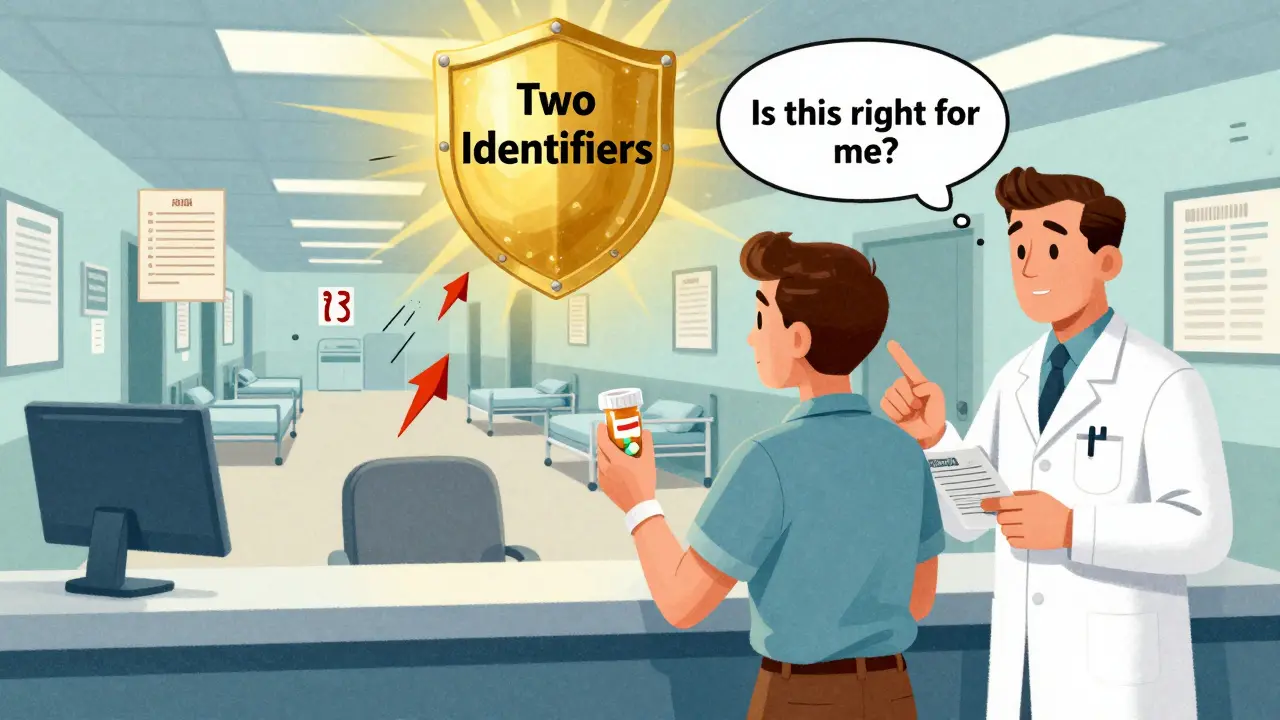
- Ask: “Is this medication right for me?”
- If you’ve been to other clinics, make sure your records are linked.
It’s not just the pharmacist’s job. It’s everyone’s.
What are the two patient identifiers required in pharmacies?
The two required identifiers must be unique to the patient and directly tied to their record. Acceptable examples include full legal name and date of birth, or name and assigned medical record number. Room number, location, or provider name are not acceptable because they are not person-specific.
Why can’t I use room number or bed number as a patient identifier?
Room or bed numbers change frequently and are tied to location, not identity. A patient might be moved from Room 205 to Room 207 after surgery. If you rely on room number, you could give medication to the wrong person who just moved into that bed. Identifiers must follow the patient, not the space.
Is double-checking by two staff members enough to prevent errors?
No. A 2020 systematic review in BMJ Quality & Safety found no strong evidence that having two people verify a prescription reduces medication errors. If both staff members are looking at the same incorrect record or misreading the same label, the error won’t be caught. Technology like barcode scanning is far more reliable because it forces a match between the patient, the drug, and the record.
What’s the most common reason pharmacies fail compliance audits for patient identification?
The most common reason is failure to document the verification. The Joint Commission found that in 37% of non-compliant facilities, staff verified the patient’s identity but didn’t record it in the medication administration record. Verification without documentation is invisible-and that’s a violation.
How do barcode systems reduce medication errors in pharmacies?
Barcode systems link the patient’s wristband, the medication label, and the electronic prescription. When the pharmacist scans both, the system checks for a match. If the patient’s name or ID doesn’t align with the drug, the system blocks the transaction. Studies show this reduces errors reaching patients by up to 75%.
Can patients help prevent medication errors by using two identifiers?
Yes. Patients should always confirm their full name and date of birth are correct on the prescription label. If asked for their DOB, they should answer even if they’ve already given it. Asking, “Is this medication right for me?” is a simple but powerful safety step. Patients are the last line of defense.
CAROL MUTISO
So let me get this straight-we’re still using paper charts and human memory to keep people from dying of the wrong pill? In 2025? I mean, we put a man on the moon, invented self-driving cars, and still can’t get a barcode scanner to do its job? It’s not incompetence. It’s laziness dressed up as tradition. And the worst part? We all know it. We just don’t want to pay for the fix.
Martin Spedding
barcods r the answer but they r expensive and most pharmacies r run by greedheads who care more about profit than patient safety. also who the hell uses room numbers?? that’s like identifying a dog by the leash it’s wearing. lol.
Raven C
It is, quite frankly, a moral failure of the healthcare system that we continue to permit such an elementary lapse in protocol. The Joint Commission’s guidelines are not suggestions-they are the bare minimum of ethical practice. To treat patient identification as an afterthought is not merely negligent; it is an affront to the sanctity of human life. One must wonder: at what point does systemic indifference become complicity?
Donna Packard
I’ve seen pharmacists do this right. They slow down, they smile, they ask for DOB even if they already know it. It’s not about the tech-it’s about the habit. Small moments matter. One pharmacy I worked at had a sign: ‘Check twice. Live once.’ We didn’t lose a single error in three years.
Patrick A. Ck. Trip
While i agree with the necessity of two identifiers, i believe we must also consider the cognitive load on staff. overburdened pharmacists are more likely to make errors-even with tech. perhaps a hybrid approach-tech + structured pauses-is the real solution. also, typo in 'record' on pg 3, i think.
Sam Clark
Consistency and documentation are the unsung heroes of patient safety. No system is perfect, but when you combine clear policy, trained staff, and auditable records, you create a culture of accountability. That’s what separates good pharmacies from great ones. And yes-it takes time. But so does recovering from a medication error.
Jessica Salgado
Wait-so you’re telling me a woman in Texas got chemo meant for a woman in Ohio because their names were similar and no one scanned the wristband? And this isn’t a movie plot? This is happening in REAL hospitals? I’m not even mad. I’m just… numb. How many people have to die before this becomes a national emergency?
Chris Van Horn
Barcodes? Biometrics? Please. This is America. We don’t need ‘advanced tech’ to tell us who’s who. Just use the damn name and DOB. Stop overengineering everything. Also, EMPI? That’s just a socialist database waiting to be hacked. And why do we need a national ID? We’re not Sweden. This is tyranny wrapped in a lab coat.
Steven Lavoie
In Nigeria, we use patient names, DOB, and a handwritten ID tag tied to their wrist with a ribbon. No barcode. No EMPI. Just trained staff who treat every patient like family. Technology helps, but it doesn’t replace human care. Maybe we need less tech and more training-and respect.
Michael Whitaker
Look, I get it. You want to save lives. But let’s be real-most patients don’t even know their own DOB. I asked my aunt and she said ‘sometime in July.’ So now what? Scan her palm? Give her a QR code tattoo? This is a solution looking for a problem. Also, why are you blaming the pharmacist? The real issue is the EMR systems. They’re garbage.
Brooks Beveridge
Hey everyone-just wanted to say thank you to the pharmacists. Seriously. You’re the quiet heroes who catch the mistakes before they happen. And yes, the system’s broken. But you’re still showing up. 🙏 That counts. Keep doing the work. We see you.
Josh Potter
barcodes r fire but who has time to scan 200 scripts at 4pm? we need ai that auto-checks and alerts. also why is everyone so uptight about documentation? just take a pic of the label and call it a day. #pharmlife #overworked
Evelyn Vélez Mejía
The tragedy here isn’t the lack of technology-it’s the erosion of professional dignity. We’ve turned pharmacists into order-takers, not guardians. When you treat expertise as disposable, you don’t get better outcomes-you get more corpses. The two-identifier rule isn’t bureaucracy. It’s a ritual of reverence. And we’ve forgotten how to perform it.
Victoria Rogers
Who even is the Joint Commission? Some fancy-pants org that doesn’t know how real pharmacies work. We’re not in a hospital. We’re in a Walmart pharmacy at 8am with 12 people screaming for their Xanax. You want me to scan a barcode? Fine. But don’t act like this is about safety. It’s about control. And I’m not playing.