
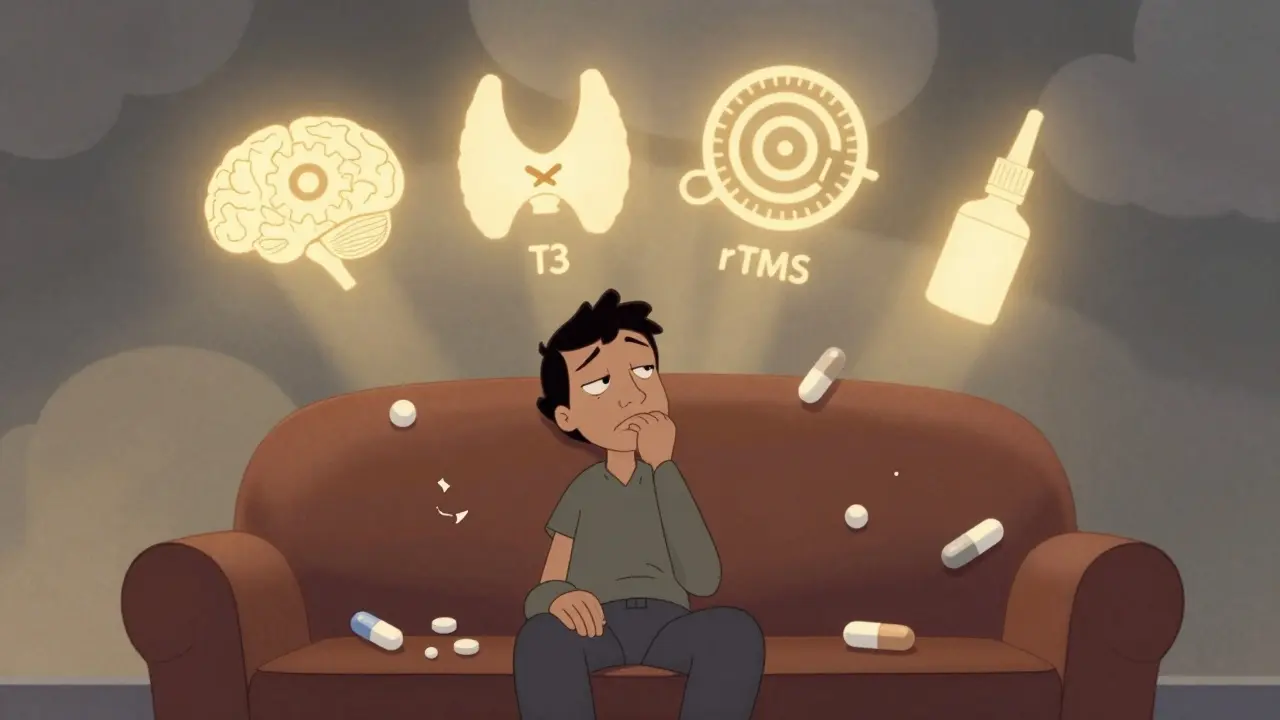
When antidepressants stop working, it’s not a failure of willpower-it’s a sign the brain needs a different kind of help. About treatment-resistant depression (TRD) affects 30-40% of people with major depression after trying two or more standard antidepressants. These aren’t people who didn’t try hard enough. They’re people whose brains didn’t respond to the usual tools. And that’s where things get complicated, but also where real hope begins.
What Exactly Is Treatment-Resistant Depression?
TRD isn’t just a label. It’s a clinical reality backed by data. The landmark STAR*D trial, which followed over 2,800 people with depression over several years, found that nearly half didn’t respond to the first antidepressant they tried. After two tries, about one in three still weren’t better. That’s not rare. That’s common.
What makes a treatment "adequate"? It’s not just taking the pill. It’s taking the right dose, for long enough-usually 6 to 8 weeks at full therapeutic levels. Many people give up too soon. Others get prescribed doses too low to matter. TRD only counts if you’ve done it right. And if you have, and you’re still stuck, it’s time to look beyond the basics.
Augmentation: Adding Something, Not Switching
Augmentation means adding a second medication to your current antidepressant-not replacing it. This isn’t about throwing everything at the wall. It’s about using science to stack tools that work together.
The FDA has approved four specific augmentation options for TRD:
- Aripiprazole (Abilify): 2-15 mg/day. Works well for people with fatigue or low motivation. Side effects? Restlessness (akathisia) in up to 25% of users.
- Brexpiprazole (Rexulti): 0.5-3 mg/day. Similar to aripiprazole but often better tolerated.
- Quetiapine extended-release (Seroquel XR): 150-300 mg/day. Strong evidence for improving mood, especially sleep and anxiety. But it causes drowsiness and weight gain in many.
- Olanzapine-fluoxetine (Symbyax): A combo pill. Effective, but weight gain is common-up to 7% of body weight in some.
These aren’t magic bullets. But they’re backed by solid trials. The VAST-D trial, which studied over 1,500 veterans with TRD, showed aripiprazole led to remission in nearly 25% of patients-better than switching to another antidepressant.
Other augmentation agents aren’t FDA-approved for TRD but still show promise:
- Lithium: Used for decades. Works best when blood levels are kept between 0.3-0.6 mEq/L. Requires regular blood tests. Helps people with mood swings or mixed depression.
- Liothyronine (T3): A thyroid hormone. Surprisingly effective-studies show it nearly triples the chance of response compared to placebo.
- Bupropion: Often added when sexual side effects or fatigue are problems. The STAR*D trial found it helped 21% achieve remission.
- Modafinil and lisdexamfetamine: Stimulant-like agents. Useful when energy is the biggest barrier.
But not all augmentations are equal. Some, like ziprasidone or mirtazapine, have higher dropout rates because of side effects. Aripiprazole and brexpiprazole have the best balance of effectiveness and tolerability.
Psychotherapy: The Underrated Booster
Medication isn’t the only path. Therapy, especially cognitive behavioral therapy (CBT), isn’t just for mild depression. When added to antidepressants for TRD, CBT has an effect size of 1.58-stronger than most drugs. That means it’s not just helpful. It’s powerful.
Why? Because depression isn’t just chemical. It’s also cognitive. Negative thoughts, avoidance, self-blame-they keep the brain stuck. CBT teaches you to break those patterns. And when paired with medication, it doesn’t just improve mood-it changes how you live.
Esketamine: Fast Relief, But With Caveats
In 2019, the FDA approved esketamine nasal spray (Spravato) for TRD. This was huge. For the first time, a treatment could lift depression in hours, not weeks.
In the TRANSFORM-2 trial, 70% of people on esketamine responded after four weeks-compared to 48% on placebo. That’s not minor. That’s life-changing for someone who’s been suicidal or paralyzed by despair.
But there’s a catch. Esketamine must be given in a certified clinic. You can’t take it home. Why? Because it causes dissociation-feeling detached from your body-in nearly 60% of users. Some feel dizzy, nauseous, or briefly lose touch with reality. It’s controlled for safety.
It’s also expensive. And not everyone responds. But for those who’ve tried everything else? It’s often the first real breakthrough.
rTMS: Non-Invasive Brain Stimulation
If you want results without pills or needles, repetitive transcranial magnetic stimulation (rTMS) is one of the most reliable options. Over 50 trials, involving more than 10,000 patients, show it works.
How? A magnetic coil is placed on the scalp, targeting the prefrontal cortex-the part of the brain that’s underactive in depression. It’s like a workout for your brain. No anesthesia. No memory loss. You sit in a chair, listen to clicking sounds, and go home the same day.
Response rates? Around 50-55%. Remission? 30-35%. That’s similar to ECT, but without the risks of general anesthesia or confusion. Many patients start seeing improvement after 2-3 weeks. By week 6, many are back to normal life.
It’s covered by Medicare and most insurers for TRD. And unlike drugs, it doesn’t cause weight gain, sexual side effects, or sedation.
Deep Brain Stimulation and Beyond
For the rare few who don’t respond to anything else, there’s deep brain stimulation (DBS). It’s surgery. A device is implanted in the brain, targeting the subcallosal cingulate cortex. It sends tiny pulses of electricity to reset abnormal activity.
One small study with six patients showed a 92% response rate after two years. That’s extraordinary. But it’s still experimental. Only a handful of centers in the U.S. offer it. It’s not for everyone. But for those with years of failed treatments? It’s a last resort that sometimes works.
The Emerging Frontier: Inflammation and Psychedelics
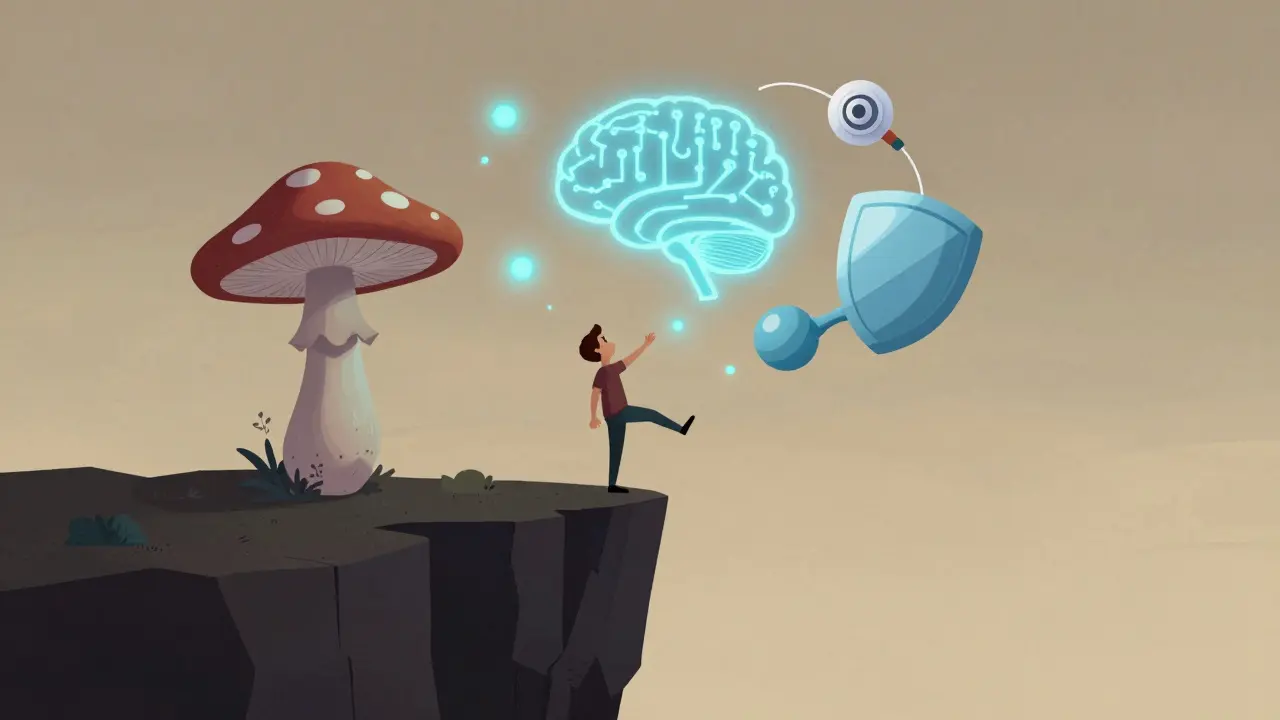
Science is moving fast. One 2022 study found that people with TRD and high inflammation (measured by hs-CRP levels) responded better to infliximab, an anti-inflammatory drug used for rheumatoid arthritis. Those with high inflammation had a 30.5% remission rate with infliximab-nearly double the placebo group.
That’s huge. It suggests depression isn’t one disease. For some, it’s an inflammatory condition. For others, it’s hormonal. For others, it’s neural. Personalization is the future.
And then there’s psilocybin. A 2020 JAMA Psychiatry trial gave 24 people with TRD a single dose of psilocybin. After four weeks, 71% responded. Only 9% did in the placebo group. The effects lasted. Many described it as a spiritual experience that shifted their entire perspective.
But psilocybin isn’t legal for depression treatment yet. It’s still in clinical trials. Still, it’s proof that we’re on the edge of a new era.
Why Do So Many Still Struggle?
Despite all this, only about 28% of TRD patients achieve lasting remission with current treatments. Why?
Because depression isn’t simple. The brain isn’t a light switch. It’s a tangled network. Some people respond to lithium. Others need rTMS. Others need esketamine. One size doesn’t fit all.
And many doctors still don’t know the options. They give one antidepressant, then another. And another. And when nothing works, they say, "We’ve tried everything." But that’s not true. We haven’t tried the right things for you.
The answer isn’t more pills. It’s better matching. Matching the treatment to your biology, your symptoms, your life. That’s the future.
What Comes Next?
If you’ve tried two antidepressants and still feel stuck, you’re not alone. And you’re not out of options.
Start with your doctor. Ask: Have I had adequate trials? Is augmentation being considered? Is rTMS an option? Could I qualify for esketamine?
Don’t accept "there’s nothing else" as an answer. There is. It’s just not always the first thing offered.
TRD is hard. But it’s not hopeless. The tools are here. The science is real. And for the first time in history, we’re not just managing depression-we’re starting to understand how to reverse it.
Darren McGuff
Been through TRD for 8 years. Aripiprazole saved me-finally felt like myself again. The akathisia? Yeah, it sucked for the first two weeks. But after that? Night and day. Don’t let side effects scare you off if your doctor’s monitoring you. This isn’t weakness. It’s science.
Alicia Hasö
To anyone reading this and feeling hopeless: you are not broken. Your brain just hasn’t found its rhythm yet. rTMS changed my life-no pills, no weight gain, no fog. I went from crying in the shower to hiking with my kids in six weeks. There is help. You just have to keep asking until someone listens.
Jeffrey Hu
Let’s be real-most people don’t even take antidepressants long enough to know if they work. STAR*D showed that. And now you’re talking about esketamine and psilocybin like they’re magic? You’re ignoring the fact that 70% of people who fail SSRIs do so because they quit at week 3. Stop romanticizing the extreme options and fix the basics first.
Meghan Hammack
I was suicidal last winter. Took me 3 months to even get my doctor to consider augmentation. When they added lithium? I cried for an hour just because I could get out of bed. You’re not alone. And yes, it’s messy. But you deserve to feel better. Keep pushing. One step. One day. One pill. One session. You’ve got this.
Matthew Maxwell
Psilocybin? Seriously? We’re turning depression into a spiritual retreat now? This is the same logic that got us into the opioid crisis-quick fixes disguised as enlightenment. If you want real change, go to therapy, get off social media, and stop treating your brain like a smartphone that needs a software update. This is not a trend. It’s a medical condition.
Lindsey Wellmann
ESKETAMINE IS A GAME CHANGER. 🌈✨ I felt like I was waking up from a 5-year coma after my third dose. The dissociation? Wild. Like floating outside my body while my therapist held my hand. I laughed. I sobbed. I remembered what sunlight felt like. This isn’t just treatment-it’s rebirth. 🙏💛 #SpravatoSavior
tali murah
Oh, so now we’re just throwing drugs at people because doctors are lazy? Let’s not pretend that adding lithium or modafinil is some revolutionary breakthrough. It’s just the same old pharmacological roulette-except now we’re slapping a fancy FDA label on it. And psilocybin? Cute. Until someone has a psychotic break because their therapist was too busy posting on Instagram to monitor them. This isn’t progress. It’s capitalism with a side of serotonin.
Diana Stoyanova
I want to sit with you for a minute and say this: you are not broken. You are not failing. You are not weak. You are a human being whose brain got tangled in a storm it didn’t ask for-and you’re still here. You’re still trying. That’s courage. Not the pills. Not the therapy. Not the magnetic coil. YOU. The fact that you read this far? That’s the first step. And if you’ve tried everything and still feel like you’re drowning? That’s not failure. That’s the universe whispering: ‘There’s something deeper here.’ Maybe it’s inflammation. Maybe it’s trauma. Maybe it’s a gene nobody’s mapped yet. But you’re not alone in the dark. I’ve been there. I’m here now. And I’ll keep showing up-because healing isn’t linear. It’s messy. It’s loud. It’s quiet. It’s a thousand tiny victories. And you’re already winning just by being here. Breathe. You’re doing better than you think.