
Steroid Psychosis Risk Calculator
What Is Steroid-Induced Psychosis?
Steroid-induced psychosis isn’t just a rare side effect-it’s a serious, sometimes life-threatening reaction that can happen when someone takes corticosteroids like prednisone, dexamethasone, or methylprednisolone. It’s officially classified in the DSM-5 as a substance/medication-induced psychotic disorder, meaning the hallucinations, delusions, or severe mood swings are directly caused by the drug, not by another mental illness like schizophrenia or bipolar disorder. This isn’t something that happens to just a few people. Studies show between 2% and 60% of patients on high-dose steroids develop psychiatric symptoms, with 6% experiencing full-blown psychosis. The risk jumps sharply with dose: at over 80 mg of prednisone per day, nearly 1 in 5 patients develop symptoms.
When Do Symptoms Show Up?
Timing matters. Most people don’t wait weeks to react. Symptoms typically appear within the first 1 to 5 days after starting high-dose steroids. Early signs are easy to miss: confusion, restlessness, irritability, or trouble sleeping. These aren’t just "bad days." They’re red flags. If left unchecked, they can spiral into full psychosis-people hearing voices, believing they’re being followed, or acting aggressively without warning. In some cases, patients become manic, talking nonstop, spending recklessly, or refusing to eat or sleep. Others slip into deep depression with suicidal thoughts. The pattern isn’t random. Short-term, high-dose steroid use (like for asthma flare-ups or transplant rejection) is more likely to trigger mania. Long-term use (like for lupus or rheumatoid arthritis) leans toward depression. But psychosis can happen with either.
Why Does This Happen?
It’s not just "steroids mess with your head." The science is more specific. Corticosteroids flood the body with synthetic versions of cortisol, the body’s natural stress hormone. This overloads the brain’s glucocorticoid receptors and disrupts the balance between cortisol and other hormones. The hypothalamus-pituitary-adrenal (HPA) axis-the system that controls stress response-gets thrown off. This same disruption is seen in Cushing’s syndrome (too much cortisol) and Addison’s disease (too little). The result? Impaired thinking, emotional instability, and altered perception. The brain’s chemistry changes fast, and the person doesn’t have time to adapt. That’s why symptoms hit so quickly and intensely.
How Do You Know It’s Steroid Psychosis and Not Something Else?
This is the hardest part-and the most critical. Emergency doctors can’t assume every agitated patient on steroids has steroid psychosis. They have to rule out everything else first. That means checking for:
- High or low blood sugar (hyperglycemia/hypoglycemia)
- Electrolyte imbalances (low sodium, high calcium)
- Infections like sepsis or meningitis
- Drug interactions or alcohol withdrawal
- Brain tumors or strokes
- Other psychiatric disorders that weren’t diagnosed before
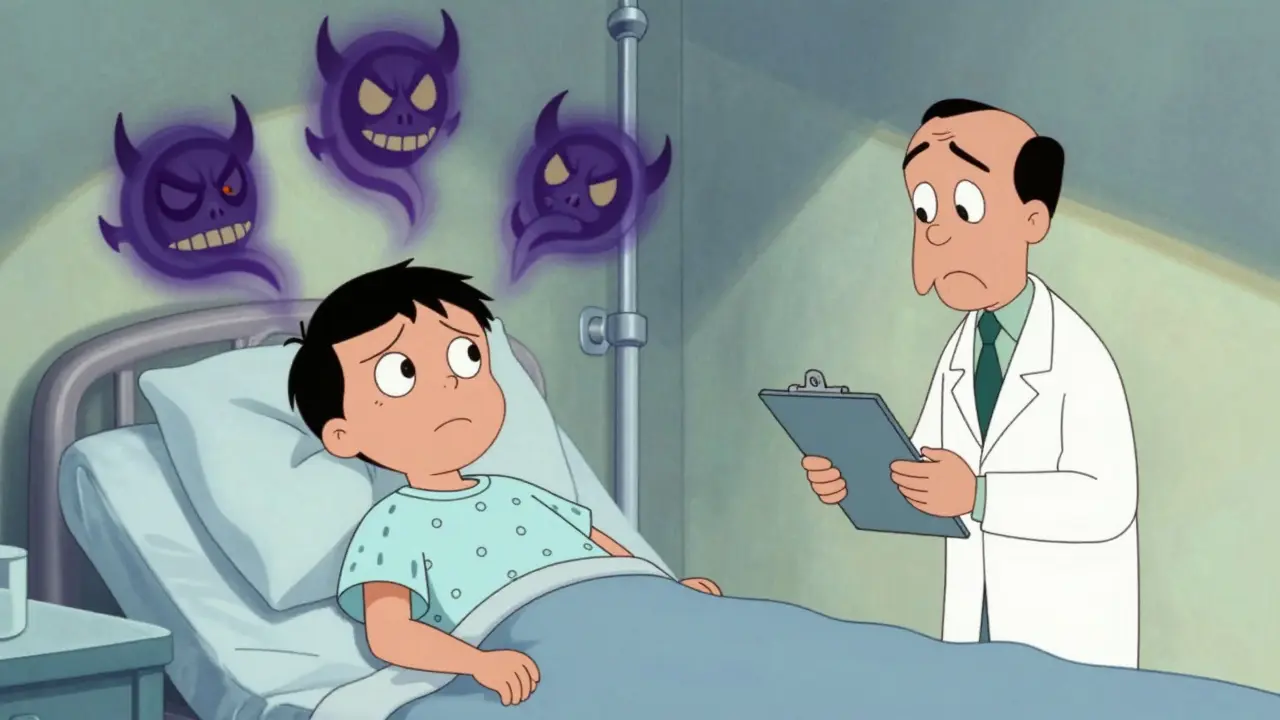
Without these tests, you might misdiagnose a diabetic ketoacidosis patient as psychotic. Or mistake delirium from a UTI for steroid-induced psychosis. The DSM-5 requires that symptoms aren’t better explained by another condition. That’s why labs, imaging, and a full drug history are non-negotiable. If the patient started steroids three days ago and now says they see demons on the ceiling, and all other causes are ruled out? That’s steroid psychosis.
What Do You Do in an Emergency?
Step one: Make sure no one gets hurt. If the patient is violent, screaming, or trying to jump out a window, you need to act fast. But don’t rush to handcuffs or sedation. First, try de-escalation. Lower the lights. Speak calmly. Remove crowds. Give space. If that doesn’t work, medication is next. The goal isn’t to knock them out-it’s to calm them safely.
For mild to moderate cases, oral antipsychotics work well:
- Olanzapine: 2.5 to 20 mg per day
- Risperidone: 1 to 4 mg per day
- Haloperidol: 0.5 to 1 mg per day
For aggressive patients who won’t swallow pills, intramuscular (IM) options are used:
- IM olanzapine: 10 mg
- IM haloperidol: 2 to 5 mg, always with benztropine or diphenhydramine to prevent muscle stiffness
- Lorazepam (1-2 mg IM) can help if anxiety or agitation is extreme
Never use high doses. A typical first-episode psychosis dose might be 20 mg of olanzapine. For steroid-induced psychosis, that’s dangerous. Studies show 50-75% less is often enough. Higher doses increase the risk of sedation, low blood pressure, and movement disorders. The American College of Emergency Physicians updated their guidelines in 2023 to stress this exact point.
The Real Fix: Taper the Steroids
Medication helps, but it doesn’t fix the root cause. The only way to truly reverse steroid-induced psychosis is to reduce the steroid dose. In 92% of cases, symptoms disappear when the dose drops below 40 mg of prednisone per day-or even lower. That’s not a suggestion. It’s the standard of care. But here’s the catch: You can’t just stop steroids cold. If someone is on them for a transplant, severe asthma, or autoimmune disease, sudden withdrawal can cause adrenal crisis, shock, or death. The key is tapering smartly. Work with the prescribing doctor. Lower the dose by 25% every few days if possible. If the patient is on 120 mg of prednisone, drop to 80 mg, then 60 mg, then 40 mg. Monitor closely. Sometimes, switching from prednisone to dexamethasone (which has less psychiatric impact) helps. But that’s not always an option.
What If You Can’t Taper the Steroids?
Sometimes, the underlying disease is too dangerous to reduce treatment. In those cases, you manage the psychosis while keeping the steroids going. That’s when long-term antipsychotics come in. Olanzapine and risperidone are still first-line. Lithium can help prevent mania, but it’s risky-it needs blood tests, can hurt the kidneys, and interacts with many drugs. Antidepressants like SSRIs may help if depression dominates. Antiseizure drugs like valproate or carbamazepine are sometimes used off-label, but evidence is weak. The bottom line: If you can’t stop the steroid, you need to keep treating the psychosis until the steroid dose can be safely lowered. This often requires close collaboration between the emergency team, the patient’s specialist, and a psychiatrist.
Why Are So Many Doctors Getting It Wrong?
A 2022 survey of 127 ER doctors found that while 89% knew steroids could cause psychosis, only 43% followed recommended tapering protocols. Why? Fear. Fear that stopping steroids will make the patient’s original illness worse. Fear that antipsychotics won’t work fast enough. So they give high doses-20-30 mg of olanzapine-thinking more is better. But that’s not how it works. In steroid psychosis, the brain is already overloaded. More medication doesn’t help-it just adds side effects: tremors, confusion, low blood pressure, even seizures. The solution isn’t more drugs. It’s better education. Emergency departments need protocols. Staff need training. Every nurse and doctor who sees a patient on steroids should ask: "When did they start? What’s the dose? Any recent changes?" That simple question saves lives.
What’s Coming Next?
Researchers are working on ways to predict who’s at risk before it happens. The NIH is tracking 500 patients on high-dose steroids, looking for genetic markers or blood biomarkers that signal a higher chance of psychosis. Early results suggest certain gene variants affect how the brain responds to cortisol. In 2025, the American Psychiatric Association plans to launch a digital tool that will tell doctors: "This patient has a 34% risk of psychosis based on their dose, age, and history. Consider lowering the dose or adding prophylactic monitoring." That’s huge. Right now, we’re reacting. Soon, we’ll be preventing.
What Should Patients and Families Know?
If you or someone you love is starting high-dose steroids, watch for these signs in the first week:
- Sudden mood swings-anger out of nowhere
- Confusion or trouble remembering things
- Paranoia-thinking people are talking about them
- Seeing or hearing things that aren’t there
- Not sleeping for days
- Extreme energy or reckless spending
Don’t wait. Call the prescribing doctor immediately. Don’t assume it’s "just stress." Don’t wait for it to get worse. Early action means faster recovery. Most people return to normal within days to weeks after the steroid is lowered. But delays can lead to hospitalization, trauma, or even suicide. This isn’t rare. It’s predictable. And it’s treatable-if you catch it in time.
Alexandra Enns
This is the most irresponsible medical advice I've ever read. Who the hell lets people take 120mg of prednisone without a psychiatric screening? This isn't medicine, it's chemical warfare on vulnerable people. I've seen this happen to my cousin in Toronto - they just kept pumping her full of steroids while she screamed at the walls. No one listened. Now she's on disability. The system is broken.
Marie-Pier D.
I'm so glad someone finally wrote this. 💔 My sister was misdiagnosed with bipolar after starting dexamethasone for lupus - they gave her antipsychotics for months before anyone checked her steroid dose. She cried for days when they lowered it and the voices stopped. Please, if you're reading this and someone you love is on high-dose steroids and acting "off" - don't wait. Call the doctor. TODAY. 💙
Shanta Blank
Oh sweet mother of Jesus, another medical post that sounds like it was written by a robot who binge-watched Grey's Anatomy while on Adderall. "The HPA axis gets thrown off" - wow, groundbreaking. Meanwhile, real people are getting locked in psych wards because their rheumatologist thinks "steroids are fine" and the ER docs are too lazy to run a basic sodium panel. This isn't science. It's corporate negligence dressed up in jargon. And don't even get me started on the "digital tool in 2025" - we're still waiting for EMRs that don't crash when you click "print".
Chloe Hadland
i just wanted to say thank you for writing this. my mom was on prednisone for a bad flare and she started talking to the tv like it was her dead dad. we thought it was grief. turns out it was the meds. she's fine now but it took 3 weeks to get someone to listen. you're right - it's predictable. and it shouldn't be this hard to fix. ❤️
Amelia Williams
This is so important. I work in a clinic and we had a 22-year-old come in last month after a transplant - thought he was seeing aliens because the ceiling was "breathing." Turned out he was on 100mg prednisone. We tapered him down over 5 days and he was back to normal by day 4. No meds needed. People need to know: it's not in their head. It's in the bottle. And we can fix it. We just have to look.
Viola Li
Let me get this straight - you're telling me we should reduce life-saving steroids because someone might hallucinate? So what, we just let people die of lupus or asthma instead? This is the exact kind of fear-mongering that makes patients distrust medicine. If you're going to post this, at least mention that psychosis is reversible and rare. Not everyone gets it. But everyone gets the side effects of under-treating their disease.
Dolores Rider
they're watching you through the IV. the steroids are laced with the government's mind control serum. i know because my cousin's neighbor's dog barked at the pharmacy once and now the CDC is tracking everyone on prednisone. they're using the HPA axis to sync our dreams. wake up sheeple. ☠️👁️
Jenna Allison
Key point missed: antipsychotics in steroid psychosis aren't like regular psychosis. You don't need 20mg olanzapine. 5mg is often enough. I've seen patients crash from overmedication - hypotension, falls, prolonged sedation. The goal isn't sedation. It's stabilization. And yes, tapering works. I had a patient on 80mg prednisone for myasthenia gravis - dropped to 40mg, psychosis gone in 36 hours. No antipsychotics. Just dose reduction. It's that simple. Stop overtreating.
Vatsal Patel
Ah yes. The classic medical savior complex. You write a 10-page essay on how to treat steroid psychosis... but never ask why we're prescribing 120mg of synthetic cortisol in the first place. Are we healing people? Or are we just buying time while the pharmaceutical industry sells another bottle? The real psychosis isn't in the brain - it's in the system that thinks more drugs = better care. Wake up. The cure was never in the pill. It was in the question you refused to ask.