
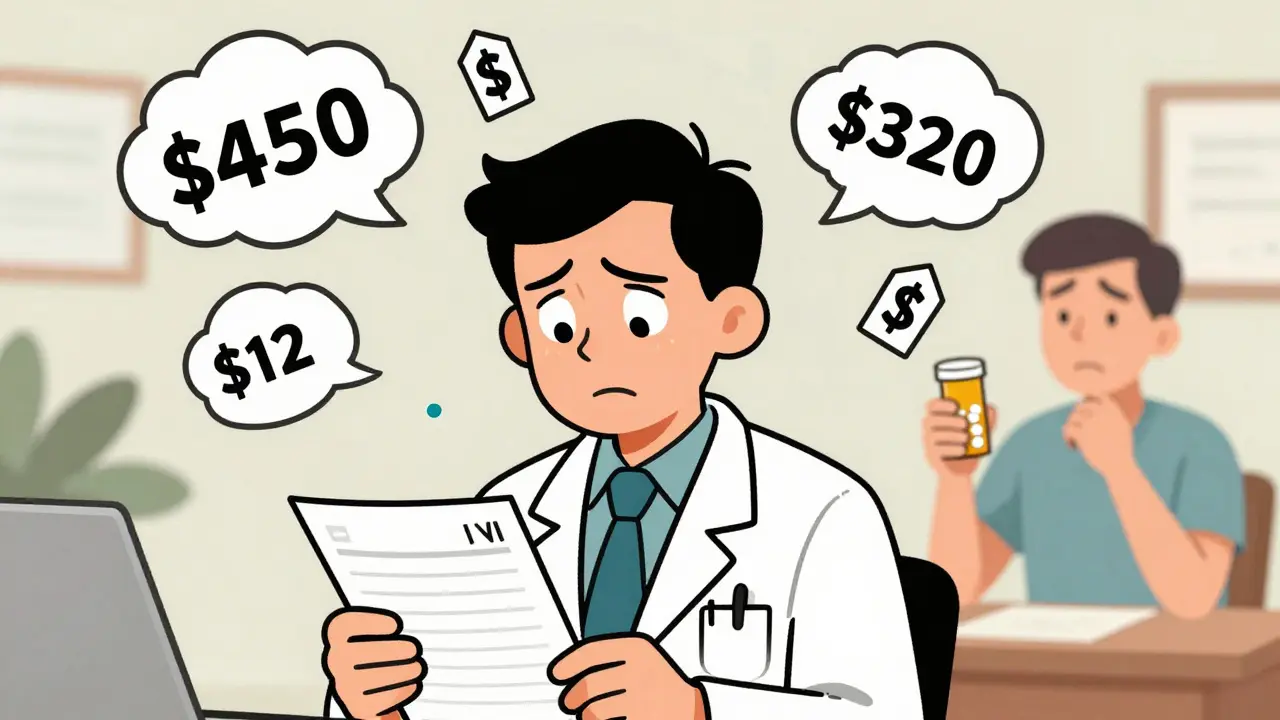
Doctors don’t know how much drugs cost - and it’s hurting patients
Imagine prescribing a medication that costs $450 a month, when a nearly identical one costs $12. You wouldn’t do it on purpose. But if you don’t know the difference, you might do it every day. That’s the reality for many clinicians today. Despite spending years training to treat illness, most doctors have no idea what their patients actually pay for prescriptions. A 2016 study of 254 medical students and doctors found that only 5.4% of generic drug prices and 13.7% of brand-name drug prices were estimated within 25% of the actual cost. That’s worse than guessing.
It’s not that clinicians are careless. It’s that the system hides the truth. Drug prices aren’t posted on the wall like menu prices at a restaurant. They’re buried in insurer contracts, pharmacy benefit manager deals, and complex rebate systems. A patient might pay $15 at one pharmacy and $320 at another for the same pill. Without real-time data, doctors are flying blind.
What clinicians get wrong - and why it matters
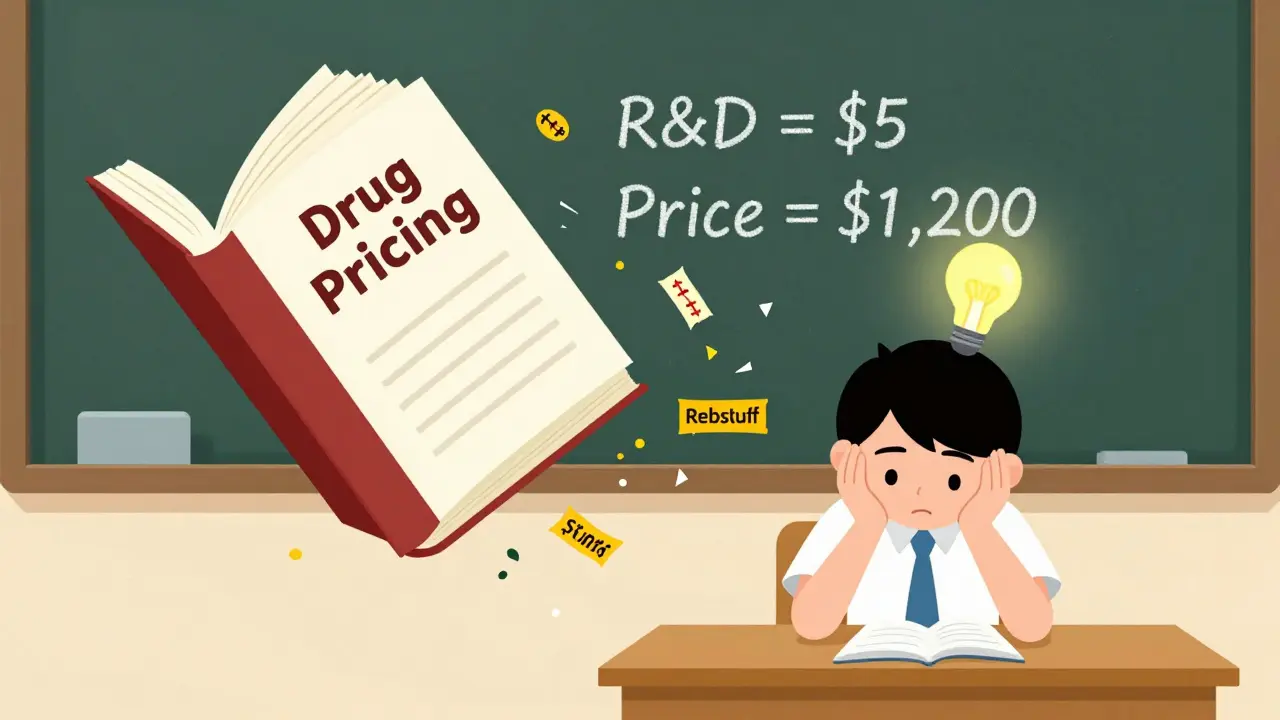
Research shows a clear pattern: doctors overestimate the cost of cheap drugs and underestimate expensive ones. In one major review, physicians thought a $5 generic medication cost $6.60 - a 31% overestimate. Meanwhile, a $1,200 brand-name drug was guessed at just $312 - a 74% underestimate. That’s not just inaccurate. It’s dangerous.
When doctors think a drug is expensive, they may avoid prescribing it, even if it’s the best option. When they think it’s cheap, they might choose it over a better, cheaper alternative. This isn’t theory. A 2021 JAMA Network Open study showed that when EHRs displayed out-of-pocket costs, doctors changed prescriptions in 12.5% of cases. That’s one in eight. When savings were over $20, it jumped to one in six. These aren’t minor tweaks. They’re life-changing decisions.
And it’s not just about money. When patients can’t afford their meds, they skip doses, cut pills in half, or stop entirely. Nearly 3 in 10 adults in the U.S. skip medication because of cost, according to KFF. That leads to more ER visits, hospitalizations, and worse outcomes. If a doctor prescribes a $500 insulin pen without knowing a $35 generic alternative exists, they’re not just wasting money - they’re risking health.
The education gap: Why medical schools don’t teach this
Most doctors didn’t learn drug pricing in med school. A 2021 study found that 56% of U.S. medical schools have no formal curriculum on drug costs. Students graduate knowing how a drug works - but not how much it costs. That’s like training a chef without teaching them the price of ingredients.
Even when students get better with experience, their knowledge stays shaky. A study tracking medical students over four years showed improvement - but the median score on a 10-question cost quiz was only 6 out of 10. And here’s the kicker: 44% of students didn’t even know drug prices have almost nothing to do with research and development costs. Most people think high prices mean high R&D. They’re wrong. The price of Humira, for example, went up 4.7% in 2023 - with no new clinical benefit. That’s not innovation. That’s profit.
One doctor told researchers, “I assumed all brand-name drugs were expensive. I didn’t realize generics could be cheaper than coffee.” That’s not ignorance - it’s a system designed to obscure.
Technology can fix this - but it’s not working yet
There’s a solution: real-time benefit tools (RTBTs) built into electronic health records. These tools show the patient’s exact copay before the prescription is written. UCHealth, for example, rolled out a system that reduced patient out-of-pocket costs by $187 per person per year. That’s hundreds of thousands of dollars saved across their patient base.
But adoption is painfully slow. As of late 2024, only 37% of U.S. health systems use RTBTs. Why? Because it’s complicated. The same drug can have 10 different prices depending on the insurer, pharmacy, deductible, and whether the patient has met their out-of-pocket maximum. Many systems show “list price” - which means nothing to the patient. One resident on Reddit complained: “Our Epic system shows insurer pricing, but not my patient’s actual copay. I end up spending five minutes calling the pharmacy just to find out.”
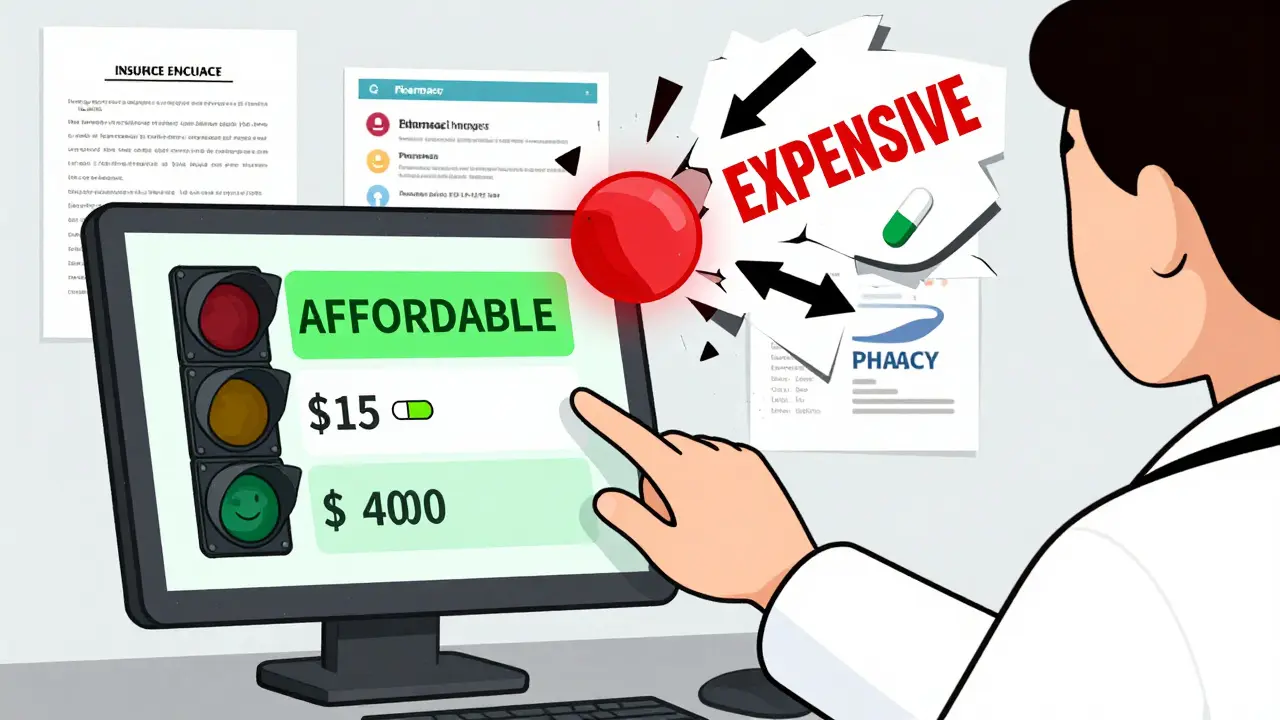
Even when the tech works, it’s not always intuitive. Some alerts pop up too late. Others are buried under layers of menus. Doctors are already overwhelmed. Adding a 30-second lookup for every prescription isn’t helpful - it’s a burden. The best systems integrate cost data right into the prescribing flow, like a traffic light: green for affordable, yellow for moderate, red for expensive.
Who’s getting it right - and what they’re doing differently
Some places are making progress. Mayo Clinic’s Drug Cost Resource Guide, updated quarterly, gets a 4.7 out of 5 from physicians. It’s simple: a searchable database with actual cash prices, insurance estimates, and alternatives. No jargon. No fluff. Just facts.
At UCHealth, cost alerts don’t just show price - they suggest cheaper alternatives. One study found that when doctors saw a $400 drug with a $15 generic option, they switched 68% of the time. That’s not just awareness - that’s action.
And it’s not just about cost. Newer tools are starting to show value. For example, if two drugs cost the same but one reduces hospitalizations by 40%, the system flags that. This moves beyond “what’s cheapest” to “what’s best for the patient.” The Institute for Clinical and Economic Review is pushing for this kind of value-based pricing data to be standard.
Even small changes help. One clinic started printing a simple one-page sheet with the top 20 most common prescriptions and their cash prices. Nurses handed it to patients before the doctor came in. Within six months, non-adherence dropped by 19%.
Why this isn’t just a doctor problem - it’s a system problem
Blaming clinicians misses the point. No one expects a mechanic to know the price of every spark plug from every brand in every state. But in healthcare, that’s exactly what we ask. The pricing system is broken. Drug manufacturers set list prices. PBMs negotiate rebates. Pharmacies get paid differently based on contracts. Patients get stuck with the leftovers.
And the data is fragmented. A patient on Medicare might pay $10. A patient with private insurance might pay $120. A cash-paying patient might pay $30. The doctor doesn’t know which one they are until they start typing. That’s not a flaw in the clinician - it’s a flaw in the system.
The 2022 Inflation Reduction Act gave Medicare the power to negotiate prices for 10 high-cost drugs. That’s a start. But it only affects a fraction of prescriptions. Meanwhile, drug prices keep rising. Five major drugs saw price hikes in 2023 with no clinical justification. That’s not market dynamics. That’s exploitation.
What needs to change - and how fast
Here’s what works:
- Integrate real-time cost data into EHRs - not as a pop-up, but as part of the prescribing flow.
- Train clinicians from day one - medical schools need mandatory modules on drug pricing, insurance complexity, and value-based prescribing.
- Standardize pricing transparency - require manufacturers to report true out-of-pocket costs to insurers and pharmacies.
- Make alternatives obvious - when a high-cost drug is selected, the system should auto-suggest equally effective, lower-cost options.
- Measure outcomes, not just savings - track if cost awareness leads to fewer ER visits, better adherence, and improved health.
Doctors want this information. In a 2007 study, 92% said they wanted cost data at the point of care - but couldn’t find it. Today, that number hasn’t changed. The tools are here. The data exists. What’s missing is the will to make it simple.
Patients aren’t asking for perfect care. They’re asking for affordable care. And if clinicians can’t see the price, they can’t deliver it.
Frequently Asked Questions
Why don’t doctors know how much drugs cost?
Drug pricing is intentionally complex. Prices vary by insurer, pharmacy, patient’s deductible, and rebates. Most systems don’t show the patient’s actual out-of-pocket cost, and medical schools rarely teach pricing. Doctors are expected to prescribe without access to the most basic financial information.
Do cheaper drugs work as well as expensive ones?
In most cases, yes. Generic drugs are required by the FDA to have the same active ingredients, strength, and effectiveness as brand-name versions. The difference is usually just in packaging, fillers, or branding. Studies show identical outcomes for conditions like high blood pressure, diabetes, and depression when using generics versus brand-name drugs.
Can cost alerts in EHRs really change prescribing habits?
Yes. A 2021 JAMA Network Open study found that when clinicians had access to real-time cost data, they changed prescriptions in 12.5% of cases. When potential savings exceeded $20, that number rose to 16.7%. In one system, switching from a $400 drug to a $15 generic happened 68% of the time when the alternative was clearly shown.
Why aren’t all hospitals using cost-aware tools?
Integration is expensive and technically difficult. Building a system that pulls real-time data from dozens of insurers and pharmacies requires millions in development. Many health systems lack the resources, and others prioritize other EHR upgrades. Only 37% of U.S. hospitals had these tools as of late 2024.
Is this just a U.S. problem?
No, but the U.S. is the worst. Other countries have government-set drug prices or universal coverage, so clinicians rarely face this issue. In Canada, the UK, or Germany, doctors know the cost because it’s standardized. In the U.S., the lack of price transparency is unique - and it’s harming patient care.
What can patients do if their doctor prescribes an expensive drug?
Ask: “Is there a generic version?” “Is there a cheaper alternative that works just as well?” “Can you check what my copay will be?” Many doctors don’t know the answer - but if patients ask, it pushes the system to improve. Some pharmacies also offer discount cards or patient assistance programs.
What’s next for clinician cost awareness
The future isn’t about making doctors into price analysts. It’s about making the system do the work for them. By 2027, 75% of U.S. health systems are expected to have advanced cost-aware tools. But the real win won’t be the technology - it’ll be the outcome: fewer patients skipping meds, fewer hospitalizations, and doctors finally prescribing with full information.
Until then, the gap remains. Clinicians care. Patients need help. And the price tag? It’s still hidden.
Hannah Gliane
So doctors are just guessing like it’s a game of Wheel of Fortune? 🤦♀️ $500 insulin vs $35 generic and they don’t blink? I’d rather my doctor prescribe me a Starbucks gift card than this nonsense. #HealthcareIsABusiness
Murarikar Satishwar
This is a systemic failure, not a clinical one. Medical education has been disconnected from economic reality for decades. We train physicians to diagnose and treat, but not to navigate the labyrinth of insurance contracts, PBMs, and manufacturer rebates. It's like asking a pilot to fly without a fuel gauge. The solution isn't more blame-it's integrated, real-time pricing data embedded in EHRs, mandatory cost literacy in med school curricula, and policy reform to standardize transparency. This isn't optional anymore-it's a patient safety issue.
Akhona Myeki
In South Africa we don’t have this problem because the government negotiates bulk drug prices and public hospitals use generics almost exclusively. But here in the US? It’s a circus. I’ve seen patients cry because they can’t afford their meds, and the doctor had no idea the price difference was 10x. It’s not that clinicians are dumb-it’s that the system is designed to confuse. And the worst part? The same companies that hike prices year after year are the ones funding medical conferences. Conflict of interest much?
Brett MacDonald
idk man i think doctors are just overworked and its not their fault. like they got 12 patients in 2 hours and you want em to memorize every drug price? lmao. its the system. not the doc. also why is everyone mad at the doctors? theyre just trying to help. smh
jay patel
I remember in med school we had this one professor who said, 'If you don't know the cost, you're not prescribing-you're gambling.' And he was right. I used to think generics were inferior until I saw a study where a $4 generic statin had identical outcomes to a $200 brand. Now I check prices before I write scripts. But here's the kicker: even when I know the cost, the EHR doesn't show my patient's actual copay. It shows 'list price' or some insurer's negotiated rate that means nothing. So I end up calling pharmacies like a damn detective. And I'm not even a resident anymore. This is 2025. We have AI that can write poems. Why can't it tell me if my patient can afford their medicine? It's not that we don't care. It's that the system doesn't care enough to make it easy.
Ansley Mayson
Doctors are clueless. Patients suffer. System is broken. End of story.
phara don
I wonder if this is why so many people stop taking meds... I mean, if the doctor doesn't know the price, how can they explain why it's so expensive? Also, is there any data on how often patients lie about their ability to pay just to get the script filled? 🤔
Dan Pearson
Oh wow, so doctors are just winging it like it's a TikTok trend? 😂 Meanwhile, Big Pharma is sipping champagne on a yacht bought with $1,200 insulin profits. And we're supposed to be shocked? Let me guess-next they'll tell us surgeons don't know how much a scalpel costs. Newsflash: this isn't incompetence. It's corporate malice wrapped in white coats. And no, I don't want to hear about 'system complexity.' The system was built to exploit. Fix it or burn it down.
Bob Hynes
In Canada, we don’t have this problem because the government negotiates prices and everyone gets the same rate. But I get it-US healthcare is like trying to play chess while blindfolded and someone keeps moving the pieces. I’ve seen American friends cry over $800 pills. It’s not just unfair-it’s inhumane. Maybe the real question isn’t why doctors don’t know the price… it’s why we let this keep happening.