
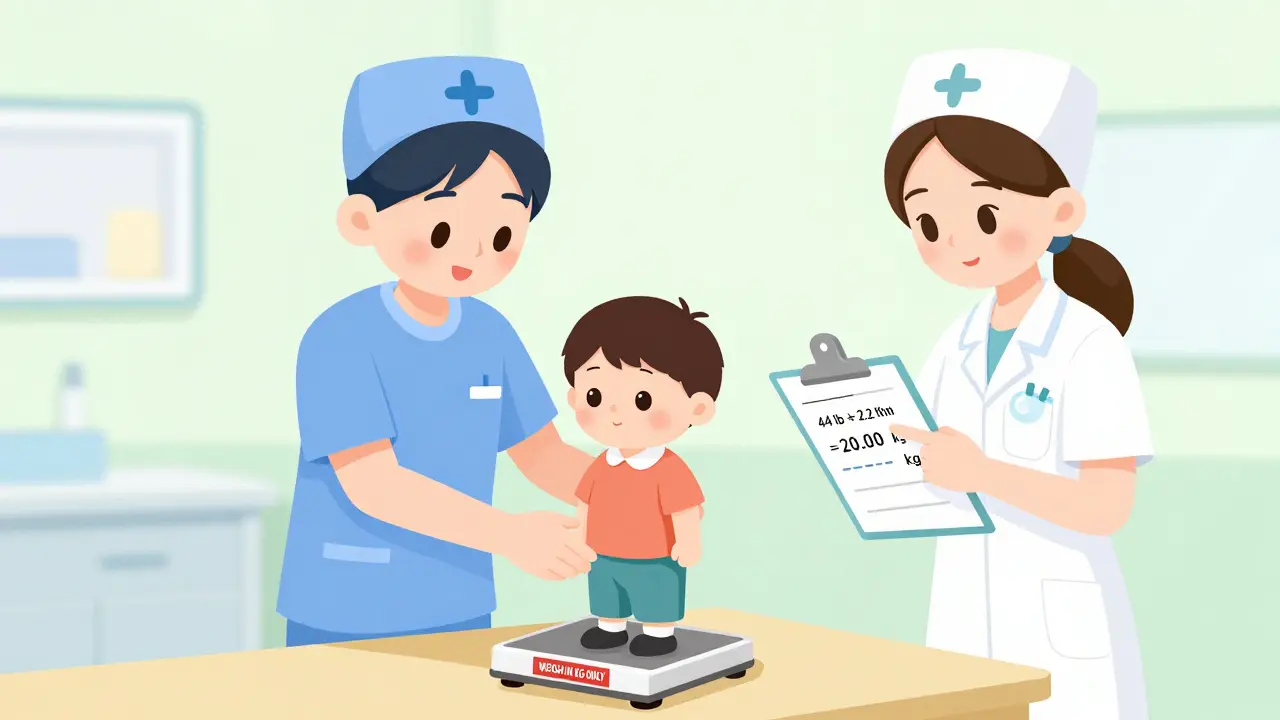
Getting the right dose of medicine for a child isn’t just about guessing based on age. It’s about weight-based calculations-a precise science that can mean the difference between healing and harm. In pediatric care, a wrong number isn’t a minor mistake. It’s a life-threatening error. Every year, thousands of children in hospitals and clinics receive incorrect doses because of simple miscalculations. But there’s a proven way to prevent this: using weight in kilograms, doing the math right, and having a second person verify it every time.
Why Weight Matters More Than Age
For decades, doctors used age to guess a child’s dose. A 2-year-old gets half of what a 4-year-old gets. Simple, right? But it’s not accurate. Children aren’t just small adults. Their bodies process drugs differently. A newborn’s liver and kidneys aren’t fully developed. A toddler has more body water than an adult. An obese child has more fat tissue, which changes how drugs spread through the body. A 2022 study in Pediatrics found that using age alone leads to dosing errors in nearly 3 out of 10 cases. That’s 29% of kids getting the wrong amount. Weight-based dosing cuts that error rate by more than 40%. It’s not just better-it’s the standard. Today, 87% of hospitals in the U.S. and Europe use weight (in kilograms) to calculate doses for antibiotics, pain meds, and even chemotherapy.How Weight-Based Dosing Works
There are three steps. Do them in order. Skip one, and you risk error.- Convert pounds to kilograms. Use the exact conversion: 1 kg = 2.2 lb. Never round until the very end. If a child weighs 44 pounds, divide by 2.2. That’s 20.00 kg. Not 20. Not 20.1. 20.00. This precision matters.
- Multiply weight by the dose per kg. If the prescription says 15 mg/kg/day for amoxicillin, then 20 kg × 15 mg/kg = 300 mg total per day.
- Divide by how many times a day. If it’s given twice daily, then 300 mg ÷ 2 = 150 mg per dose.
The Double-Check That Saves Lives
Calculating the dose is only half the job. The other half is verifying it. The Joint Commission requires two licensed professionals to independently check high-alert medications-drugs like insulin, heparin, opioids, and chemotherapy. This isn’t just a formality. It’s a safety net. A 2022 meta-analysis of 87,000 pediatric doses found that double-checking reduces serious errors by 68%. One nurse in Colorado told a story about catching a 10-fold overdose. A resident ordered 200 mg of a drug for a 10 kg child. The safe maximum is 40 mg/kg/day-that’s 400 mg total, or 200 mg per dose if given twice. But the resident wrote 200 mg per dose, four times a day. That’s 800 mg total. The nurse caught it because the calculated dose didn’t match the institutional limit. The child was fine. The error was caught because someone took the time to double-check.
Where Things Go Wrong
Even with the right system, mistakes happen. The Institute for Safe Medication Practices tracked over 1,200 pediatric dosing errors in 2022. The top three causes:- Unit confusion (38%): Someone reads the scale in pounds but calculates in kilograms. Or vice versa. That’s why many hospitals now put bright red stickers on all scales: “WEIGH IN KG ONLY.”
- Decimal point errors (27%): Writing 1.0 mg instead of 10 mg. Or 0.5 mL instead of 5 mL. A single misplaced decimal can be fatal.
- Ignoring organ function (19%): A child with kidney or liver problems needs a lower dose-even if their weight is correct. This is especially true for babies under 6 months.
What About Body Surface Area?
Some drugs, especially chemotherapy, use body surface area (BSA) instead of weight. BSA = √(weight in kg × height in cm ÷ 3600). It’s more accurate for these drugs-about 18% better than weight alone. But it takes longer. Each calculation adds 47 seconds. In an emergency, that’s time you might not have. For most common medications-antibiotics, fever reducers, asthma inhalers-weight-based dosing is faster, simpler, and just as safe. BSA is reserved for cancer treatment, not routine care.What’s Changed in 2025
Technology is helping. Most major electronic health records-like Epic and Cerner-now have built-in pediatric dosing calculators. They auto-convert pounds to kilograms, apply institutional limits, and flag doses that are too high or too low. In 78% of children’s hospitals, these systems are now standard. The FDA now requires drug manufacturers to include pediatric dosing algorithms in new drug applications by 2025. The World Health Organization updated its Essential Medicines List for Children in April 2023 to include weight-band dosing for 127 medications-so nurses no longer have to look up doses from memory.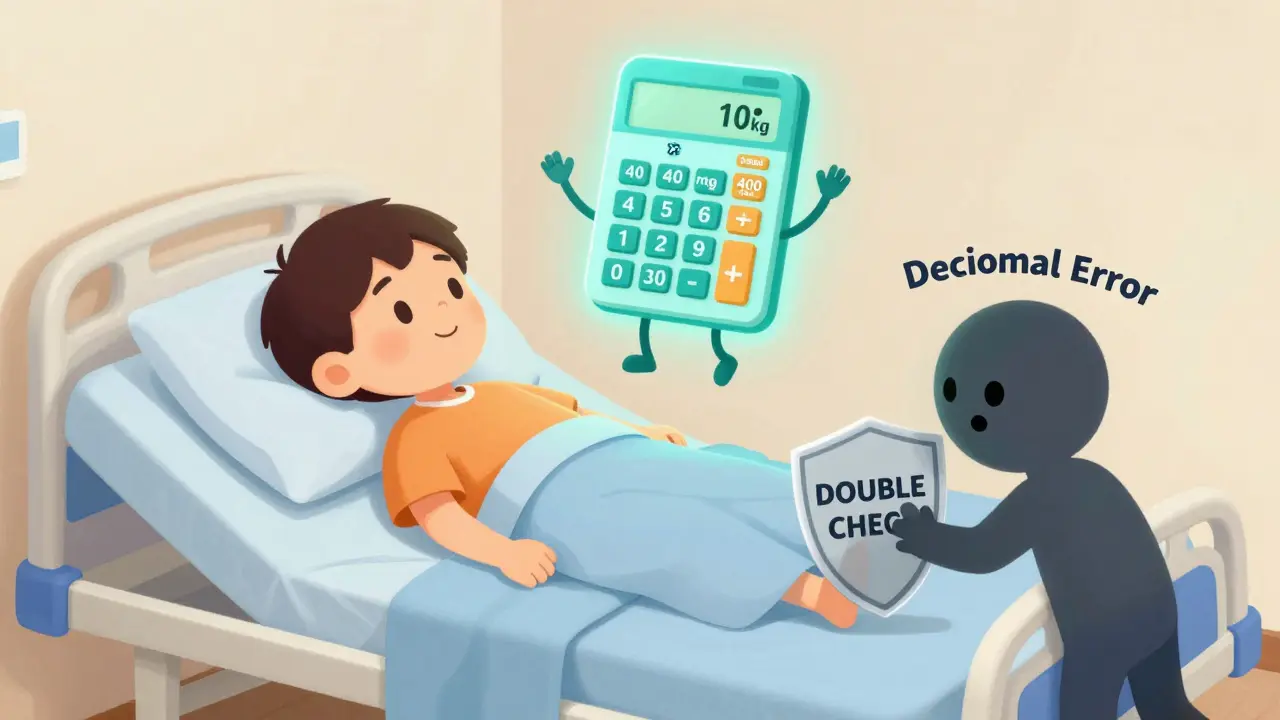
What You Need to Remember
- Always weigh children in kilograms. Never assume. Never estimate.- Do the math step by step. Write it down. Don’t rely on memory.
- Always have a second person verify the dose-especially for high-alert drugs.
- Check renal and liver function in infants and children with chronic illness.
- Use electronic alerts. They’re not optional-they’re essential.
- If the dose seems too high or too low, stop. Ask. Double-check.
Training and Competency
Pediatric nurses and pharmacists must prove they can do these calculations correctly every year. The Pediatric Nursing Certification Board requires a 90% pass rate on a 25-question test. No exceptions. Because one mistake can cost a child’s life. In one hospital, after implementing mandatory annual testing, dosing errors dropped by 41% in six months. That’s not luck. That’s discipline.Final Thought
Weight-based dosing isn’t complicated. It’s simple math. But it’s also the most powerful tool we have to protect children from preventable harm. The technology exists. The guidelines are clear. The training is available. What’s missing is complacency. Every time you calculate a dose, you’re not just doing math. You’re holding a child’s life in your hands. Get it right. Twice.Why is weight-based dosing better than age-based dosing for children?
Weight-based dosing is better because children’s bodies process medications differently based on their size, organ maturity, and body composition-not just their age. Age-based dosing leads to errors in 29% of cases, especially in children who are very small or large for their age. Weight-based dosing reduces errors by 43% and is the standard in 87% of pediatric hospitals.
How do you convert a child’s weight from pounds to kilograms?
Divide the weight in pounds by 2.2. For example, a 33-pound child is 33 ÷ 2.2 = 15.00 kg. Never round until after the final calculation. Use the exact value in your dose calculation to avoid cumulative errors.
What is a double-check protocol in pediatric dosing?
A double-check protocol means two licensed healthcare providers independently calculate and verify the dose before administration. One person does the math, the other checks it. This is required for high-alert medications like opioids, insulin, and chemotherapy. Studies show it reduces serious errors by 68%.
What are the most common dosing errors in children?
The top three are: (1) unit confusion-using pounds instead of kilograms (38% of errors), (2) decimal point mistakes-like writing 0.5 mg instead of 5 mg (27%), and (3) failing to adjust for kidney or liver problems (19%). These errors are preventable with proper training and double-checks.
Do obese children need special dosing considerations?
Yes. For water-soluble drugs (like antibiotics), use adjusted body weight: Ideal Body Weight + 0.4 × (Actual Weight - Ideal Weight). For fat-soluble drugs (like some pain meds), use actual weight. Most children’s hospitals use this method for obese patients to avoid overdose.
Are electronic health records helping reduce pediatric dosing errors?
Yes. Systems like Epic and Cerner now have built-in pediatric dosing calculators that auto-convert weight, apply safety limits, and flag out-of-range doses. Hospitals using these systems saw a 52% drop in dosing errors. They’re not perfect, but they’re a critical safety layer.
Why is weight-based dosing still used even with advanced technology?
Because it’s the foundation. Even with AI and automated systems, the math behind weight-based dosing is what makes those systems reliable. Therapeutic drug monitoring and pharmacogenomics are emerging, but for 92% of pediatric medications, weight-based calculations remain the most reliable starting point.
Jeane Hendrix
Just read this and had to pause. I work in Peds ER and we had a near-miss last month because someone used pounds instead of kg. The system flagged it, thank god, but I swear, if we didn’t have the red stickers on every scale, we’d be burying kids by now. Weight-based dosing isn’t optional-it’s the bare minimum. And yes, I still write it out by hand before entering it into the EHR. Muscle memory saves lives.
Leonard Shit
so like… you’re telling me i need to do MATH before giving a kid medicine? what a radical concept. 🤡
Kelly Beck
YESSSS this is why I love my hospital!! 🙌 We do double-checks on EVERYTHING now-even Tylenol. I used to think it was overkill until I saw a 3-year-old almost get 10x the dose because the resident thought ‘15 mg/kg’ meant ‘15 mg total’. 😳 We had a debrief, everyone cried, now we do it right. And guess what? Our error rate dropped 50% in 4 months. You don’t need fancy tech-you need discipline. And maybe a coffee. Lots of coffee. ☕️
Dana Termini
Decimal errors are terrifying. I once saw a 0.5 mL written as 5 mL. That’s a 10x overdose. No one noticed until the child went into seizures. It wasn’t the nurse’s fault-it was the handwriting. We switched to electronic prescribing after that. No more scribbles. Ever.
Wesley Pereira
Let’s be real-most of these errors happen because someone’s rushing because the kid’s screaming and the mom’s crying and the chart’s half-filled. We all know it. The system’s supposed to catch it, but sometimes the system’s just a glorified calculator with a blinking red light. The real hero? The nurse who says, ‘Wait. That doesn’t feel right.’ That’s the one who saves the day. Not the algorithm.
Amy Le
Why are we still using kg? The US should’ve gone metric decades ago. This is why we’re behind. We’re still measuring kids in pounds like it’s 1987. Meanwhile, the rest of the world is calculating doses while sipping espresso. Fix the system, not just the math.
Pavan Vora
In India, we use weight-based dosing too-but sometimes we don’t have scales. So we estimate. It’s not ideal. But in rural clinics, we use the ‘hand method’-a palm’s width = 10 kg, roughly. It’s not perfect, but it’s better than guessing age. Still, I’m glad your systems are improving. We need more tools like this everywhere.
Lily Lilyy
Every single child deserves to be safe. Every single time. You don’t need to be a genius to do this. You just need to care enough to slow down. And if you’re tired? Take a breath. Then check again. You’re not just a nurse. You’re a guardian. And this? This is sacred work.
Susan Arlene
math is hard but not doing it is worse