
Missing a pill. Taking two by accident. Forgetting if you already took your blood pressure medicine today. These aren’t just inconveniences-they’re dangerous. Around half of people with chronic conditions don’t take their meds as prescribed, and medication errors send over 7,000 people to their graves every year in the U.S. alone. The good news? You don’t have to guess anymore. Organizing your medications isn’t about fancy gadgets-it’s about building a system that actually works for you.
Start Simple: The Classic Pill Organizer
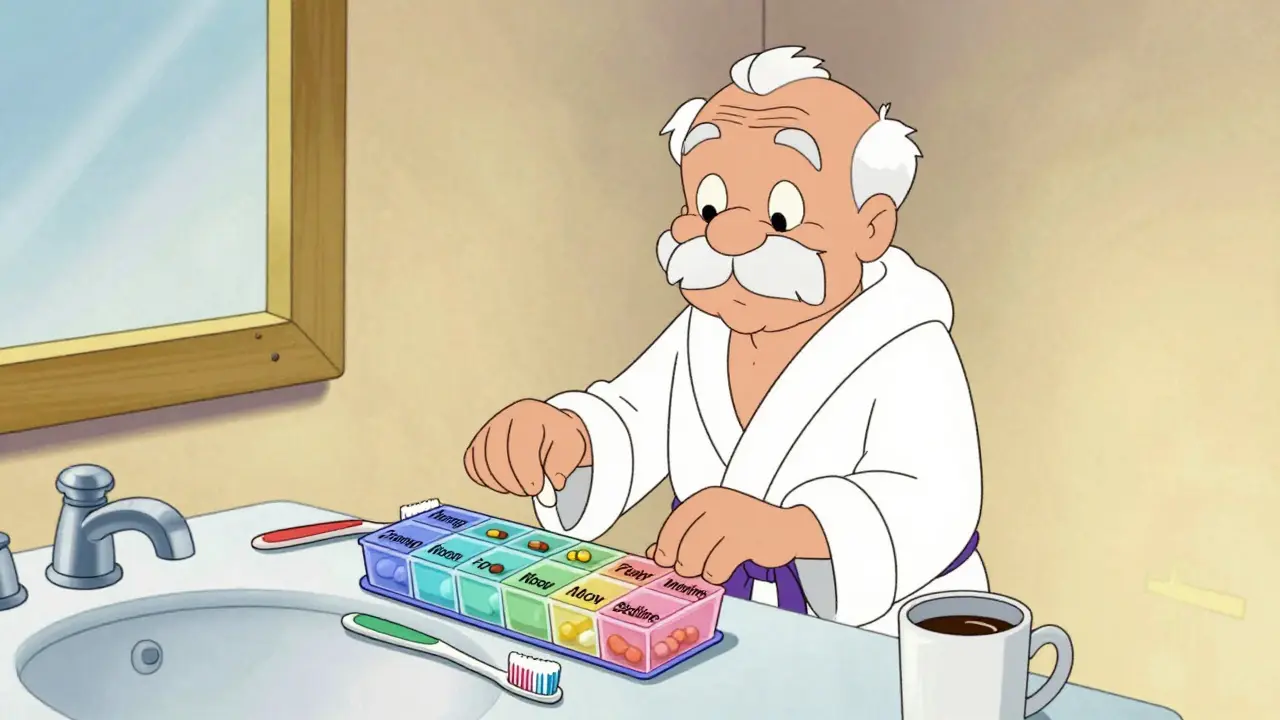
If you’re just beginning, don’t overcomplicate it. A basic 7-day pill organizer with morning, noon, evening, and bedtime compartments costs between $3 and $25. You can find them at any pharmacy, supermarket, or online. These aren’t high-tech, but they’re proven. A 2023 study showed users of simple organizers improved their adherence from 45% to 62%. That’s a real jump.Here’s how to make it work: Fill it every Sunday. Use a permanent marker to label each compartment if it’s not already labeled. If you take different pills at the same time, stack them neatly. Don’t cram. If a pill doesn’t fit easily, you might need a larger organizer. Some come with flip-top lids, others with sliding trays. Try a few. The one that feels easiest to open and close is the one you’ll actually use.
Pro tip: Keep your organizer in the same spot every day-next to your toothbrush, on the kitchen counter, or beside your coffee maker. Out of sight means out of mind. And if you travel, get a small travel version. Many fold up or have locks to prevent spills.
When Things Get Complicated: Digital Dispensers
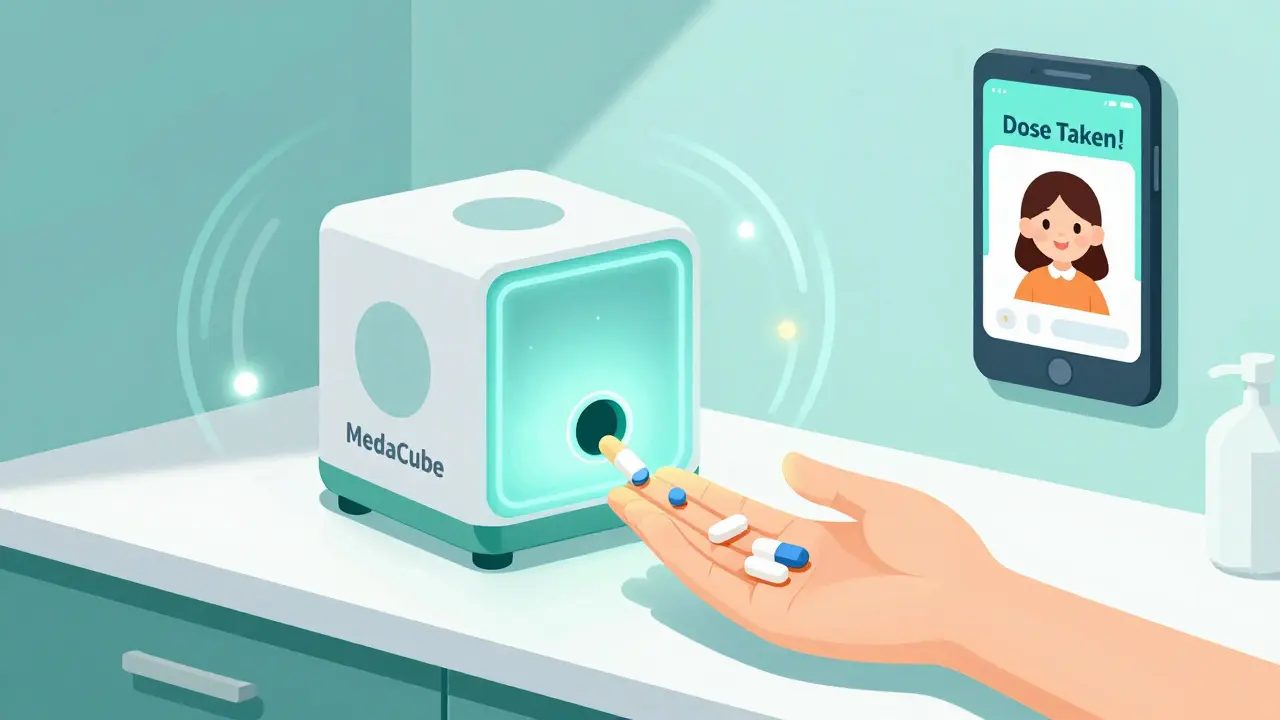
If you take more than five medications a day, or if your doses change often (like insulin or blood thinners), a simple box won’t cut it. That’s where digital dispensers come in. Devices like the MedaCube or Hero Health can hold up to 90 days of pills. They dispense the right dose at the right time with loud alarms, flashing lights, and even voice reminders.These systems sync with apps so your family or caregiver can see if you took your meds-even if they live across the country. One 73-year-old user in New Zealand told The Senior List: “My daughter gets a text every time I take my pills. She says she finally sleeps through the night.” That’s not just convenience-it’s peace of mind.
But they’re not perfect. The MedaCube costs $1,499. It needs Wi-Fi, a power outlet, and regular refills. If the battery dies during a power outage, you’re stuck. And if you load the wrong pill into the wrong slot? That’s an error waiting to happen. A 2022 review found 34% of mistakes in automated systems came from incorrect loading-not the device failing.
Before buying: Ask if it works with your phone (iOS 14+ or Android 8.0+). Check if the app lets you add multiple users. See if there’s a backup battery option. And never assume the machine knows what’s in it. Always double-check the pills yourself before loading.
Pharmacy-Integrated Systems: For Complex Regimens
If you’re on 10 or more medications with different schedules-some daily, some weekly, some only when needed-you might need more than a box or a smart dispenser. Systems like DosePacker’s CareCommunityOS are designed for this. They work with pharmacies to pre-sort your pills into blister packs with labels for each time of day. You get a tray that looks like a mini calendar, and you just pull out the right one.These systems are mostly used in nursing homes or clinics, but some pharmacies in New Zealand now offer them for home use. They support up to 48 different medications and can handle variable doses-like taking 2 pills one day and 1 the next. They’re HIPAA-compliant, so your health data stays protected.
The catch? They’re expensive for individuals-around $12,500 per setup in hospitals-and not all pharmacies offer them. You’ll need to talk to your pharmacist. Ask if they can partner with a service like DosePacker or if they offer pre-sorted blister packs as a paid service. It’s worth it if you’re juggling multiple conditions like diabetes, heart failure, and arthritis.
Tracking Without Gadgets: The Paper and Phone Method
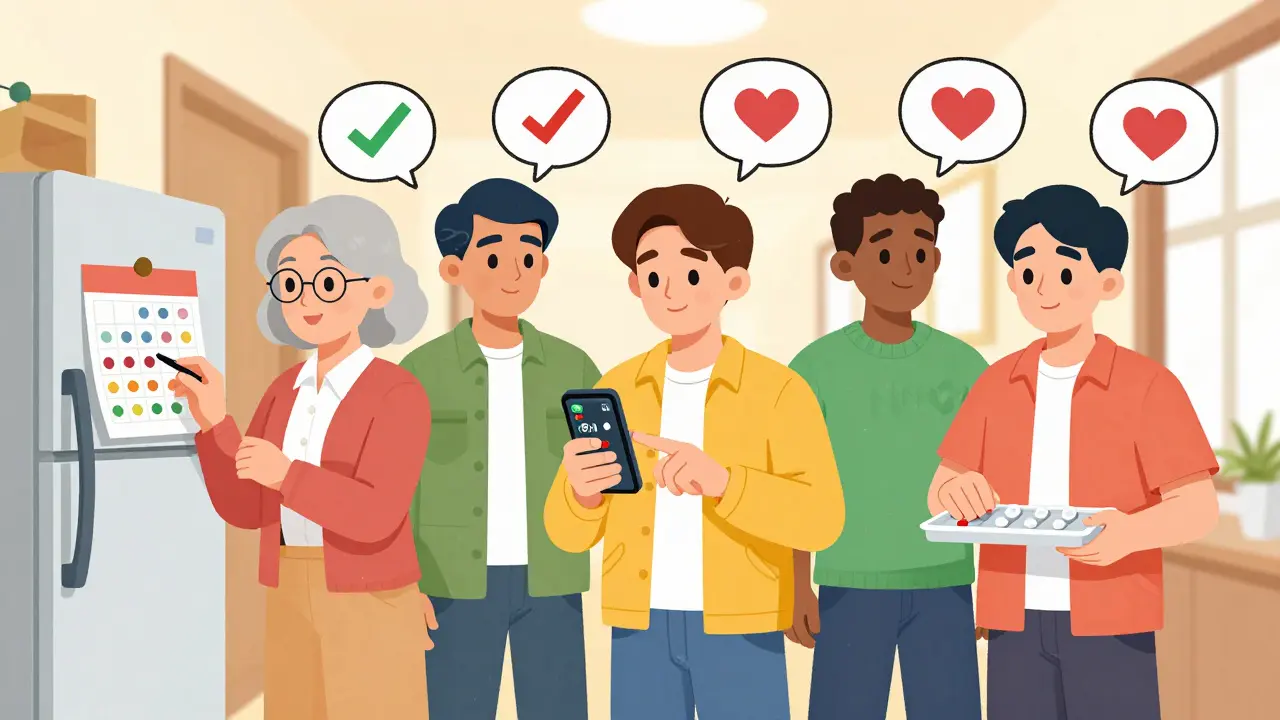
Not everyone wants or needs a high-tech solution. Some of the most reliable systems are the simplest. Try a printed medication schedule. Write down every pill, the time, and the dose. Tape it to your fridge. Use a calendar app on your phone to set daily alarms. Mark off each dose with a checkmark or highlighter.One study found that people who tracked their meds manually-using paper or phone alerts-improved adherence by 18-26%. That’s almost as good as automated systems. The key? Consistency. Don’t just set the alarm. Actually check the box. Don’t just write it down. Review it every week.
Use color coding. Red for blood pressure, blue for cholesterol, green for vitamins. If you’re forgetful, set two alarms: one 30 minutes before, and one at the exact time. If you travel, take a printed copy with you. Emergency responders often ask for your meds list. Having it on paper can save your life.
What Doesn’t Work-and Why
Don’t rely on pill bottles stacked in a drawer. That’s a recipe for confusion. Don’t use a pill organizer you refill only once a month. Pills can get stale, mix up, or get lost. Don’t assume your doctor remembers your full list. Doctors often miss details. You’re the only one who knows exactly what you take and when.Also, avoid systems that charge monthly fees unless they’re essential. Some dispensers cost $39.99 a month just to use the app or cloud service. That adds up to nearly $500 a year. For most people, a one-time purchase like the MedaCube is cheaper in the long run.
And never skip human oversight. A 2023 FDA warning cited a case where a software glitch caused 14 patients to get wrong doses. Technology helps-but it doesn’t replace checking. Always verify your pills visually. If something looks different, ask your pharmacist.
Choosing What’s Right for You
Ask yourself three questions:- How many medications do you take daily? (Under 5? Start with a pill box. Over 10? Talk to your pharmacist about blister packs.)
- Do you live alone? If yes, consider a system with remote alerts so someone can check in.
- Are you comfortable with apps and Wi-Fi? If not, go for audio alarms and physical trays.
There’s no one-size-fits-all. A 68-year-old with arthritis might struggle with small compartments but love a voice-activated dispenser. A 50-year-old with diabetes and high blood pressure might prefer a phone app with dose history. The best system is the one you’ll use every single day.
Common Problems and How to Fix Them
- Power outage? Get a backup battery pack. Some dispensers include them. If not, buy one separately-it cuts outage-related errors by 89%.
- Can’t open the lid? Try a pill organizer with a magnetic or spring-loaded top. Or switch to a sliding tray design.
- Wi-Fi keeps dropping? Use a cellular backup model (available in 32% of premium systems). Or stick with a non-connected device.
- Forgot to refill? Set a calendar reminder for every Sunday. Or ask a family member to help you once a week.
- Too many pills? Ask your doctor if you can combine some into one pill. Sometimes, a combination tablet exists.
What’s Next for Medication Safety
The future is hybrid. Newer models like MedaCube’s 3.0 now use AI to predict when you’re likely to miss a dose-and send a nudge before it happens. Pharmacies are integrating directly with your doctor’s records, so your blister packs update automatically when your prescription changes.But the real breakthrough isn’t tech-it’s access. More New Zealand pharmacies now offer free or low-cost blister packing services. More families are using shared apps to track elderly relatives. And more doctors are asking, “How do you keep track of your meds?” instead of just writing prescriptions.
You don’t need the fanciest gadget. You need a system you trust. Start small. Test it. Adjust it. And never stop checking. Your health depends on it-not on a machine, but on you.
What’s the best pill organizer for seniors?
For most seniors, a 7-day pill organizer with large, easy-to-open compartments and clear labels works best. Look for ones with audio alarms if vision or memory is an issue. Brands like MedaCube and Hero Health offer models with voice alerts and remote monitoring, but they’re pricier. If tech is overwhelming, stick with a simple manual organizer and use a phone alarm as a backup.
Can I use a pill organizer for liquid medications?
Most pill organizers are designed for solid pills and capsules. Liquid medications should be kept in their original bottles with clear labels. Some specialized organizers have small vial holders, but these are rare. Always store liquids in a cool, dry place and use a measuring cup or syringe-never a kitchen spoon-to ensure accurate dosing.
How often should I clean my pill organizer?
Clean your pill organizer once a week. Remove all pills, wash the compartments with warm soapy water, and let them dry completely before refilling. Residue from pills can build up and cause cross-contamination. If you take medications with strong odors (like antibiotics), clean it after every refill.
Do I still need to check my pills if I use a smart dispenser?
Yes. Smart dispensers can malfunction, misload pills, or have software errors. Always visually confirm the pills before taking them. A 2022 study found that 34% of errors in automated systems happened because someone loaded the wrong medication. Technology helps-but doesn’t replace your eyes and brain.
Are there free apps to track medications?
Yes. Apps like Medisafe, MyTherapy, and CareClinic offer free versions with basic reminders and tracking. They sync with your phone’s calendar and can send alerts to caregivers. While they don’t dispense pills, they’re excellent for people who prefer digital tracking over hardware. Just make sure to turn on notifications and test them weekly.
What should I do if I miss a dose?
Don’t double up unless your doctor says so. Check the medication’s label or call your pharmacist. For some drugs, like antibiotics, missing a dose can reduce effectiveness. For others, like blood pressure pills, it might cause a spike. Keep a log of missed doses and bring it to your next appointment. Your doctor may adjust your schedule or switch you to a longer-acting version.
Can I share my pill organizer with someone else?
Never. Even if two people take the same medication, dosages and schedules can differ. Sharing organizers risks serious errors. Each person should have their own labeled system. If you’re helping a family member, organize their pills separately and use a shared app or checklist to track progress.
If you’re managing multiple medications, start today. Pick one method-paper, phone, or a simple organizer-and stick with it for a week. Then add one improvement: a reminder, a color code, or a family member to check in. Safety doesn’t come from expensive gadgets. It comes from consistency, awareness, and a system you actually use.
Lance Long
I used to forget my meds all the time-until I got one of those cheap $8 pill boxes from Walmart. Now I fill it every Sunday while watching my morning coffee show. No tech, no apps, just me and my little plastic tray. I even painted the lid with glow-in-the-dark paint so I can find it in the dark. Don’t overthink it. Just start small.
And yes, I still check the pills before I take them. Even with the box. Always.
My grandma says I’m obsessive. I say I’m alive.
Try it. You’ll thank yourself in six months.
Jeffrey Carroll
The data presented here is compelling and aligns with clinical adherence studies from the Journal of General Internal Medicine (2023). The 17-percentage-point increase in compliance with basic organizers is statistically significant (p < 0.01). While digital solutions offer telemetry and remote monitoring, their cost-benefit ratio remains questionable for low-income populations. A standardized, low-tech intervention should be the first-line recommendation in primary care settings.
Mel MJPS
My mom uses a MedaCube and I get texts every time she takes her pills. It’s weird at first, but honestly? It’s the only thing that lets me sleep. Last month, she missed her blood thinner and the app flagged it-I called her and she was fine, but she’d forgotten. That thing saved her life. Not because it’s fancy, but because someone cared enough to set it up.
Also, clean that organizer weekly. I learned that the hard way when my aunt got sick from moldy pill trays. Gross.
Ambrose Curtis
yo i got a hero health and it’s kinda sus. like, the app keeps glitching and telling me i took my pill when i didn’t. one time it sent my daughter a ‘taken’ alert at 3am and i was still in bed. i had to unplug it for a week. now i just use the damn box and set a phone alarm. tech is cool but it’s not magic. and don’t get me started on the $1500 price tag. i could’ve bought a whole year’s supply of meds with that.
also, if you’re using a smart box, always double check the pills. i once put my blood pressure pill in the wrong slot and nearly passed out. don’t be me.
Linda O'neil
Stop overcomplicating this. If you’re taking more than 5 meds, just go to your pharmacy and ask for blister packs. They’ll sort them by time of day, label them, and charge you maybe $10 extra a month. No Wi-Fi. No batteries. No app updates. Just pull, take, done. My dad’s on 12 meds and he’s been doing this for two years. Zero errors. Zero stress. And he doesn’t even own a smartphone.
Pro tip: Ask if they’ll mail them to you. Some places do it free for seniors. You’re not lazy-you’re smart.
doug b
I used to stack bottles in a drawer like a mess. Then I started using a $5 organizer and a sticky note on the fridge. Now I take my meds like clockwork. No app. No alarm. Just me, my coffee, and the box.
It’s not about the gadget. It’s about making it part of your routine. Like brushing your teeth. You don’t need a $200 toothbrush to have clean teeth.
Start today. Not tomorrow. Today.
Katie Mccreary
Why are you all acting like this is some life-changing breakthrough? People have been using pill organizers since the 80s. The real issue is that doctors don’t simplify regimens. Why are you on 12 meds? Why not ask your doctor to cut the fluff? You’re treating symptoms, not causes. And now you’re spending $1500 on a box to compensate for bad medicine? Sad.
Kevin Kennett
Hey, I’m a veteran with PTSD and I take 7 meds a day. I tried everything-apps, boxes, alarms. What finally worked? My VA nurse showed me how to use a simple 7-day box and color-code everything. Red = heart, blue = brain, green = sleep. I even put a tiny sticker on each one with a doodle I made. It’s dumb, but it stuck.
And I have my sister check in every Sunday. Not because I can’t do it-but because I need to feel seen.
You don’t need tech to be safe. You need connection.
Jess Bevis
Just got back from NZ. Their pharmacies give out free blister packs for seniors. No cost. No apps. Just a tray with your name on it. We should be doing this here. Why are we selling gadgets when the solution is already free?
Rose Palmer
While the practical utility of low-cost pill organizers is empirically validated, one must not overlook the sociotechnical implications of digital adherence systems. The reliance on proprietary platforms introduces potential vulnerabilities in data integrity and patient autonomy. Furthermore, the economic disparity in access to premium devices exacerbates existing health inequities. A public health initiative advocating for subsidized, non-digital, pharmacist-supported medication management systems would yield greater societal benefit than consumer-grade technological solutions.
Howard Esakov
Ugh. So you’re telling me the answer to 7,000 deaths a year is… a $25 plastic box? 😒 I mean, come on. If you’re gonna take meds, at least use something that syncs with Apple Health, has AI-driven predictive alerts, and blockchain-backed compliance logs. Otherwise you’re just a Luddite with a death wish. 🤦♂️