
What is narcolepsy, and why does it make you so tired during the day?
Narcolepsy isn’t just feeling sleepy after a long night. It’s a neurological disorder where your brain can’t control when you’re awake or asleep. People with narcolepsy experience excessive daytime sleepiness - an overwhelming, uncontrollable urge to fall asleep, even in the middle of talking, eating, or driving. This isn’t laziness. It’s not poor sleep habits. It’s a biological glitch in the brain’s wakefulness system, often tied to low levels of hypocretin, a chemical that helps keep you alert.
Most people with narcolepsy get enough sleep at night, yet they still crash during the day. These sleep attacks can happen 4 to 6 times a day, lasting 15 to 30 minutes. Afterward, they feel refreshed - for a little while - before the urge returns. It’s a cycle that repeats endlessly, making school, work, and even conversations a constant battle.
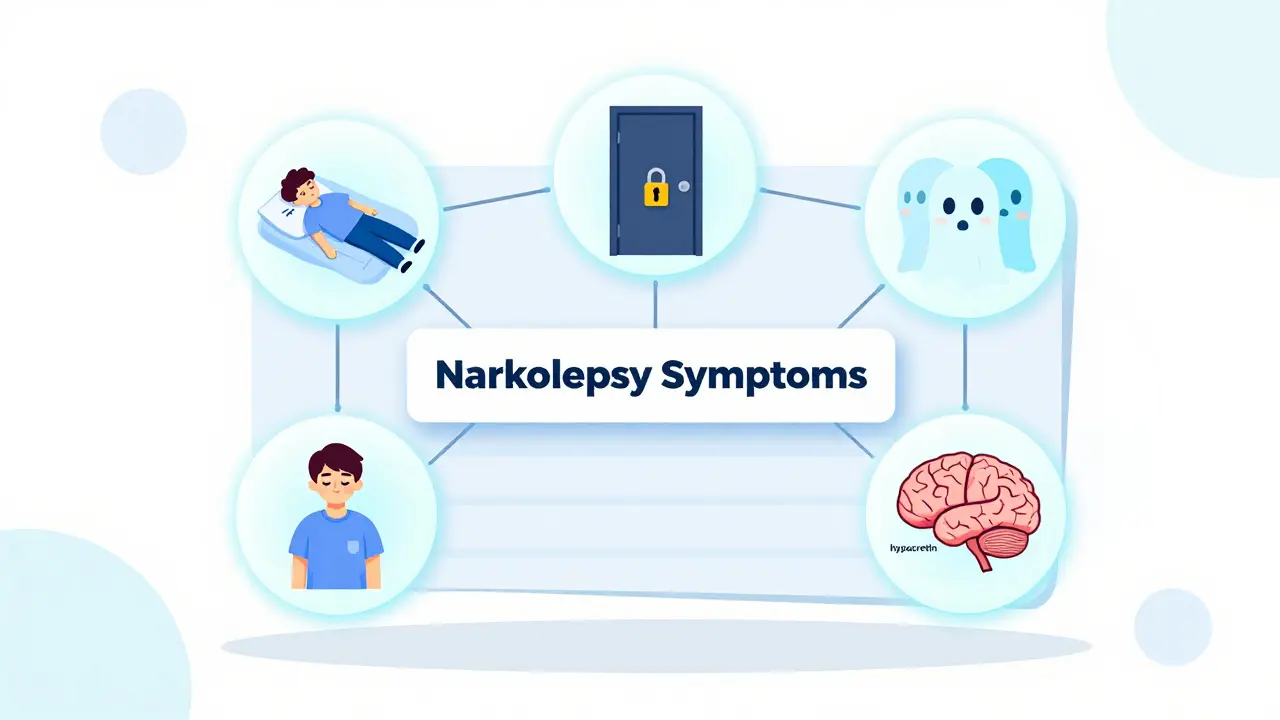
The five signs of narcolepsy - not just tiredness
Narcolepsy doesn’t just cause sleepiness. It comes with a cluster of symptoms that, together, point to the diagnosis:
- Excessive daytime sleepiness (EDS) - Always present. Happens daily for at least three months.
- Cataplexy - Sudden muscle weakness triggered by strong emotions like laughter or anger. You might drop your head, buckle your knees, or even collapse. This only happens in Type 1 narcolepsy, which makes up about 70% of cases.
- Disrupted nighttime sleep - You spend 8+ hours in bed, but your sleep is broken into 4 to 6 chunks. You wake up often, even if you don’t remember it.
- Sleep paralysis - When you’re falling asleep or waking up, your body can’t move, even though your mind is fully awake. It lasts 1 to 5 minutes and can be terrifying.
- Hallucinations - Vivid, scary images or sounds as you drift off to sleep or wake up. These aren’t dreams - they feel real.
If you have three or more of these, especially EDS and cataplexy, you need to see a sleep specialist. Diagnosis requires a sleep study - first an overnight polysomnogram, then a Multiple Sleep Latency Test (MSLT) the next day. The test measures how fast you fall asleep and whether you enter REM sleep too quickly. A mean sleep latency under 8 minutes with two or more sleep-onset REM periods confirms narcolepsy. Or, a spinal fluid test showing hypocretin-1 levels below 110 pg/mL does too.
Why stimulants are the first-line treatment for daytime sleepiness
There’s no cure for narcolepsy. But there are treatments that help you stay awake and functional. Stimulants are the most common starting point because they directly target the brain’s wakefulness pathways.
Three main types are used today:
- Modafinil (Provigil) - A wakefulness-promoting agent approved in 1998. It doesn’t work like caffeine or amphetamines. Instead, it gently boosts dopamine and modulates orexin systems. Most people take 200 mg in the morning. If that doesn’t help after two weeks, doctors may increase it to 400 mg. Studies show 70% of users get a 5-point or better drop on the Epworth Sleepiness Scale - a big improvement.
- Armodafinil (Nuvigil) - This is the longer-lasting version of modafinil. It stays in your system for about 15 hours, so one dose in the morning is often enough. In clinical trials, 65% of people on armodafinil reached ESS scores under 10 - meaning they were no longer severely sleepy during the day.
- Traditional stimulants - Like methylphenidate (Ritalin) or amphetamine salts (Adderall). These are stronger. They work fast and help people with severe EDS (ESS over 16). But they come with risks: higher chance of anxiety, jitteriness, high blood pressure, heart rate spikes, and misuse. About 45% of people stop taking them within a year because of side effects.
Why start with modafinil or armodafinil? Because they’re safer. In a 2022 European analysis, less than 5% of people quit modafinil due to side effects. That number jumps to 25% for traditional stimulants. For most people, the benefits outweigh the risks - but only if you’re monitored.
What about newer drugs like pitolisant and solriamfetol?
There are newer options that don’t fit the classic stimulant mold.
- Pitolisant (Wakix) - Approved in 2019, it works by stimulating histamine in the brain, which promotes wakefulness. It’s as effective as modafinil, with fewer cardiovascular side effects. But it’s expensive - around $850 a month - and not always covered by insurance.
- Solriamfetol (Sunosi) - A dopamine and norepinephrine reuptake inhibitor. It gives strong wakefulness support, with ESS reductions of 7.5 to 9.8 points at higher doses. It has low abuse potential, but it can raise blood pressure. About 7% of users in trials saw readings above 140/90 mmHg.
These aren’t first-line yet. Most doctors still start with modafinil. But if modafinil stops working after 12 to 18 months - which happens in over 40% of users - these are the next step. Some patients report better focus and less “rebound fatigue” with these newer drugs compared to traditional stimulants.
Sodium oxybate - not a stimulant, but essential for cataplexy
If you have cataplexy, you’ll likely need sodium oxybate (Xyrem). It’s not a stimulant. It’s a depressant taken at night. It helps you sleep more deeply and reduces cataplexy attacks by up to 85%. It also improves daytime sleepiness - by about 5.8 points on the ESS.
But it’s complicated. Sodium oxybate is tightly controlled. You have to take it in two doses at night, and it’s part of a special program called REMS because of abuse risk. It also has a high sodium load, which can be dangerous for people with heart or kidney problems. That’s why many are waiting for JZP-258, a lower-sodium version expected to be approved by the end of 2024.
Real people, real results - and real challenges
Stories from people living with narcolepsy show how treatment changes lives.
Sarah Johnson, a 34-year-old teacher, went from an ESS score of 18 (severe sleepiness) to 6 on armodafinil 250 mg. She went back to full-time teaching. She says, “I finally feel like I’m in control.”
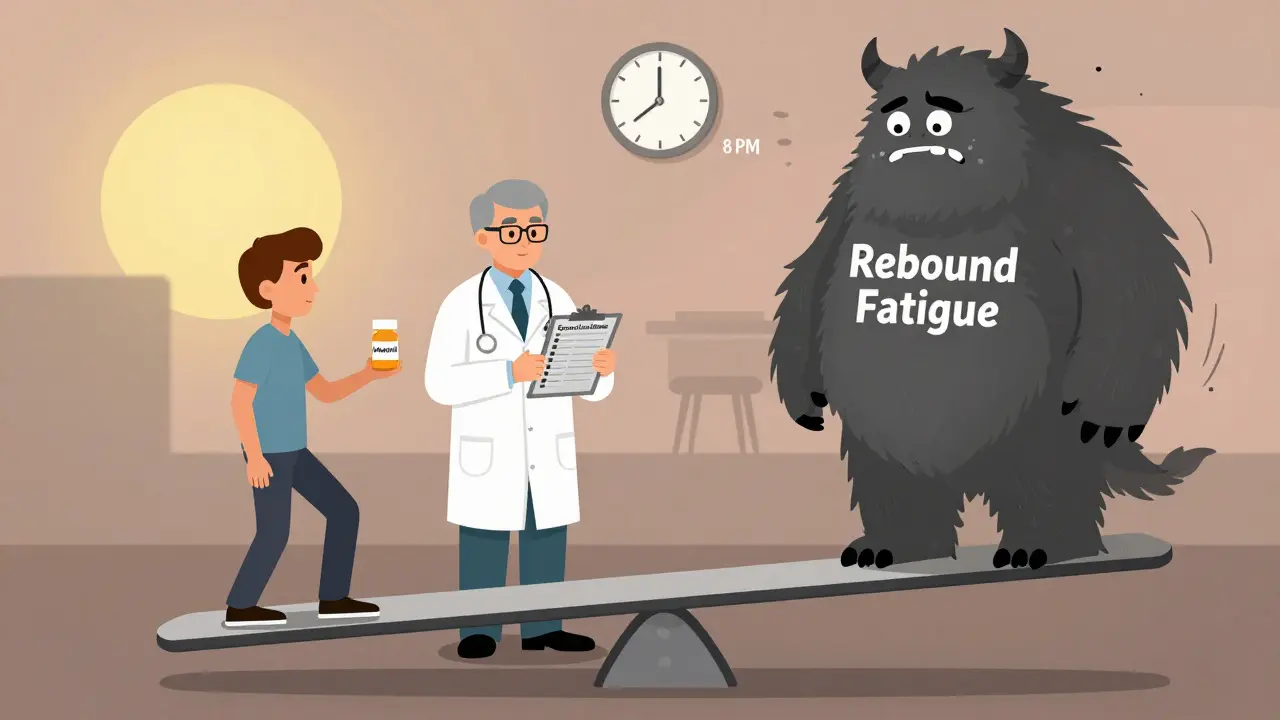
But not everyone has that outcome. Many report diminishing effects after 18 months. Others deal with headaches, loss of appetite, or emotional numbness. On Reddit, 68% of users talk about “rebound fatigue” - crashing hard in the evening after a stimulant high. And while stimulant-induced psychosis is rare (0.03% of cases), it does happen - mostly with high-dose amphetamines.
Access is another issue. Insurance often denies coverage. The average wait for prior authorization is 14 days. And many doctors don’t know how to dose these drugs properly. A 2022 study found 42% of patients stayed on too-low doses for over six months.
How treatment is monitored - and what to watch for
Stimulants aren’t a “set it and forget it” solution. You need regular check-ins:
- Monthly Epworth Sleepiness Scale checks
- Quarterly blood pressure and heart rate measurements
- Annual cardiovascular screening - especially if you’re on traditional stimulants
- Watching for tolerance - if your dose isn’t working like it used to, talk to your doctor before increasing it
Resources like the Narcolepsy Network’s Patient Toolkit and the American Academy of Sleep Medicine’s Pocket Guide are used by 85% of sleep specialists. They’re not optional - they’re essential.
What’s next for narcolepsy treatment?
Right now, all treatments manage symptoms. None fix the root cause - the loss of hypocretin-producing brain cells. But research is moving fast.
The 2023 REST-ON trial showed TAK-994, an orexin receptor agonist, could restore wakefulness without side effects. But development was paused due to liver concerns. Still, it proves the concept: if we can replace or boost hypocretin, we might not need stimulants at all.
Future therapies may include immunotherapy for Type 1 narcolepsy - since it’s likely autoimmune - or even stem cell transplants to replace lost hypocretin neurons. The European Sleep Research Society has listed these as top priorities.
For now, stimulants remain the backbone of care. But the goal isn’t just to keep you awake. It’s to help you live fully - without fear of falling asleep, without shame, without being misunderstood.
Can narcolepsy be cured?
No, there is no cure yet. Narcolepsy is caused by the loss of hypocretin-producing brain cells, and current treatments only manage symptoms like daytime sleepiness and cataplexy. Research into disease-modifying therapies - such as hypocretin replacement or immune system modulation - is ongoing, but none are available for clinical use yet.
Is modafinil addictive?
Modafinil has very low abuse potential compared to traditional stimulants like Adderall or Ritalin. It doesn’t cause euphoria or a crash, and it’s not classified as a controlled substance in most countries. However, some people develop tolerance over time, meaning they need higher doses to get the same effect - which is why regular doctor check-ups are important.
Can I drive if I have narcolepsy?
Yes, but only if your symptoms are well-controlled. Many people with narcolepsy drive safely after starting treatment. However, if you still have frequent sleep attacks or cataplexy episodes, driving is dangerous and often restricted by law. Always follow your doctor’s advice and report any lapses in alertness immediately.
Do stimulants work for everyone with narcolepsy?
No. About 20-30% of people don’t respond well to modafinil or armodafinil. In those cases, doctors may switch to traditional stimulants, pitolisant, or solriamfetol. Some patients need a combination of medications - like modafinil plus sodium oxybate - to manage both sleepiness and cataplexy. Finding the right treatment often takes time and patience.
What should I do if my medication stops working?
Don’t increase the dose on your own. Contact your sleep specialist. Diminishing effectiveness after 12-18 months is common. Your doctor may adjust your dose, switch medications, or add another drug like sodium oxybate or pitolisant. Keep a sleep diary and track your ESS score - this helps your doctor make informed decisions.
Can lifestyle changes help with narcolepsy?
Yes, but not as a replacement for medication. Scheduled short naps (15-20 minutes) during the day can reduce sleep attacks. Regular exercise, avoiding heavy meals, and maintaining a consistent sleep schedule help too. Avoid alcohol and sedating medications. These changes support treatment - they don’t replace it.
Final thoughts: It’s not about being lazy - it’s about being understood
Narcolepsy is invisible. People don’t see your fatigue. They don’t know you’re fighting to stay awake. But with the right diagnosis and treatment, you can live a full life. Stimulants aren’t magic - but they’re the best tool we have right now. The goal isn’t to feel like a machine. It’s to feel like yourself again - present, alert, and in control.
Gray Dedoiko
I’ve had narcolepsy for 12 years, and modafinil was the first thing that actually let me hold a job. Not perfect - I still crash by 6 PM - but I can drive, teach my kid to read, and not fall asleep mid-sentence. It’s not a cure, but it’s a lifeline.
Also, the rebound fatigue is real. I schedule my naps like appointments. No shame in it.
Thanks for writing this. People need to stop calling it laziness.
Aurora Daisy
Oh great, another article pretending stimulants are some noble medical breakthrough. Let’s just call it what it is - a chemical crutch for people who can’t be bothered to get enough sleep. Meanwhile, my cousin in the UK sleeps 9 hours, exercises, and never needs a pill to stay awake. Maybe we should stop medicating normal human tiredness.
Also, who approved this nonsense? The FDA? The same people who let Big Pharma sell us Adderall as a ‘focus booster’ for college kids?
Paula Villete
Okay but… did anyone else notice how the article says ‘modafinil doesn’t work like caffeine’ and then immediately compares it to dopamine modulation? Like… isn’t that basically what coffee does, just with more steps? 🤔
Also, ‘rebound fatigue’ is just your body screaming ‘I’m not a battery, I’m a human.’
And yes, I typed that with one hand while the other was holding a coffee mug. Still got the typo. I’m proud.
Also also - pitolisant costs more than my rent. Can we talk about how broken the healthcare system is? Or is that too much to ask?
Georgia Brach
The assertion that stimulants are ‘first-line treatment’ is a reflection of pharmaceutical influence, not clinical efficacy. The Epworth Sleepiness Scale is a subjective metric with poor inter-rater reliability. Furthermore, the claim that 70% of users experience a ‘5-point or better drop’ is statistically misleading when the baseline mean is 16. A 5-point reduction represents only a 31% improvement - hardly transformative.
Additionally, the normalization of chronic stimulant use as a lifestyle intervention for a neurological disorder represents a dangerous precedent. The absence of long-term neurocognitive outcome data renders this approach ethically questionable.
One must also consider the socioeconomic stratification inherent in access to pitolisant and solriamfetol. This is not medicine - it’s a market-driven performance enhancement regime disguised as therapy.
Katie Taylor
STOP LETTING PEOPLE THINK THEY’RE BROKEN BECAUSE THEY NEED MEDICINE TO STAY AWAKE. You’re not lazy. You’re not weak. You’re not failing. You have a neurological condition that’s been misunderstood for decades - and now we have tools to fight it. If modafinil lets you teach your kids, drive to work, or laugh with friends without collapsing - TAKE IT. No guilt. No shame. You’re not cheating. You’re surviving.
And if your doctor doesn’t get it? Find a new one. You deserve to live.
I’m cheering for you. You’ve got this.
Isaac Bonillo Alcaina
Modafinil is a placebo with a prescription label. The fact that you feel ‘better’ after taking it doesn’t mean your brain is fixed - it means you’ve been conditioned to associate chemical stimulation with alertness. The real issue? Society doesn’t accommodate biological diversity. We medicate the symptoms instead of redesigning work hours, school schedules, or public expectations.
And let’s not pretend narcolepsy is rare. It’s just underdiagnosed because doctors are trained to dismiss fatigue as depression or poor sleep hygiene. Your ‘5-point ESS drop’ is a Band-Aid on a broken leg.
Chris Buchanan
Bro, I’ve been on armodafinil for 5 years. First year? Life-changing. Year 3? Started needing 250mg instead of 150. Year 5? Now I’m on armodafinil + pitolisant + scheduled naps. And yeah, I still crash sometimes.
But here’s the thing - I’m alive. I’m present. I didn’t lose my job. I didn’t lose my family. That’s not ‘just a pill.’ That’s me getting to be a dad.
And if you think this is easy? Try explaining to your boss why you fell asleep during the Zoom call. Again.
Keep fighting. You’re not alone.
Andy Grace
Just wanted to say thanks for the detail on sodium oxybate. I’ve been on it for 2 years. The two-night doses are a nightmare - but the cataplexy is gone. No more collapsing when my niece laughs at my jokes.
Worth it.
Also, the REMS program is a pain, but at least they’re trying to keep it safe. Hope JZP-258 comes soon.
John Pearce CP
It is an incontrovertible fact that the medicalization of narcolepsy through pharmacological intervention reflects a broader cultural pathology: the commodification of human biological variance. The reliance upon stimulants as a first-line therapeutic modality constitutes a capitulation to productivity-based norms, wherein the human organism is expected to conform to industrial temporal structures rather than the reverse.
Furthermore, the statistical normalization of ESS scores obscures the phenomenological reality of lived experience. A 5-point reduction does not equate to restored autonomy; it equates to marginally improved compliance.
The true solution lies not in neurochemistry, but in systemic reconfiguration - universal flexible work hours, institutional recognition of neurodivergent circadian rhythms, and the dismantling of the ‘sleep hygiene’ mythos.
Pankaj Chaudhary IPS
As someone from India where access to even basic sleep clinics is rare, I want to say this: your article gives hope to people who’ve been told they’re just ‘lazy’ or ‘depressed.’
Here, many patients wait 2+ years for a sleep study. Some never get diagnosed. So when I see someone explain narcolepsy with this clarity - it matters.
And yes, the drugs are expensive. But the fact that we’re even talking about pitolisant and hypocretin replacement? That’s progress.
Keep writing. Someone out there needs to read this today.