

When Recurrent Infections Are More Than Just Bad Luck
Most kids get colds. Lots of them. Six to twelve respiratory infections a year? That’s normal. But what if your child gets pneumonia twice in one year? Or ear infections every few months, even after antibiotics? What if they keep getting thrush in their mouth after age one, or skin abscesses that won’t heal? These aren’t just bad luck. They could be signs of something deeper - a problem with the immune system itself.
Primary immunodeficiencies (PIDs) are not rare. Around 1 in 1,200 people have one. Yet most go undiagnosed for years. Why? Because doctors - even pediatricians - often assume recurrent infections are just part of growing up. But when they hit certain red flags, it’s time to look beyond the common cold.
The 10 Warning Signs That Demand Action
The American Academy of Allergy, Asthma & Immunology and the European Society for Immunodeficiencies agree on a clear set of warning signs. If a patient has two or more of these, it’s time for an immune workup:
- Four or more ear infections in one year
- Two or more serious sinus infections in one year
- Two or more pneumonias within 12 months
- Persistent oral thrush after age one
- Recurrent deep skin or organ abscesses
- Infections that don’t improve after two months of antibiotics
- Need for intravenous antibiotics to clear infections
- Two or more deep-seated infections like septicemia or meningitis
- Failure to gain weight or grow normally
- A family history of primary immunodeficiency
These aren’t vague suggestions. They’re based on decades of clinical data. For example, thrush lasting past age one has an 89% specificity for antibody deficiency. That means if a child still has white patches in their mouth after turning one, and it doesn’t go away with treatment, it’s very likely not just a yeast overgrowth - it’s a sign their body can’t fight off fungi properly.
What the Physical Exam Reveals
Lab tests aren’t the only clue. Sometimes, the answer is right in front of you during a physical exam. In severe combined immunodeficiency (SCID), doctors find absent or tiny tonsils and lymph nodes in 78% of cases. That’s not normal - those are key immune organs. In ataxia-telangiectasia, you’ll see tiny red blood vessels (telangiectasias) on the eyes and skin - seen in 95% of patients. Growth failure is another red flag. Nearly two-thirds of children with undiagnosed PIDs fall below the 5th percentile for height and weight. If a child is constantly sick and not growing, it’s not just poor nutrition. Their immune system is draining their energy just to survive.
The First Step: Basic Blood Tests
Once red flags appear, the workup starts with simple, widely available tests. The first is a complete blood count (CBC) with manual differential. In children over one year, a lymphocyte count under 1,500 cells/μL is suspicious. In babies under one, anything below 3,000 is a warning. Next comes immunoglobulin levels: IgG, IgA, and IgM. But here’s the catch - these numbers change with age. A 3-month-old with an IgG of 243 mg/dL is normal. An 8-year-old with the same level is severely deficient. Many doctors miss this. One pediatrician in Ohio told me she had three patients misdiagnosed because their IgG was 420 mg/dL - just above the old cutoff of 400 - but way below what’s normal for their age.
After Ig levels, flow cytometry checks T-cells (CD3, CD4, CD8) and B-cells (CD19). If CD3+ T-cells are under 1,000/μL in a child over two, that’s a major red flag for T-cell deficiency. But the real gold standard is functional testing: vaccine response.
Testing Immune Function: The Vaccine Challenge
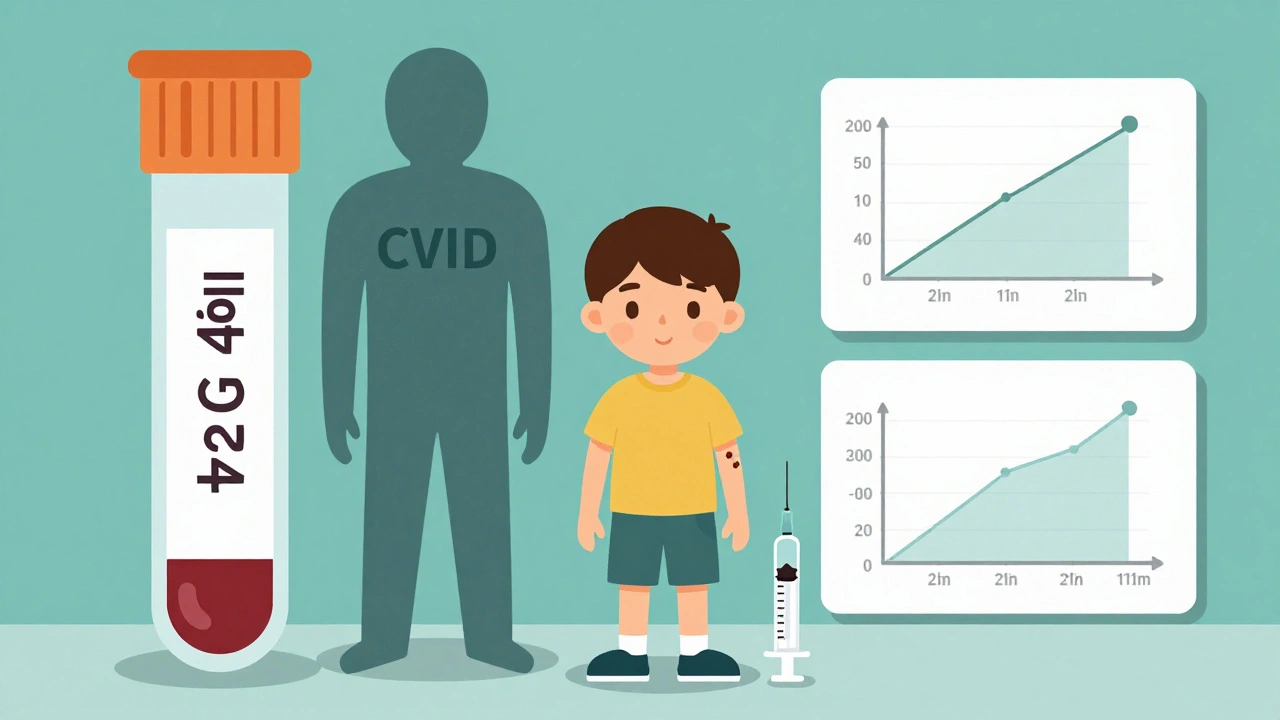
Having normal IgG levels doesn’t mean the immune system works. You need to test if it can respond to threats. That’s why we give vaccines - not for prevention, but for diagnosis. After giving tetanus and diphtheria toxoids, we check IgG levels four to six weeks later. A protective response is ≥0.1 IU/mL. For pneumococcal polysaccharide vaccine, we check at 4-8 weeks. Protective titers are ≥1.3 μg/mL. If the patient doesn’t respond, they have an antibody deficiency - even if their IgG looks fine.
This is where many patients get misdiagnosed. Common Variable Immunodeficiency (CVID) requires IgG under 400 mg/dL plus low IgA or IgM plus poor vaccine response. If you only check IgG, you’ll miss it. And if you give IVIG without confirming the response, you’re treating the wrong problem.
Don’t Jump to Treatment - Rule Out Mimics First
Not every recurrent infection is immune failure. In fact, up to 43% of cases have other causes. Cystic fibrosis accounts for 12%. Structural problems like deviated septum or chronic sinusitis cause 31%. Inhaled foreign bodies - yes, a tiny peanut or toy piece stuck in the airway - can mimic pneumonia in 18% of kids. Autoimmune diseases, cancers, and medications like steroids can also lower antibodies. One study found that 30% of patients diagnosed with CVID actually had a secondary cause. That’s why we don’t start immunoglobulin therapy until we’ve ruled these out. Giving IVIG without knowing why the immune system is failing doesn’t fix the root problem - it just masks it.
What Comes Next: Genetic Testing and New Tools
Once basic testing points to a PID, the next step is often genetic testing. In 2023, the FDA approved next-generation sequencing panels that look at 484 immune-related genes. These tests find the exact mutation in 35% of suspected cases - double the rate of older methods. The International Union of Immunological Societies now lists 485 distinct PIDs, grouped into 10 categories. SCID, X-linked agammaglobulinemia, and CVID are the most common, but dozens of rare types exist. Newborn screening for SCID is now mandatory in 38 U.S. states. Babies are tested via a heel prick right after birth. If caught before 3.5 months, survival jumps from 69% to 94%. That’s the power of early detection.
Why Delay Is Dangerous
On average, patients wait 9.2 years before getting a correct diagnosis. That’s nearly a decade of unnecessary infections, lung damage, chronic sinusitis, and organ scarring. But when doctors follow the 10-warning-signs pathway, diagnosis drops to 2.1 years. The difference? Preventable bronchiectasis. Preventable liver damage. Preventable death. In one study, kids who got treated early had normal school attendance. Those who didn’t ended up in the hospital every few months. The cost isn’t just medical - it’s emotional, social, and financial.
What You Can Do
If you’re a parent and your child keeps getting sick - really sick - don’t accept "they’re just a sickly kid" as an answer. Write down the infections: type, frequency, duration, treatment response. Bring it to your doctor. Ask: "Could this be an immune problem?" If they say no, ask for a referral to an immunologist. If you’re a clinician, don’t rely on outdated cutoffs. Use age-adjusted reference ranges. Order functional antibody tests. Rule out structural and secondary causes before starting IVIG. And remember: if a child isn’t growing and keeps getting infections, it’s not just a nutritional issue. It’s an immune emergency.
What’s Changing in 2025
By 2025, whole exome sequencing may become the first test for suspected PIDs in developed countries. AI tools are being trained to predict immune disorders from routine blood work - early data shows 92% accuracy. The WHO is adding flow cytometry to its Essential Diagnostics List, which could help low-resource areas. But right now, 78% of low- and middle-income countries can’t even test for basic IgG levels. That’s the real gap. For now, in places like New Zealand, Australia, or the U.S., we have the tools. We just need to use them.
How many ear infections are too many in a child?
Four or more ear infections in one year is a red flag for possible immunodeficiency. While it’s normal for young children to have 6-12 upper respiratory infections annually, repeated middle ear infections (otitis media) that require antibiotics or lead to hearing loss may signal an underlying immune problem, especially if paired with other warning signs like sinus infections or poor growth.
Can a child have normal IgG levels and still have an immune deficiency?
Yes. IgG levels must be interpreted by age. A child’s normal IgG range changes dramatically from infancy to adulthood. A level of 420 mg/dL might be normal for a teenager but dangerously low for an 8-year-old. Even more importantly, normal IgG doesn’t mean the immune system works. Some children have normal or even high IgG levels but can’t produce antibodies in response to vaccines - a condition called specific antibody deficiency. That’s why functional testing with pre- and post-vaccine titers is essential.
Is oral thrush after age one always a sign of immunodeficiency?
Not always, but it’s a very strong indicator. Oral thrush (candidiasis) is common in infants under one due to immature immunity and antibiotic use. But if it persists beyond age one, especially if it doesn’t respond to antifungal treatment, it has an 89% specificity for antibody deficiency. It’s one of the most reliable clinical signs for conditions like CVID or X-linked agammaglobulinemia. Always investigate further if thrush lingers past toddlerhood.
What’s the difference between primary and secondary immunodeficiency?
Primary immunodeficiencies are genetic - you’re born with them. Examples include SCID, CVID, and X-linked agammaglobulinemia. Secondary immunodeficiencies are acquired later in life due to other causes: cancer (like leukemia), autoimmune diseases (like lupus), chronic steroid use, malnutrition, or HIV. Up to 30% of patients initially thought to have CVID actually have a secondary cause. That’s why doctors must rule out these conditions before diagnosing a primary disorder.
When should a child be referred to an immunologist?
Any child with two or more of the 10 warning signs should be referred. This includes recurrent pneumonia, deep abscesses, failure to thrive, persistent thrush after age one, or a family history of immunodeficiency. Early referral cuts diagnosis time from nearly a decade to under two years. Waiting for "more infections" or "worse symptoms" leads to irreversible damage. Don’t wait for perfection - act on the pattern.
Can adults develop primary immunodeficiency?
Yes. While many PIDs show up in childhood, some - especially Common Variable Immunodeficiency (CVID) - are often diagnosed in adults in their 20s to 40s. Adults with recurrent sinus infections, pneumonia, or gastrointestinal infections (like chronic giardiasis) that don’t respond to standard treatment should be evaluated. Many adults have been misdiagnosed with asthma, bronchitis, or allergies for years before the real cause is found.
Ashley Skipp
Ive seen so many kids get misdiagnosed as just sickly when its actually PID. My cousin had 7 ear infections in one year and they kept giving her more antibiotics till her mom pushed for an immunologist. Turned out she had CVID. Now shes 12 and thriving. Stop normalizing constant illness.
sandeep sanigarapu
This is important information. In my country, many doctors do not have access to basic immunoglobulin tests. Early detection saves lives.
wendy b
Honestly if you're not ordering functional antibody tests after seeing two red flags you're just a lazy pediatrician. I mean c'mon. IgG levels alone are like judging a car by its color. The engine matters. And no, your 8 year old with 420 mg/dL IgG is NOT fine. That's not a number, that's a cry for help.
Robert Webb
I appreciate how this breaks down the clinical reasoning. Too often we treat symptoms without understanding the system behind them. The immune system isn't just a firewall-it's a dynamic network. When it fails silently, it doesn't scream, it just stops growing, stops healing, stops thriving. That's why we need to look beyond the infection count and into the child's entire story-growth, development, family history. It's not just medicine. It's listening.
Nathan Fatal
The vaccine challenge test is the real game changer. I've seen so many kids with normal IgG levels who can't respond to pneumococcal vaccines. They're labeled as allergic or asthmatic. But they're just not making antibodies. That's not an allergy. That's a broken immune response. Functional testing isn't optional-it's the baseline.
Donna Anderson
This post changed my life. My daughter had thrush at 18 months and we were told it was just from antibiotics. I pushed for more testing and found out she had CVID. Now she gets IVIG every 3 weeks. She's in 3rd grade and actually went to school all year. Thank you for writing this.
Rob Purvis
Wait, wait, wait... I just want to clarify something: if a child has normal IgG, but poor vaccine response, and no family history, and no growth delay-could it still be PID? Or is that just 'idiopathic specific antibody deficiency'? I've seen this in my practice, and I'm not sure if we're overdiagnosing or underdiagnosing. Can we get a consensus on this edge case?
Adam Everitt
i mean... what if its just... stress? or maybe the kid is in daycare? or maybe the parents are just... overly anxious? i mean... dont we all overmedicalize normal childhood stuff? like... isnt it possible that 10 warning signs is just... too many? maybe we should just let nature take its course?
Stacy Foster
You know who benefits from all this? Pharma. IVIG costs $20k a year. Who’s pushing this narrative? Who’s funding the ‘10 warning signs’? Big Pharma loves chronic patients. And don’t even get me started on newborn screening-it’s a goldmine for labs. My cousin’s kid was diagnosed with SCID at birth. Two years later, they found he had a congenital thyroid issue that was suppressing his immune markers. They gave him IVIG for 18 months. He never needed it. The system is rigged.
nikki yamashita
If your kid is constantly sick and not growing, trust your gut. Don't wait for a doctor to say it's time. Write it down. Ask for the tests. You know your child best. This isn't fear-mongering-it's empowerment.