
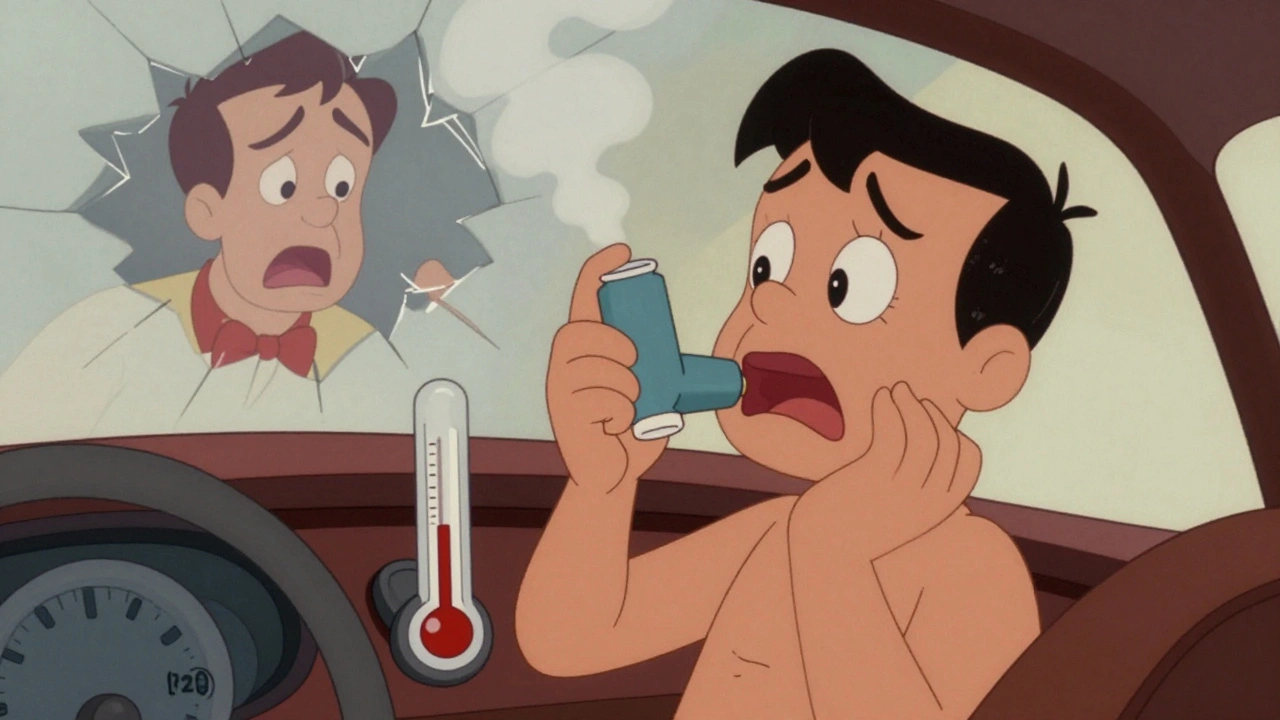
When your inhaler or nebulizer medication fails during an asthma attack, it’s rarely because the drug is expired. More often, it’s because it was stored wrong. A 2023 study from the University of North Carolina found that inhalers left in a hot car for just 24 hours delivered up to 40% less medication. That’s not a small drop-it’s the difference between breathing and struggling to breathe. And it’s happening more than you think.
What Temperature Is Safe for Inhalers?
Most inhalers work best at room temperature: between 68°F and 77°F (20°C to 25°C). That’s your sweet spot. But the acceptable range? 59°F to 86°F (15°C to 30°C). Go outside that, and you risk losing effectiveness.
Pressurized metered-dose inhalers (pMDIs), like ProAir HFA or Ventolin, contain propellant in a metal canister. Heat above 86°F can build pressure inside, making the canister dangerous to puncture or throw away. Cold? Below 59°F, the propellant doesn’t spray right. You might get a weak puff-or nothing at all.
Dry powder inhalers (DPIs), like Spiriva HandiHaler or Advair Diskus, don’t have liquid propellant. But they’re even more sensitive to moisture. Humidity above 60% causes the powder to clump or the capsules to become brittle. That means you won’t get the full dose when you inhale.
Nebulizer solutions like albuterol ampules or Pulmicort Respules have stricter rules. They need to stay between 68°F and 77°F (20°C-25°C). If they hit 104°F (40°C), the medication can break down in under 30 minutes. That’s faster than a summer car heats up.
Where NOT to Store Your Inhaler
The bathroom is the #1 worst place. It’s humid, it’s hot from showers, and it’s full of steam. St. Jude Children’s Research Hospital found that albuterol stored in a bathroom lost 35% of its potency in just 14 days. That’s not a myth-it’s lab-tested.
Don’t leave it in your car. Even on a mild 75°F day, the inside of a parked car can hit 120°F in 30 minutes. The NIH tested this in 2022: an inhaler left in a car at 158°F was completely useless. The medication was denatured-chemically broken down. No amount of shaking will fix that.
Don’t keep it in your gym bag, purse, or glove compartment. These get tossed around, left in heat, and exposed to moisture. A Reddit user in 2023 shared how their inhaler failed during an attack-turned out it had been sitting in a gym bag that reached 110°F in their car. They didn’t realize it was the storage, not the medication itself.
How to Store Inhalers and Nebulizer Medications Correctly
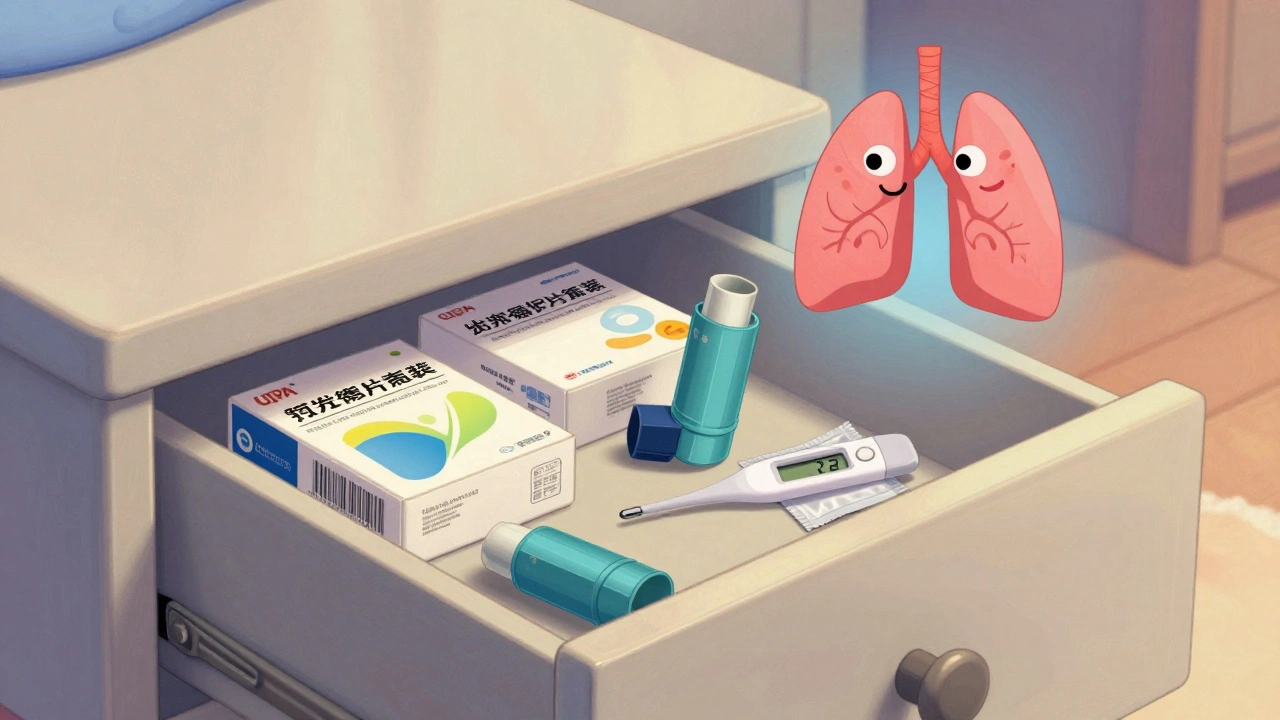
Keep your inhaler in its original box. The box blocks light, which can degrade some medications. It also protects it from bumps and moisture.
Store it in a cool, dry place. A bedroom drawer, a closet shelf, or a cabinet away from the bathroom sink are all good options. Make sure it’s not near a heater, radiator, or window that gets direct sun.
For nebulizer solutions that need refrigeration-like Pulmicort Respules-keep them in the fridge until you open them. Once opened, they’re good for only 7 days at room temperature. Don’t freeze them. Don’t leave them on the counter after opening. Track the date you opened each ampule.
If you travel, use an insulated case. The American College of Physicians recommends the “Rule of 15”: don’t leave your inhaler outside a temperature-controlled space for more than 15 minutes. For longer trips, a $15 insulated MediSafe case from Amazon has worked for many users in hot climates like Florida. One patient used theirs for 18 months with zero issues.
Special Cases: Different Inhalers, Different Rules
Not all inhalers are the same. Here’s what you need to know:
- Pressurized MDIs (ProAir, Ventolin): Avoid heat above 86°F. Don’t puncture or incinerate. Store upright.
- Dry Powder Inhalers (Spiriva, Advair): Keep dry. Humidity above 65% ruins them. Don’t store next to a humidifier or in a damp bathroom.
- Breath-Actuated Inhalers (Proventil RespiClick): Require 68°F-77°F. More sensitive than standard MDIs.
- Nebulizer Liquids (albuterol, Pulmicort): Refrigerate unopened. Use within 7 days after opening. Never microwave or heat them.
And here’s a big one: don’t store multiple inhalers together. A 2023 Johns Hopkins study found that 22% of DPI users accidentally exposed their devices to moisture from nearby pMDIs. If you keep them in the same pocket or case, the moisture from the pMDI’s propellant can seep into the DPI’s powder. That’s a silent killer of effectiveness.

What About Refrigeration?
This is where confusion runs deep. Some people think refrigerating inhalers makes them last longer. It doesn’t. For most inhalers, refrigeration isn’t recommended. The cold can change how the propellant works. The American Thoracic Society says no refrigeration for multi-dose inhalers.
But there’s an exception. The European Respiratory Society says it’s okay to briefly refrigerate Symbicort during extreme heat-like if you’re stuck in a 95°F+ environment and have no other option. But only as a short-term fix. Don’t make it a habit.
And never freeze anything. Freezing alters the chemical structure. Once frozen, even if it thaws, the medication won’t work right.
How to Check If Your Inhaler Still Works
There’s no simple test to know if your inhaler lost potency. But you can watch for signs:
- You feel less relief after using it, even with correct technique.
- The spray feels weaker or spits instead of misting.
- You’re using it more often than usual.
- The inhaler feels colder or warmer than usual when you hold it.
Some newer inhalers, like GlaxoSmithKline’s Ellipta, now have humidity-indicating packaging. If the color changes, it means moisture got in. That’s your sign to replace it.
There’s also a new FDA-cleared device called SmartInhale-a Bluetooth-enabled case that tracks temperature and humidity. It alerts your phone if your inhaler got too hot or too damp. It’s not cheap, but for people who travel often or live in extreme climates, it’s a lifesaver.
What to Do If You Suspect Your Medication Failed
If you had an asthma attack and your inhaler didn’t help, don’t assume it’s your lungs. Ask yourself: Where was this inhaler stored?
Check the expiration date. But don’t trust it blindly. A 2023 Drugs.com survey found that 35% of complaints about inhalers failing before expiration were due to improper storage.
If you think your medication is bad, get a new one. Don’t wait. Call your pharmacy. Tell them you suspect storage damage. Most will replace it without hassle if you explain the situation.
And if you’re in an emergency and your inhaler doesn’t work, call 911 or go to the ER. Don’t gamble with your breathing.
Why This Matters More Than You Think
Improper storage isn’t just inconvenient. It’s dangerous. The American Lung Association says 12% of asthma treatment failures in emergencies are linked to degraded medication. Dr. Michael Foggs of the American College of Allergy says improperly stored inhalers during summer cause about 20% of preventable ER visits for asthma.
And it’s not just individuals. Schools and hospitals struggle too. In 2022, 63% of school-related asthma emergencies involved inhalers stored in nurse’s offices that were too hot. Hospitals had 47% non-compliance with storage guidelines because nebulizers were placed near heating vents.
There’s progress. St. Jude Children’s Research Hospital installed “Cool Cubby” storage units in classrooms-temperature-monitored, locked boxes that keep inhalers at exactly 72°F. They cut medication failures by 89%.
But most people still get it wrong. Only 38% of asthma patients store their inhalers correctly, even though 92% think they are.
Practical Tips for Daily Use
Here’s a simple 3-step checklist you can follow every day:
- Check the temp: Use a $10 digital thermometer to check where you store your inhaler. If it’s over 86°F or under 59°F, move it.
- Keep it dry: Use a silica gel packet (the kind that comes in new shoes or medicine bottles) in your inhaler case. It soaks up moisture.
- Track your usage: Write the date you opened a nebulizer ampule on the vial. Throw it out after 7 days.
For travel, pack your inhaler in your carry-on. Never check it in luggage. Airplane cargo holds can drop below freezing or spike above 100°F.
If you’re a parent, teach your child where to store their inhaler. Don’t let them leave it in their backpack all day. Make a rule: home, school, and gym each have a designated spot.
Looking Ahead: What’s Changing in Storage Rules
The FDA is pushing for change. Their 2023 draft guidance says all rescue inhalers must have built-in temperature monitoring by 2026. That means inhalers with sensors that log if they got too hot. Some are already here.
Climate change is making this harder. A 2023 Lancet study predicts that by 2030, 32% of the U.S. population will face more than 60 days a year above 86°F. That’s more than two months where your car, your gym bag, or your office could turn your inhaler into a paperweight.
The American Lung Association is now pushing for federal funding to create “climate-resilient storage” in schools, workplaces, and public spaces. Because right now, the system is failing people who need help the most.
Steve World Shopping
Let’s be clear: improper inhaler storage is a catastrophic failure of basic pharmacokinetic adherence. The propellant integrity in pMDIs is governed by the Clausius-Clapeyron equation-temperature excursions beyond 30°C induce phase instability in HFA-134a, leading to dose uniformity violations exceeding the FDA’s 15% tolerance threshold. And don’t get me started on DPI hygroscopicity-water activity above 0.6 triggers particle cohesion via capillary bridging, rendering the aerosolization efficiency null. This isn’t anecdotal-it’s physicochemical law.
Jack Dao
Of course people are dying from this. You leave your inhaler in your damn car like it’s a bag of chips? 🤦♂️ I’ve seen people store theirs in the glovebox while they’re at yoga. Like, you’re trying to breathe better but you’re also trying to turn your car into a sauna? Get a clue. It’s not rocket science. Cool. Dry. Not the bathroom. Not the gym bag. Not your damn pocket. Stop being lazy.
dave nevogt
There’s something deeply human about how we treat our own survival tools-like they’re disposable, or like the body’s needs are secondary to convenience. We’ll schedule a doctor’s appointment for a cough, but leave the inhaler on the dashboard because we forgot. We don’t think of the medication as alive, but it is-in a chemical sense. It responds to heat like a plant to sun, like a battery to cold. To store it wrong is to ignore its sentience. We’ve forgotten how to care for the small things that keep us alive. Maybe that’s the real crisis.
Arun kumar
bro i used to keep my ventolin in my backpocket and it always felt weird after i sat down… then i started usin a small ziplock with a silica gel pack from my new shoes… life changed. now i just keep it in my nightstand. no more panic attacks cause the inhaler failed. simple shit but no one tells u this 😅
ATUL BHARDWAJ
Storage matters. Heat kills. Humidity kills. No drama. Just do it.
Rebecca M.
Oh so now we’re supposed to carry a mini climate-controlled vault in our purse? Next you’ll tell me to wear a tinfoil hat because my albuterol might get jealous of my AC. 🙄 I’ve got three kids, a job, and a dog who thinks my inhaler is a chew toy. I store it where it fits. If it fails? Well… guess I’ll be the one breathing through my nose like a normal person.
Lynn Steiner
My mom’s inhaler got left in the car during a 100°F day and she had to be rushed to the ER. She’s 72. She didn’t even know it was possible. And now they want us to buy a $50 Bluetooth case? Who’s gonna pay for that? Not me. Not my insurance. Not the damn government. This is just another way to make poor people feel guilty for being poor. 💔
Alicia Marks
You got this. Even small changes-like moving it from the bathroom to the bedroom-make a huge difference. And if you’re unsure, just get a new one. Your breath is worth it. 💪
Paul Keller
While the empirical data presented in this article is both compelling and statistically robust, I would argue that the underlying sociological implications are underexplored. The fact that 92% of patients believe they store their inhalers correctly, while only 38% do, reveals a profound epistemological dissonance between perceived competence and actual practice. This is not merely a failure of education, but a systemic failure of health literacy infrastructure. The FDA’s proposed sensor-integrated inhalers by 2026 represent a technocratic solution to a behavioral problem. Yet, without community-based interventions-such as the St. Jude Cool Cubby model-these innovations will disproportionately benefit urban, affluent populations. We must advocate for equitable, publicly funded climate-resilient storage in schools, workplaces, and public transit hubs. To treat asthma as an individual responsibility is to ignore the structural determinants of health. The data is clear. The moral imperative is undeniable.