

Taking your medication on time isn’t just a chore-it’s the difference between feeling okay and ending up in the hospital. About half of people with long-term health conditions miss doses at least sometimes. That’s not because they’re forgetful or careless. It’s because their routine doesn’t fit their life. You don’t need to be perfect. You just need a system that works with how you actually live.
Start with the simplest change: tie meds to something you already do
The most reliable way to remember your pills is to link them to habits you already have. Brush your teeth every morning? Take your pill right after. Eat dinner at 6 p.m. every night? That’s your evening dose time. Stanford Medicine found that 78% of people who tied their medication to daily routines improved their adherence. It’s not magic-it’s psychology. Your brain remembers actions tied to familiar triggers.Don’t guess which habit works. Test it. Try pairing your morning pill with brushing your teeth for three days. Then try it with making coffee. Which one feels more natural? Stick with that. For evening doses, feeding a pet, turning off the TV, or washing your face can all work. The key is consistency-not perfection.
Use a pill organizer-no tech required
A simple weekly pill organizer with separate compartments for morning, afternoon, and night is one of the most effective tools you can use. Studies show it reduces missed doses by up to 35% compared to keeping pills in their original bottles. You don’t need a fancy app or a smart bottle. Just buy a plastic box with labeled sections from your pharmacy.Set aside 20 minutes every Friday night to fill it. Make it part of your weekend ritual-like doing laundry or prepping meals. Fill one day at a time. Put the morning pills in the top left, afternoon in the middle, night in the bottom right. Use colored stickers if it helps: blue for morning, red for evening. The American Heart Association found this visual cue improves correct dosing by 28%.
Pro tip: Keep your organizer in the same spot every day-next to your toothbrush, on the kitchen counter, or by your bed. Out of sight means out of mind.
Set alarms-but make them foolproof
Smartphones are great for reminders, but only if you use them right. A 2020 MedStar Health study found 63% of people aged 50-75 improved adherence with phone alarms. But here’s the catch: people over 75 often struggle with them. They silence alarms by accident. They forget to turn them back on. Or they don’t know how to set them in the first place.If you use your phone, set two alarms: one 15 minutes before your dose, and one at the exact time. Label them clearly: “AM BP Meds” or “Night Heart Pill.” Don’t use generic names like “Reminder 1.” And turn on the vibration. Many people miss alarms because they’re too quiet.
For those who find phones confusing, consider a timer cap. These fit on pill bottles and beep when it’s time to take your meds. They work for all ages. No app needed. No charging. Just turn the cap after each dose. ProMedica’s data shows they maintain 62% effectiveness across all age groups.
Track your progress visually
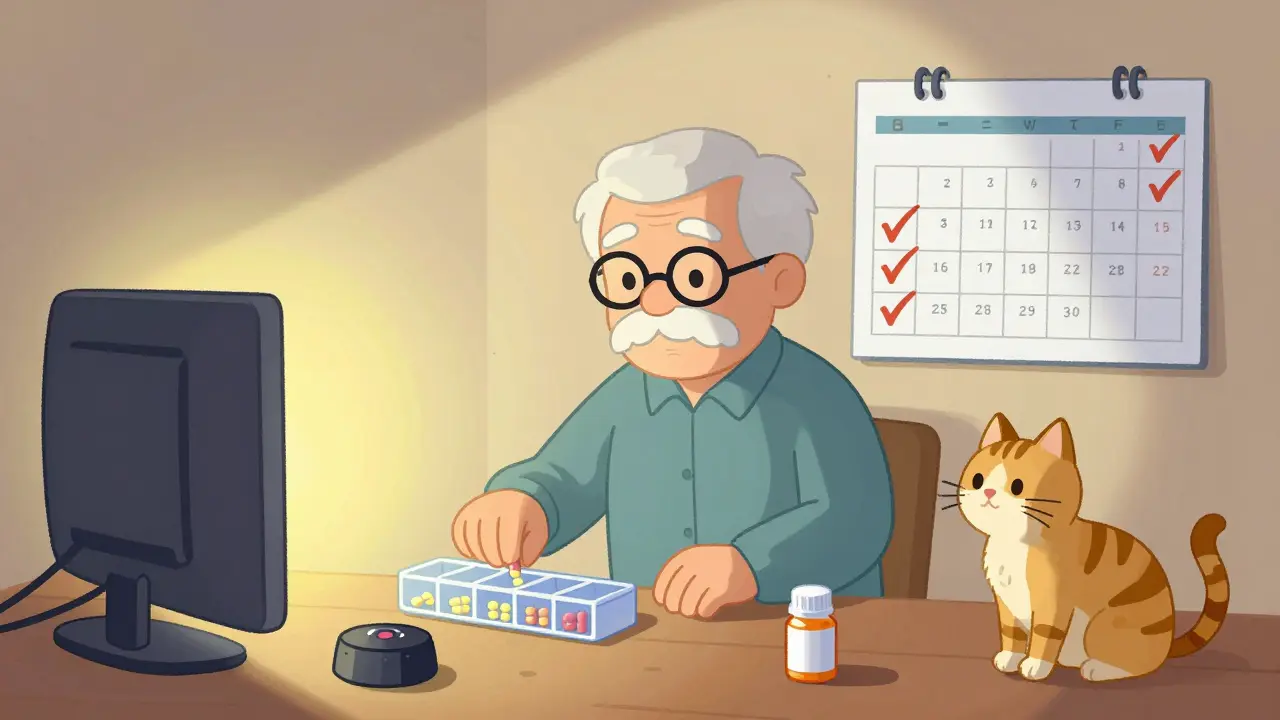
Seeing your wins builds momentum. A simple calendar on your fridge or bathroom mirror can be powerful. Mark each day you take your meds with a big checkmark or a sticker. The more you see your streak grow, the less likely you are to break it.A 2011 study in PMC found people who used check-off calendars reduced missed doses by 32%. That’s not a small gain-it’s life-changing for someone managing diabetes, high blood pressure, or heart failure. You don’t need an app. Just print a free monthly calendar from the internet and tape it up. Use a thick marker so it’s easy to see.
Some people even use a dry-erase board. Write your meds in a row across the top, and each day as a column. Put a big X in each box after you take them. It’s satisfying to wipe the board clean at the end of the week and see a full grid of X’s.
Simplify your regimen
If you’re taking five pills at four different times a day, it’s no wonder you’re overwhelmed. You don’t have to accept that. Talk to your doctor or pharmacist about simplifying your routine.Many medications can be switched to once-daily versions. Some can be combined into a single pill. One study found that reducing daily doses from four to one improved adherence by 40%. That’s not a minor tweak-it’s a game-changer.
Ask: “Can any of these be taken together?” “Is there a longer-acting version?” “Can I switch from three pills a day to two?” Don’t assume it’s not possible. Pharmacists are trained to spot these opportunities. In fact, 30-50% of patients on complex regimens can reduce their daily pill count with simple changes.
Plan for disruptions
Travel, holidays, illness, or a change in schedule can throw off your routine. That’s normal. The goal isn’t to never miss a dose-it’s to bounce back quickly.When you’re traveling, pack extra pills in your carry-on. Use a small pill organizer for trips. Keep a list of your meds and doses in your phone and wallet. If you miss a dose, don’t panic. Check your medication guide or call your pharmacist. Never double up unless they say it’s safe.
For weekends or holidays when your pharmacy is closed, ask for a 7-day supply ahead of time. Most pharmacies will give you a small extra pack. It’s a simple fix that prevents big problems.
Know why you’re taking each pill
People who understand their meds are more likely to take them. If you don’t know why you’re taking that blue pill, you’re more likely to skip it when you feel fine.Ask your doctor: “What does this medicine do?” “What happens if I don’t take it?” “What side effects should I watch for?” Write the answers down. Keep them in your pill organizer or phone notes.
For example: “This blood pressure pill keeps my heart from working too hard. If I skip it, my pressure goes up, and I risk a stroke.” That kind of clarity makes it harder to ignore your meds.

Don’t let side effects stop you
Many people stop taking meds because of side effects-dry mouth, dizziness, stomach upset. But they don’t tell their doctor. They assume it’s normal or they’re being dramatic.That’s a mistake. Side effects can often be managed. Maybe your pill can be taken with food. Maybe the dose can be lowered. Maybe a different brand works better. One study found 49% of missed doses were intentional-because patients felt worse taking the pill than they did without it.
Don’t suffer in silence. Talk to your pharmacist. They’ve heard it all. There’s almost always a solution.
Get help from someone you trust
You don’t have to do this alone. A buddy system works. Find a family member, friend, or neighbor who’s willing to check in. Not to nag-to support. A quick text: “Did you take your pills today?” can make a huge difference.ProMedica found this method works 58% of the time. But it only works if the person is consistent. If your buddy goes on vacation or gets busy, your adherence drops by 30%. So make it part of your relationship, not a chore.
Some people pair up with others who take similar meds. Join a local support group or online forum. Reddit’s r/ChronicIllness has thousands of people sharing tips. One user said filling her pill organizer every Friday night became her ritual-and cut her missed doses from 30% to under 5%.
What doesn’t work
Relying on memory. Setting alarms you ignore. Waiting until you feel sick to take your meds. Skipping doses because you feel fine. Assuming a “broken” pill is still safe. Taking someone else’s medicine. These are common mistakes-and they’re dangerous.Also avoid overcomplicating things. You don’t need five apps, a smart fridge, and a wearable tracker. Start simple. Master one thing. Then add another.
Your routine doesn’t have to be perfect. It just has to be yours.
There’s no single right way to take your meds. What works for your neighbor might not work for you. The goal isn’t to follow someone else’s system. It’s to build one that fits your life.Try one change this week. Pair your pill with brushing your teeth. Fill out your pill organizer on Friday. Set one alarm. That’s enough. If it sticks, add another next week. Slow progress beats rushed perfection.
Medication adherence isn’t about discipline. It’s about design. When your routine matches your life, taking your pills stops being a burden-and starts being part of how you stay well.
What if I forget to take my medication?
Don’t panic. Check your medication guide or call your pharmacist. For most pills, if you remember within a few hours of your usual time, take it right away. If it’s close to your next dose, skip the missed one and go back to your schedule. Never double up unless your provider says it’s safe. Keep a small log of missed doses so you can spot patterns.
Can I crush my pills or open capsules to make them easier to swallow?
Only if your pharmacist says yes. Some pills are designed to release slowly. Crushing them can cause too much medicine to enter your system at once. Others have coatings to protect your stomach. Always ask before changing how you take a pill. If swallowing is hard, ask about liquid versions or smaller tablets.
How do I know if my pill organizer is working?
Check your pill box weekly. If compartments are consistently empty or full when they shouldn’t be, your routine isn’t working. Also track how many doses you miss over a month. If you’re missing fewer than 2-3 doses a month, you’re doing well. If you’re missing more than five, try switching to a different method-like pairing meds with a different habit or adding an alarm.
Why do I still forget even with reminders?
Reminders help, but they don’t fix a broken routine. If you’re still forgetting, your trigger isn’t strong enough. Maybe you’re setting the alarm too early, or your pill organizer is hidden. Try linking your dose to a stronger habit-like eating breakfast or turning off the lights. Also, make sure you’re not overwhelmed. If you have too many meds, talk to your doctor about simplifying.
Is it okay to skip a dose if I feel fine?
No. Many medications, like those for blood pressure, diabetes, or heart conditions, work even when you feel fine. Skipping doses lets your condition creep back. You might not feel symptoms right away, but damage can build up over time. Always take your meds as prescribed, even when you’re feeling great.
What’s the best time of day to fill my pill organizer?
Friday evening is the most popular and practical time. It gives you the weekend to prepare, and you’re less likely to be rushed. Plus, most pharmacies are open Friday, so you can pick up refills. If Friday doesn’t work for you, pick another consistent day-like Sunday morning. The key is making it a fixed ritual, not a last-minute task.
Mussin Machhour
Just started tying my pills to brushing my teeth-no alarms, no apps-and I haven’t missed one in two weeks. It’s stupid simple but it works. My brain now thinks ‘brush teeth’ = ‘take meds.’ No more panic on Sunday mornings.
Also, Friday night pill organizer fill? Absolute game changer. I even put a little sticker on mine that says ‘I’m still here because I did this.’
Winni Victor
Ugh. All this ‘just tie it to brushing your teeth’ nonsense. Like everyone’s got a fucking routine. I’m on 11 pills at 5 different times, my cat knocks over my organizer, and my phone dies before the alarm goes off. You’re telling me to ‘just do it’ like I’m some kind of wellness influencer? Spare me.
Also, who the hell has time to ‘fill a pill box Friday night’? I’m working two jobs and sleeping in my car.
Maybe your meds don’t make you puke and shake. Mine do. So yeah, I skip sometimes. Guess I’m just lazy and dramatic. Cool.
Lindsay Hensel
Your honesty is both brave and necessary.
Many of us are not in a position to follow these suggestions. The assumption of stability-consistent housing, reliable electricity, access to pharmacies-is a luxury.
These systems are brilliant for those who can access them. But they are not universal truths. They are privileges dressed as advice.
Thank you for speaking up. Your experience matters more than any checklist.
Gary Hartung
Let’s be real: the ‘pill organizer’ advice is so 2012. I mean, really? Plastic compartments? In 2024? You’re telling me there isn’t a Bluetooth-enabled, AI-synchronized, voice-activated, biometrically verified, cloud-backed, blockchain-secured medication ecosystem? I’m not even surprised.
Also, ‘use a sticker’? Are we in kindergarten? I use a custom app that syncs with my smart fridge, my Fitbit, and my therapist’s portal. If you’re not using something like that, you’re not serious about your health.
And don’t even get me started on ‘Friday night.’ That’s a Tuesday evening ritual in my circle. And we use titanium organizers. With laser-engraved labels.
Just saying.
Ben Harris
People keep talking about pill organizers like they're some miracle cure but nobody ever says the real problem
It's the doctors who prescribe 12 pills at 4 different times and then act like you're the broken one when you can't keep up
They don't care about your life they just want to check a box
And then they act surprised when you stop taking half your meds
And then they say you're noncompliant
Well guess what I'm not noncompliant I'm just done being treated like a robot
And yeah I know I'm not supposed to say this but I'm not sorry
My body is not your lab
And your schedule is not my life
Oluwatosin Ayodele
Actually in Nigeria we have a different approach entirely
Most people don't even have pill organizers
We use the phone alarm but we also rely on community
Every morning at 7am someone from the neighborhood knocks on your door if you haven't taken your meds
It's called 'Omo Omo' system
It's not tech it's human
And it works better than any app
Also we use herbal teas to reduce side effects
Not all pills are meant to be taken alone
Western medicine ignores this
That's why adherence is low
You're treating symptoms not context
Jason Jasper
I tried the calendar method. Marked every day for three weeks. Felt good. Then I got sick. Missed four days. Felt like a failure.
Then I realized: I didn’t fail. My body needed rest. My meds didn’t vanish. I just paused.
It’s not about perfection. It’s about showing up when you can.
That’s the real trick.
Not the stickers. Not the alarms.
Just… being kind to yourself when things fall apart.
Carlos Narvaez
Using a dry-erase board? Cute.
But have you considered the cognitive load of maintaining a visual tracking system while managing comorbidities, transportation, and employment?
Also, the 2011 study cited? Small sample size. No control for socioeconomic variables.
Real adherence requires systemic intervention-not individual behavioral hacks.
And yes, I’ve read the paper.
Just saying.
Harbans Singh
I’ve been helping my uncle in India manage his meds for years.
He takes 6 pills. We made a simple chart with pictures-sun for morning, moon for night, a little heart for his BP pill.
He can’t read English but he knows the pictures.
We hang it on the wall next to his chai pot.
Every morning, he sips his tea, looks at the chart, and takes his pills.
It’s not fancy.
But it’s his.
And that’s what matters.
Don’t overthink it. Just find the rhythm that fits your life.
Even if it’s just one small thing.
Justin James
Here’s the truth no one wants to admit-the whole medication adherence thing is a corporate scam
Big Pharma wants you dependent
They design pills to have side effects so you need more pills to fix the side effects
They pay doctors to overprescribe
They fund those ‘studies’ that say ‘use a pill organizer’ to make you feel guilty
But what if you don’t need the pills at all
What if your condition is caused by processed food and stress and poverty
And they’re just putting a bandaid on a bullet wound
And now you’re trapped in a cycle of pills alarms organizers and guilt
They don’t want you to heal
They want you to keep buying
And if you miss a dose
It’s your fault
Not theirs
Zabihullah Saleh
There’s something deeply human about ritual.
Not the performative kind-the quiet, repeated kind.
Like filling the pill box on Friday night.
Like turning off the light and saying, ‘I did what I could today.’
It’s not about discipline.
It’s about honoring your body, even when it’s tired.
Even when the world doesn’t care.
Even when you’re not sure if you’re getting better.
Showing up anyway-that’s the quiet rebellion.
That’s how we stay alive.
Not because we’re perfect.
But because we’re stubborn.
And maybe that’s enough.