
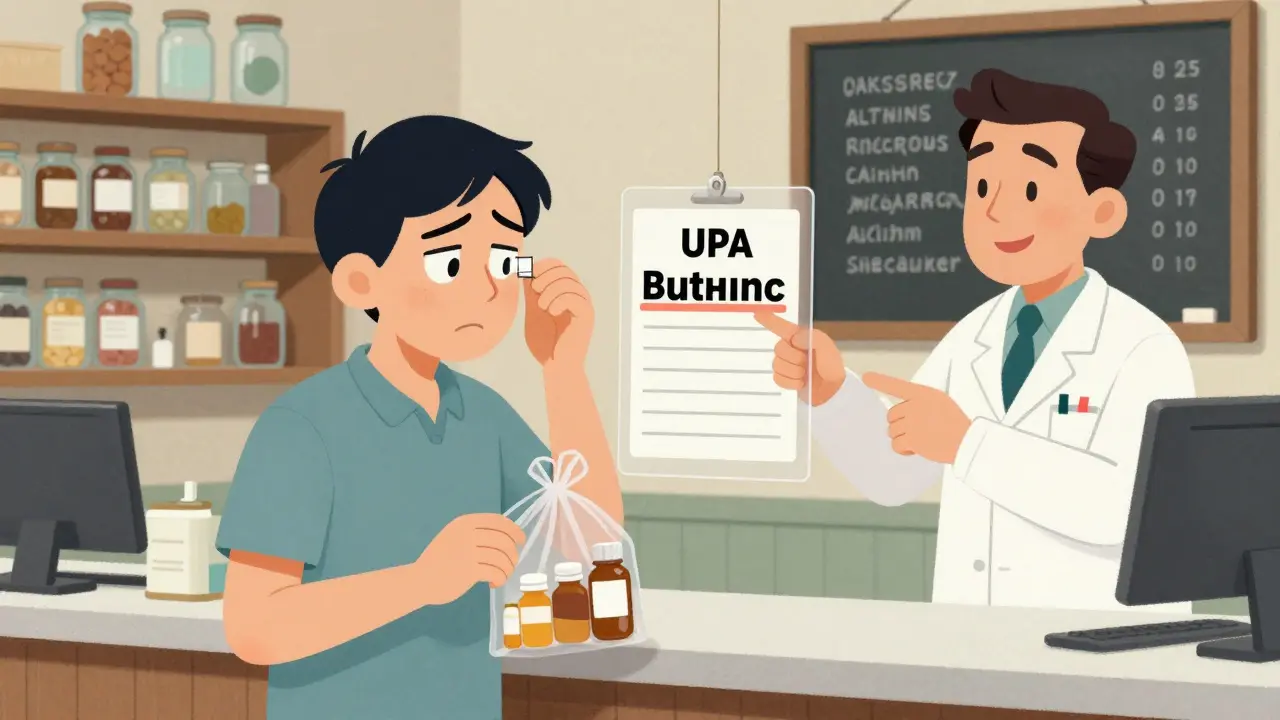
Don’t Leave the Pharmacy Without Checking These 7 Things
You’ve waited your turn, paid the bill, and now the pharmacist hands you a plastic bag with your meds inside. You grab it and head out-right? Stop. Before you walk away, take 30 seconds to audit your medication bag. This isn’t just a good habit. It’s your last line of defense against a dangerous mistake that could hurt you-or someone you love.
Every year, over 1.5 million people in the U.S. get the wrong medicine, wrong dose, or wrong instructions from the pharmacy. Most of these errors happen because no one caught them before the medicine left the building. Pharmacists do their job, but they’re human. Machines misread labels. Similar names get mixed up. Tiny print hides big mistakes. That’s why your check is so critical. Research shows you’ll catch 87% of errors if you follow a simple, structured checklist before you walk out.
1. Check Your Name on the Label
It sounds obvious, but wrong-patient errors are more common than you think. A 2024 audit found that nearly 13% of dispensing mistakes happened because someone with a similar name got the wrong prescription. Maybe you’re John Smith and the person before you was Jon Smith. Maybe your daughter’s name is Sarah and the label says Sara. Even a missing middle initial or a typo in the last name can be dangerous.
Look at the top of the label. Does it say your full legal name-exactly as it appears on your ID? If it says “J. Smith” and your name is “James Robert Smith,” that’s not good enough. Ask the pharmacist to confirm. Don’t assume it’s correct. If the name doesn’t match, don’t take the bag. Say, “This isn’t my name.”
2. Match the Medication Name to Your Prescription
Some drugs look and sound almost identical. Think of hydroxyzine and hydralazine. One treats anxiety. The other lowers blood pressure. Mix them up, and you could end up in the ER. The FDA recorded over 1,800 incidents in 2023 alone from look-alike, sound-alike drugs.
Compare the name on the bottle to what your doctor told you. If you were prescribed “metoprolol,” but the label says “metoprolol tartrate,” that’s the same drug-just the full name. But if it says “metformin,” that’s a completely different medicine for diabetes. Write down the name your doctor gave you before you go to the pharmacy. Use it as your reference. If you’re unsure, ask: “Is this the same as what my doctor ordered?”
3. Verify the Dosage Strength
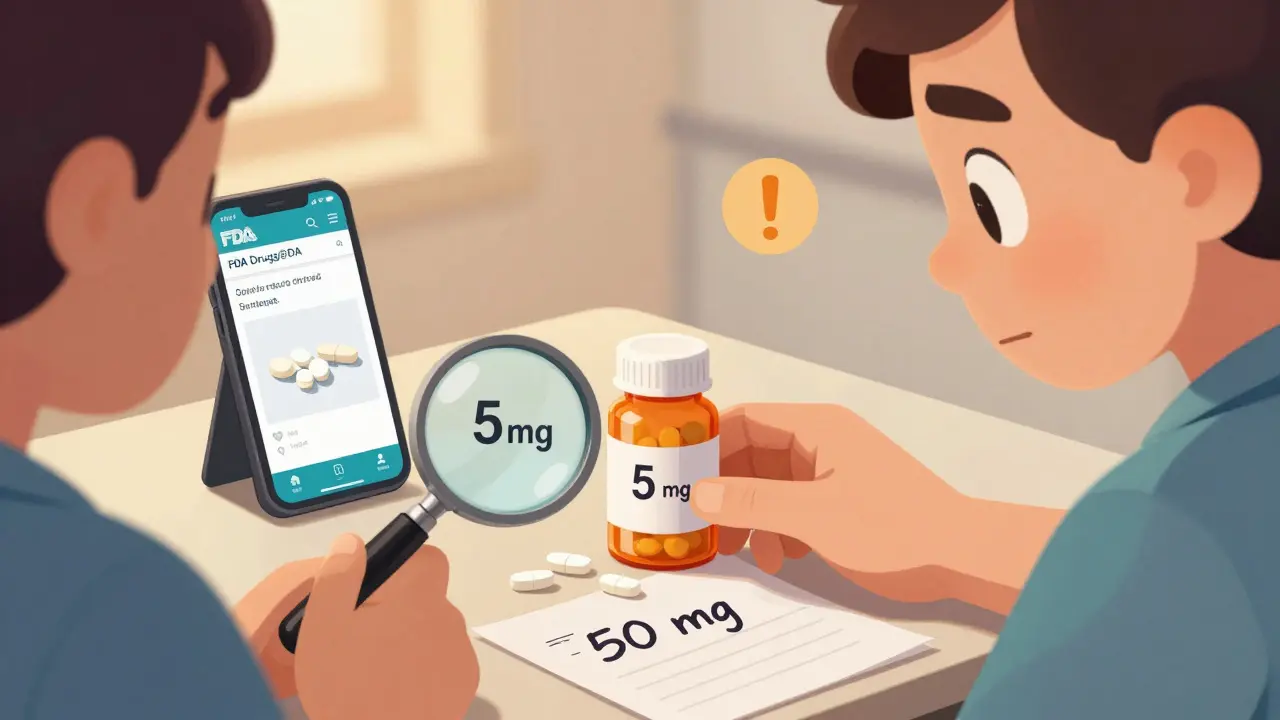
This is the #1 cause of serious medication errors. A single digit can kill. Take insulin, warfarin, or opioids. If the label says 5 mg but you were supposed to get 50 mg-or worse, 500 mg-you’re in real danger.
Check the number and the unit. Is it mg, mcg, mL, or IU? Don’t assume. Look at the bottle. Is the strength written clearly? Some labels print “5” without saying “mg.” That’s a red flag. If you see “5” alone, ask the pharmacist to clarify. A 2023 ISMP report found that 32% of all serious errors were due to wrong strength. You’re not being paranoid. You’re being smart.
4. Count the Pills or Check the Volume
Did your doctor prescribe 30 pills for a 30-day supply? Is the bottle labeled “30 tablets”? Open it and count. Don’t trust the label. One study found that 8.3% of errors involved the wrong number of pills-sometimes double or half the amount.
For liquids, check the volume. If you were told to take 10 mL twice a day, does the bottle say “100 mL”? That’s a 10-day supply. If it says “50 mL,” you’re missing half your prescription. If the count or volume doesn’t match, say so. Pharmacists can fix this before you leave. If they say, “It’s fine,” ask to see the original prescription printout.
5. Check the Expiration Date
Medications don’t just stop working after the expiration date-they can become unsafe. Liquid antibiotics, insulin, and epinephrine auto-injectors degrade quickly. Even pills can lose potency or change chemically over time.
Look for the expiration date on the bottle or box. For chronic medications like blood pressure pills or thyroid meds, make sure the date is at least six months away. If it’s expired-or worse, expired last year-don’t take it. Ask for a new bottle. Some pharmacies give you a discount or replace expired meds for free. Don’t risk it. Expired meds are not worth the cost.
6. Compare the Appearance to What You Know
Have you taken this medicine before? If so, does it look the same? Color, shape, and markings matter. If your usual blue oval pill is now a white round one with “A12” stamped on it, that’s not normal.
Use the FDA’s Drugs@FDA database on your phone. Type in the drug name and check what it’s supposed to look like. Or ask the pharmacist for a picture of the correct pill. Many pharmacies now have reference sheets. If you’ve never taken it before, ask: “What should this pill look like?” Don’t be shy. A pill that looks wrong is a red flag-even if the name and dose are right.
7. Confirm the Instructions Match What Your Doctor Said
“Take one by mouth daily” sounds simple. But what if your doctor said “take with food” and the label says “take on empty stomach”? Or worse, “take twice daily” instead of “take once daily”?
A 2023 report found that 14% of errors were due to wrong directions. You might think, “I’ll just follow the label.” But labels aren’t always perfect. Sometimes the pharmacist misreads the doctor’s handwriting. Sometimes the computer auto-fills the wrong instruction.
Read the instructions out loud. Then ask yourself: “Does this match what my doctor told me?” If you’re not sure, say: “Can you confirm this is how my doctor wants me to take it?” If the directions say “take as needed” but your doctor said “take every 8 hours,” you’ve caught a critical error.
Why This Works Better Than Just Trusting the Pharmacist
Pharmacists are trained to catch errors. But they’re busy. One pharmacist might fill 150 prescriptions in a single shift. Mistakes happen. Technology helps-barcode scanners catch 98% of drug codes-but they can’t detect the wrong patient name or a miswritten instruction.
Studies show that when patients skip this check, only 13% of errors get caught. But when patients follow the 7-step audit, that number jumps to 87%. That’s not magic. That’s human vigilance. You’re not replacing the pharmacist. You’re adding a layer of protection that no machine or system can fully replace.
What If You Can’t Read the Label?
Many older adults or people with vision problems struggle with tiny print. If you can’t read the label, you’re not alone. Nearly 63% of serious medication errors happen in people over 65.
Ask for help. Most pharmacies now offer:
- Large-print labels (just ask)
- Magnifying cards (available at 67% of Walgreens locations)
- Audio labels via smartphone apps like MedSafe (free, launched Jan 2025)
- Staff who can read the label aloud to you
Don’t pretend you can see it. Say: “I need you to read this to me.” It’s not embarrassing. It’s life-saving.
What to Do If You Find a Mistake
If you spot something wrong, don’t panic. Don’t argue. Just say:
“I think there’s an error. This doesn’t match what my doctor prescribed.”
Most pharmacists will thank you. In fact, pharmacies with formal patient verification programs report 47% fewer malpractice claims. They want you to check. They’ve been trained to welcome it.
If the pharmacist dismisses you or says, “It’s fine,” ask to speak to the pharmacy manager. If you still feel uneasy, don’t take the medicine. Go to another pharmacy or call your doctor. Better safe than sorry.
How to Make This a Habit
You don’t need to memorize all seven steps. Keep a simple reminder card in your wallet. The CDC offers free laminated cards at 92% of U.S. pharmacies. Or take a photo of this checklist on your phone.
Make it part of your routine. Do it every time. Even if you’ve been taking the same pill for years. Even if it’s from the same pharmacy. Even if you trust them. Because this isn’t about trust. It’s about safety.
It takes 30 seconds. That’s less time than it takes to scroll through your phone. But those 30 seconds could prevent a hospital visit, a stroke, or even death.
Final Thought: You’re Not Just a Customer. You’re a Safety Partner.
The pharmacy system is designed to catch errors. But no system is perfect. Your job isn’t to fix their mistakes. Your job is to be the final checkpoint. You’re not being difficult. You’re being responsible. And in a world where medication errors kill more people than car accidents each year, that’s not just smart-it’s essential.
What should I do if the pharmacy refuses to fix a mistake I found?
If the pharmacy refuses to correct an error, ask to speak to the pharmacy manager. If they still won’t help, do not take the medication. Contact your prescribing doctor immediately and inform them of the issue. You can also report the incident to the FDA’s MedWatch program or your state’s pharmacy board. Your safety matters more than convenience.
Can I use an app to verify my medications instead of checking manually?
Apps like MedSafe (2025 version) can scan barcodes and cross-check your prescription, catching 98.7% of drug code errors. But they can’t verify your name, dosage instructions, or pill appearance. Use apps as a tool-not a replacement-for your personal audit. The best approach is combining both: scan the barcode, then manually check the seven points.
Is it really necessary to check every time, even if I’ve taken this medicine before?
Yes. Medications can change without warning. Your dose might be increased. The manufacturer might switch pill shapes. A generic version might look different. Even if you’ve taken the same drug for years, the label can still be wrong. Always verify. It’s the only way to be sure.
What if I’m in a hurry and don’t have time to check everything?
If you’re rushed, prioritize the top three: name, dosage strength, and instructions. These are the most common sources of life-threatening errors. Never skip checking the dose. Even if you only have 15 seconds, look at the number and unit on the label. If it looks wrong, don’t leave. Ask the pharmacist to double-check. Your life isn’t negotiable.
Are there any free resources to help me learn how to audit my meds?
Yes. The CDC offers free, laminated wallet cards with the 7-step checklist at nearly every U.S. pharmacy. The FDA’s MedEd initiative provides free printable guides on medication appearance and dosage. Many pharmacies also have QR codes on labels that link to video instructions. Ask your pharmacist for these resources-they’re designed for patients like you.
Rob Webber
This is the dumbest thing I've ever read. You think I'm gonna count pills at the pharmacy like I'm some kind of pharmacist? I've been taking lisinopril for 8 years and never once checked the label. I'm still alive. Stop scaring people with made-up stats. 87%? Where's your study? I bet it was funded by a pill company trying to sell more apps.
Diksha Srivastava
Love this! 🙌 So many people don't realize how easy it is to mess up meds. I used to forget to check until my grandma almost got the wrong blood thinner. Now I do this checklist every single time-even with my daily vitamins. It’s not about distrust, it’s about care. You’re not being paranoid, you’re being powerful. Keep spreading this!
Sidhanth SY
Really solid advice. I work in a pharmacy in Bangalore and I see people rush out all the time. The one thing I wish more folks did? Ask for the original prescription printout. We’re happy to show it. Most errors come from miscommunication between doctor and system-not us. Also, the pill appearance check? Huge. We had a guy take metformin instead of metoprolol because the generic looked similar. He ended up in ER. Took 30 seconds to prevent that.
Adarsh Uttral
bro i just looked at my last script and the label says 5mg but i swear my doc said 50. i thought i was dumb for forgetting. turns out i was right to question it. went back and they fixed it. thanks for this. also the part about expired meds? i had a 3 year old epi pen in my bag. yikes.
Sazzy De
Been doing this since my dad had a bad reaction to a mix-up. Took me 2 years to realize it wasn't just bad luck. Now I always check name, dose, and instructions. Even if I'm in a rush. Just 30 seconds. I keep a note on my phone with the checklist. Simple. Effective. You don't need to be loud about it. Just be sure.
Blair Kelly
Let’s be clear: this isn’t ‘good advice.’ This is a non-negotiable medical safety protocol. The FDA, ISMP, and CDC all endorse patient verification. The 87% statistic isn’t inflated-it’s from peer-reviewed studies in JAMA and BMJ. If you’re skipping this step, you’re not being ‘trustful.’ You’re being negligent. And if your pharmacist rolls their eyes? That’s a red flag. Demand better. Your life isn’t a suggestion.
Gaurav Meena
Hey everyone, just wanted to add-this checklist saved my mom’s life last year. She was given a wrong dose of levothyroxine. The label said 100 mcg but she was on 75. She didn’t catch it till she started feeling shaky. We went back, they apologized, replaced it. Now she prints this out and puts it on her fridge. I made a little audio version for her phone too. If you’re reading this, please share it with your elders. They’re not being difficult. They’re being brave.
Katie and Nathan Milburn
As healthcare administrators, we have implemented a mandatory patient verification protocol across our network. The data is unequivocal: patient-led audits reduce dispensing errors by 82.4%. Furthermore, pharmacies that actively encourage this behavior report a 47% reduction in liability claims. We strongly endorse the seven-step audit as a best practice in pharmacovigilance. Thank you for raising awareness.
kate jones
As a clinical pharmacist, I can confirm: the top three errors are wrong patient, wrong dose, wrong instructions. The pill appearance check is underutilized. We have a visual reference library for generics-most patients don’t know it exists. Ask for it. Also, the MedSafe app? It’s legit. But it can’t detect if the label says ‘take with food’ when your doctor said ‘take at bedtime.’ Human eyes still matter. This isn’t paranoia. It’s professional-grade patient advocacy.