
What is Paragraph IV and why does it matter?
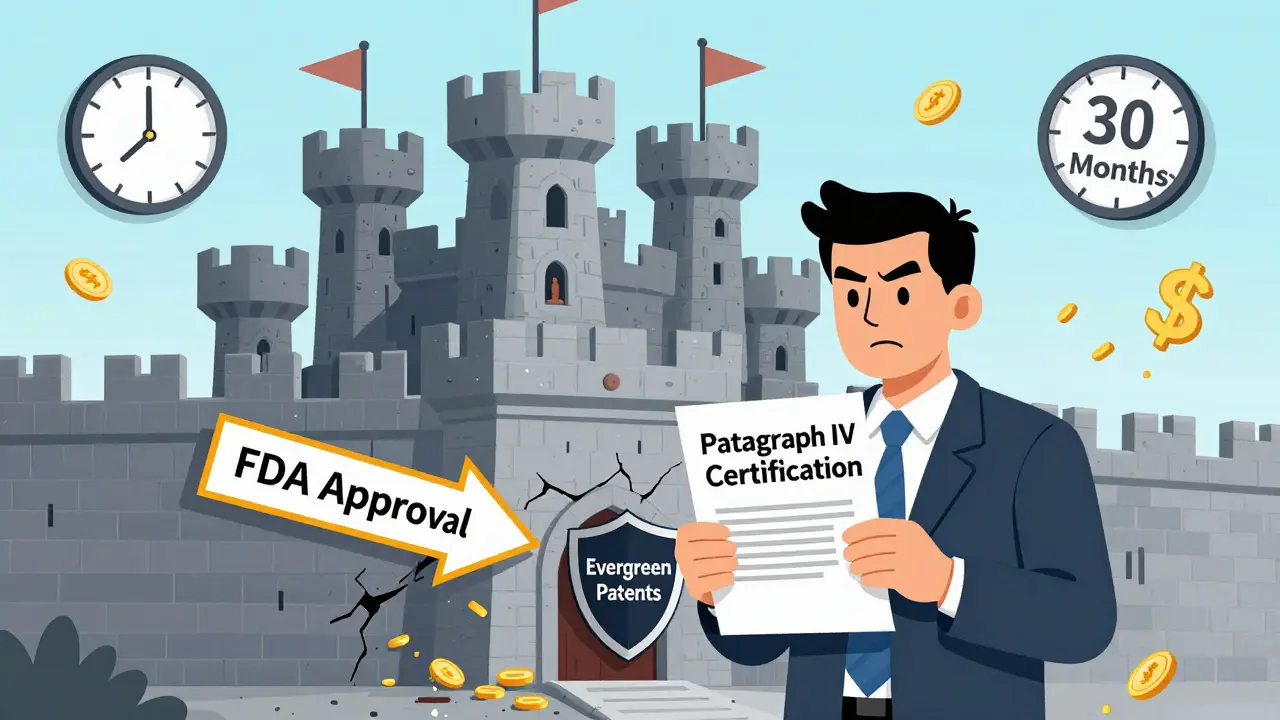
Paragraph IV isn’t a law, a drug, or a government agency. It’s a legal shortcut-built into U.S. drug policy-that lets generic drug makers challenge patents on brand-name medicines and get to market faster. This single clause in the Hatch-Waxman Act of 1984 changed how Americans access affordable medications. Before it existed, generic companies had to wait until every patent expired, even if those patents were weak, vague, or just extensions of the original. Now, if a generic manufacturer believes a patent is invalid or won’t be infringed, they can file a Paragraph IV certification with their application to the FDA. That triggers a legal showdown with the brand-name company. If the generic wins, the drug becomes available months or years earlier than it otherwise would.
The Hatch-Waxman Act: A deal between innovation and affordability
The Hatch-Waxman Act wasn’t written in a vacuum. It was a compromise. On one side, big pharmaceutical companies wanted to protect their research investments-patents that could take over a decade and billions of dollars to develop. On the other, lawmakers and consumer advocates wanted to make sure people weren’t stuck paying high prices forever. The solution? Give brand companies extra patent life to make up for time lost during FDA approval, but give generic makers a legal tool to challenge weak patents upfront. That tool is Paragraph IV. It’s not about breaking patents-it’s about testing them. If a patent holds up, the generic stays out. If it doesn’t, the market opens. The goal was balance. But over time, the system got twisted.
How a Paragraph IV challenge actually works
Here’s the step-by-step reality:
- A generic company picks a brand-name drug listed in the FDA’s Orange Book-a public directory of approved drugs and their patents.
- They review every patent tied to that drug. Some cover the active ingredient. Others cover how it’s made, how it’s taken, or even the shape of the pill. The goal is to find the weakest one.
- They file an Abbreviated New Drug Application (ANDA) with the FDA and include a Paragraph IV certification. This isn’t just a statement. It’s a legal document that must explain, in detail, why the patent is invalid or won’t be infringed. Vague claims get rejected.
- The brand company gets a notice. They have exactly 45 days to sue for patent infringement. If they do, the FDA can’t approve the generic for 30 months-or until the court rules, whichever comes first.
- Meanwhile, both sides go to court. Lawyers argue over patent claims. Experts testify on chemistry, manufacturing, and prior art. The judge holds a Markman hearing to define what the patent actually protects. This often decides the case.
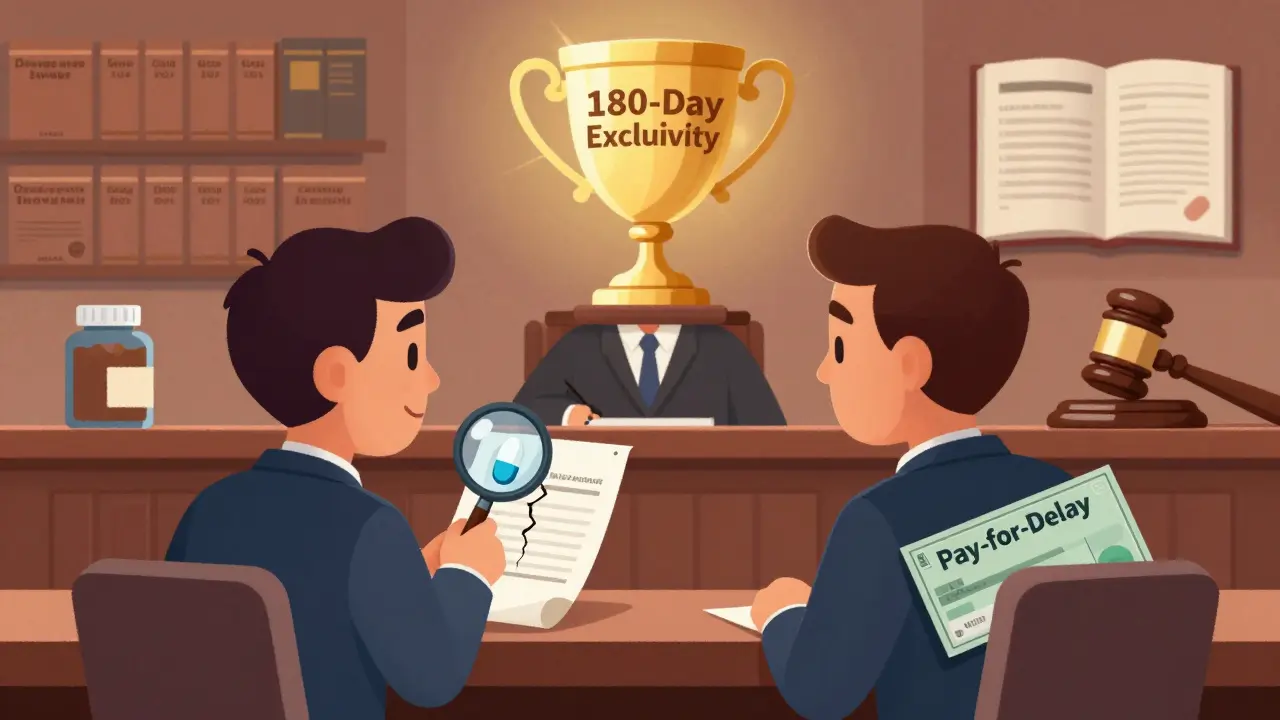
- If the generic wins, the FDA approves it immediately. The first company to file gets 180 days of exclusive rights to sell the generic, no other generics allowed. That’s worth billions.
Why the 180-day exclusivity is a game-changer
That 180-day window isn’t a bonus-it’s the whole reason generic companies risk millions on litigation. When Barr Labs beat Eli Lilly’s patent on Prozac in 2000, they became the only seller of generic fluoxetine for six months. During that time, they captured nearly 80% of the market. Other generics waited. When the exclusivity ended, prices dropped even further. That’s the power of the incentive. It’s why, according to the FTC, 87% of Paragraph IV filers aim to be first. But it’s also why companies sometimes collude. Brand companies have paid generics not to enter the market-so-called “pay-for-delay” deals. The Supreme Court outlawed these in 2013, but they still happen in disguised forms.
Who wins? Who loses? The real cost of litigation
Generic manufacturers spend an average of $7.8 million on Paragraph IV litigation. Brand companies spend just as much defending. The average case lasts almost 29 months. That’s a lot of money for a process that ends in settlement 76% of the time. Most cases never go to trial. But when they do, the stakes are high. Mylan lost a case against Novartis over Gleevec and was hit with a $1.1 billion damages award for willful infringement. That’s not just a fine-it’s a warning. Meanwhile, the public wins when generics enter. A 2019 study found that after a successful Paragraph IV challenge, drug prices drop by 79% within six months. Between 2009 and 2019, these challenges saved U.S. consumers $1.68 trillion.
Why some patents survive-and others don’t
Not all patents are created equal. The strongest ones are for the actual chemical compound-the “composition of matter.” These are hard to challenge. But many patents listed in the Orange Book now cover things like pill coatings, dosing schedules, or methods of use. These are called “secondary patents.” Teva successfully challenged Pfizer’s Lyrica patent because it covered a method of treating nerve pain with a specific dose-something prior art already suggested. But AbbVie’s Humira patents held up for years because they were tied to complex formulation changes. Today, the average drug has nearly five patents listed. In 1984, it was one. This “patent thicket” strategy is designed to overwhelm generics. It works. The average market exclusivity for new drugs has stretched from 12.1 years in 1995 to 14.7 years in 2022.
What’s changing now?
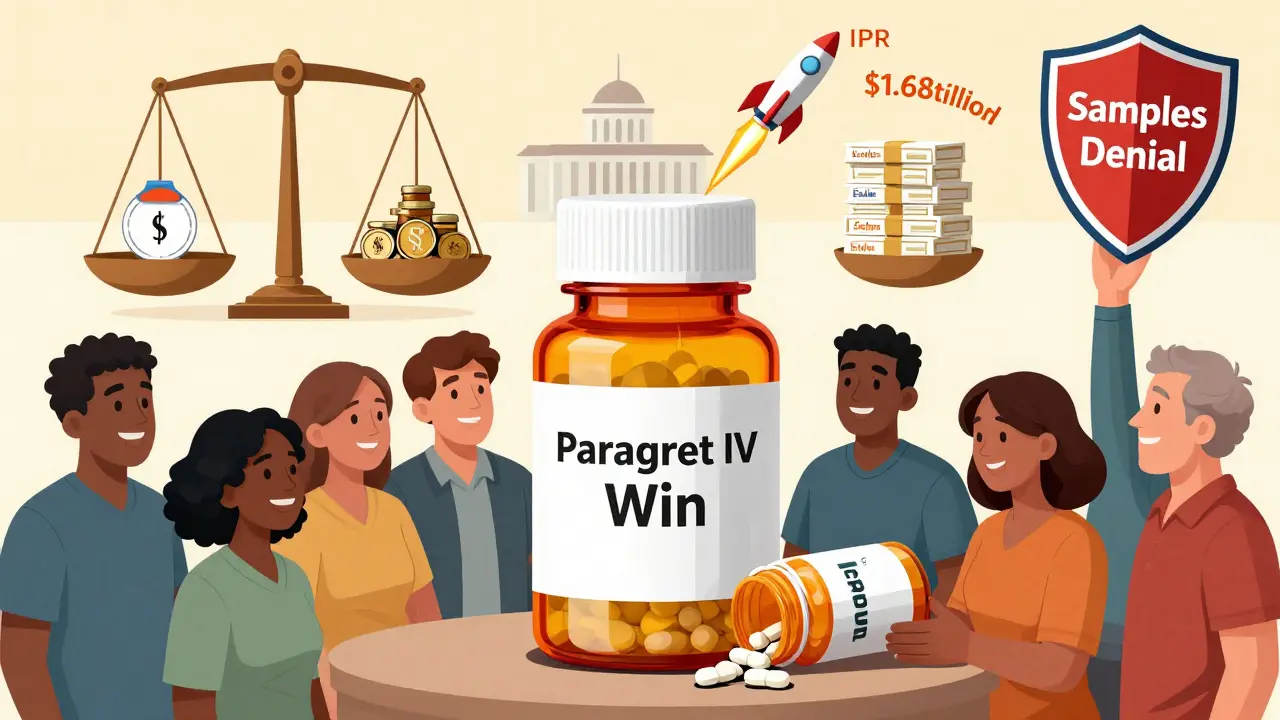
The system is under pressure. The FDA now requires Paragraph IV filers to address every Orange Book patent, not just the main one. That makes filings more complex and expensive. The 2023 CREATES Act helps generics get the samples they need to test their products-something brand companies used to withhold. The Inflation Reduction Act lets Medicare negotiate drug prices, which changes how brand companies think about generic competition. And the FTC is pushing for reforms to stop the flood of weak patents. Meanwhile, generic companies are starting to team up with the USPTO, filing Inter Partes Review (IPR) petitions alongside their court cases. It’s a two-front strategy: challenge the patent in court and at the patent office. It’s expensive, but it’s working. In 2022, coordinated filings jumped 47% year over year.
How does this compare to other countries?
The U.S. is unique. In Europe, there’s no Paragraph IV equivalent. Generic makers can’t challenge patents before approval. They have to wait until the patent expires-or get sued after they launch. That means generics enter later, and prices stay high longer. The OECD found that U.S. generics reach the market an average of 18 months faster than in Europe. That’s not just a regulatory difference-it’s a health difference. Millions of Americans rely on these faster entries to afford insulin, blood pressure meds, or cancer drugs.
What’s next for Paragraph IV?
The system is still functional-but it’s strained. Patent thickets, delayed approvals, and legal games have made it harder for generics to win. But the core idea remains powerful: if a patent is weak, it shouldn’t block affordable medicine. Congress has the power to fix it. Proposals to cap the number of patents per drug, shorten the 30-month stay, or limit evergreening are already on the table. For now, the battle continues in courtrooms, FDA offices, and corporate boardrooms. But one thing is clear: without Paragraph IV, millions of Americans would still be paying full price for drugs that could be generic today.
What is a Paragraph IV certification?
A Paragraph IV certification is a legal statement filed by a generic drug manufacturer with its Abbreviated New Drug Application (ANDA). It claims that one or more patents listed for the brand-name drug in the FDA’s Orange Book are either invalid, unenforceable, or will not be infringed by the generic version. This triggers a 45-day window for the brand company to sue for patent infringement.
What happens after a Paragraph IV notice is filed?
Once the brand-name company receives the notice, they have 45 days to file a patent infringement lawsuit in federal court. If they do, the FDA is automatically blocked from approving the generic drug for up to 30 months-or until the court rules in favor of the generic company. This is called a regulatory stay. During this time, both sides prepare for trial, exchange evidence, and often negotiate a settlement.
Why is the 180-day exclusivity period so important?
The first generic company to successfully challenge a patent under Paragraph IV gets 180 days of exclusive rights to sell its version of the drug. No other generic can enter during that time. This creates a huge financial incentive-during those 180 days, the first filer can capture 70-80% of the generic market. This single reward has driven most Paragraph IV challenges since the 1980s.
What’s the difference between Paragraph IV and IPR?
Paragraph IV challenges happen in federal district court and are tied to FDA approval. IPR (Inter Partes Review) happens at the U.S. Patent Office and is a faster, cheaper way to challenge patents-but it doesn’t directly affect FDA approval. Many generic companies now use both: they file an IPR to weaken the patent and a Paragraph IV to force the FDA to act. IPR has a higher burden of proof (clear and convincing evidence) than court cases (preponderance of evidence), but costs about $2.1 million versus $7.8 million for Paragraph IV litigation.
Can brand companies delay generic entry without litigation?
Yes. Brand companies have used tactics like filing citizen petitions with the FDA to delay approval, refusing to provide drug samples for testing, or listing dozens of weak secondary patents in the Orange Book. The 2023 CREATES Act now makes it harder to block sample access, and the FDA has tightened rules on citizen petitions. But these delays still happen, especially with complex drugs like biologics.
How do Paragraph IV challenges affect drug prices?
When a generic enters after a successful Paragraph IV challenge, prices typically drop by 79% within six months. The first generic often sells at 20-30% of the brand’s price. After the 180-day exclusivity ends, more generics enter and prices fall further-sometimes below 10% of the original cost. Between 2009 and 2019, these challenges saved U.S. consumers $1.68 trillion.