
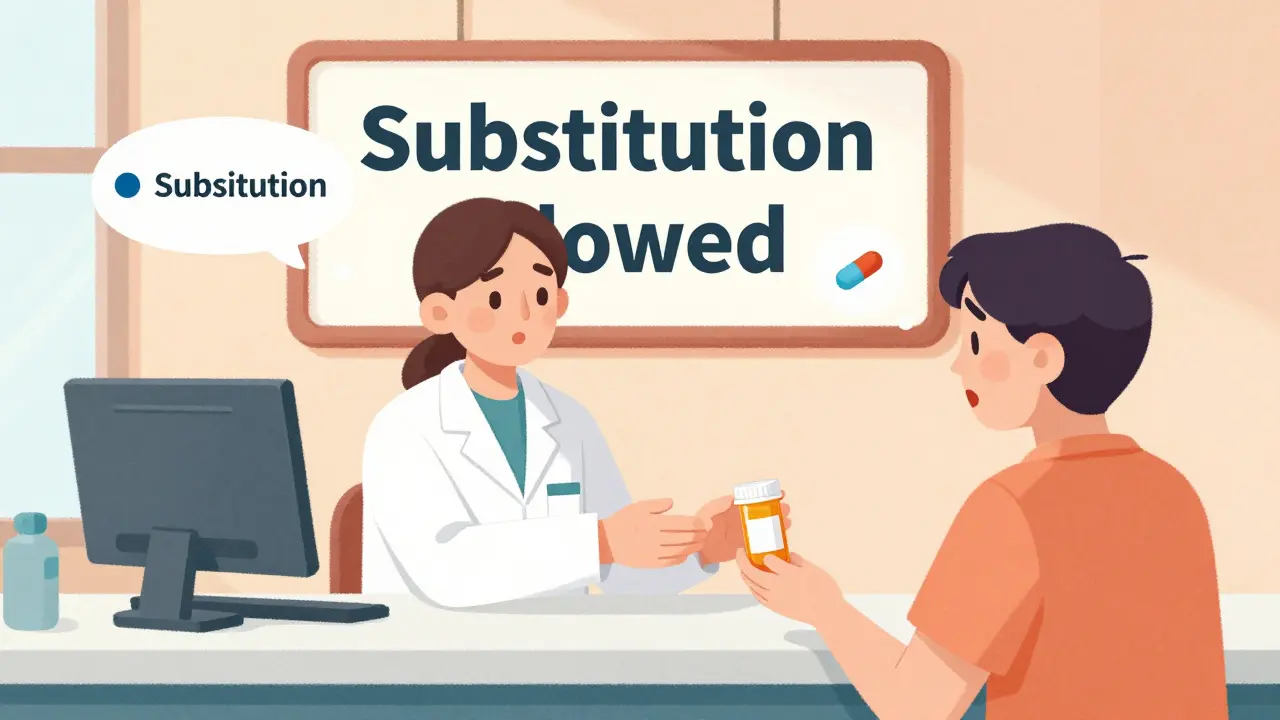
When you pick up a prescription, you might not realize that the pill in your bottle could be different from what your doctor wrote on the script. That’s because of generic substitution laws - rules that vary by state and determine whether a pharmacist can swap your brand-name drug for a cheaper generic version. These laws exist in all 50 states and Washington, D.C., but they don’t all work the same way. Some states force pharmacists to substitute, others leave it up to them, and a few require your explicit permission before making any change. Understanding how these laws operate can help you avoid confusion, save money, and stay in control of your treatment.
What Exactly Is Generic Substitution?
Generic substitution means replacing a brand-name drug with a chemically identical version that has the same active ingredient, dosage, strength, and route of administration. The FDA approves these generics after proving they work the same way in the body. The key tool for this is the Orange Book, a public database maintained by the FDA that rates drugs for therapeutic equivalence. If a generic is rated "A," it’s considered interchangeable with the brand. But even if a generic is FDA-approved, state laws still control whether a pharmacist can swap it in.
Before the 1980s, most states had "anti-substitution" laws that forced pharmacists to give exactly what the doctor prescribed - even if a cheaper generic was available. That changed when Louisiana passed the first modern substitution law in 1980. Since then, every state has adopted its own version, driven by the goal of lowering drug costs. The FTC estimates that states with mandatory substitution laws see generic use rates 8-12 percentage points higher than states that leave it optional. That translates to $50-$150 saved per prescription annually for patients.
Mandatory vs. Permissive Substitution Laws
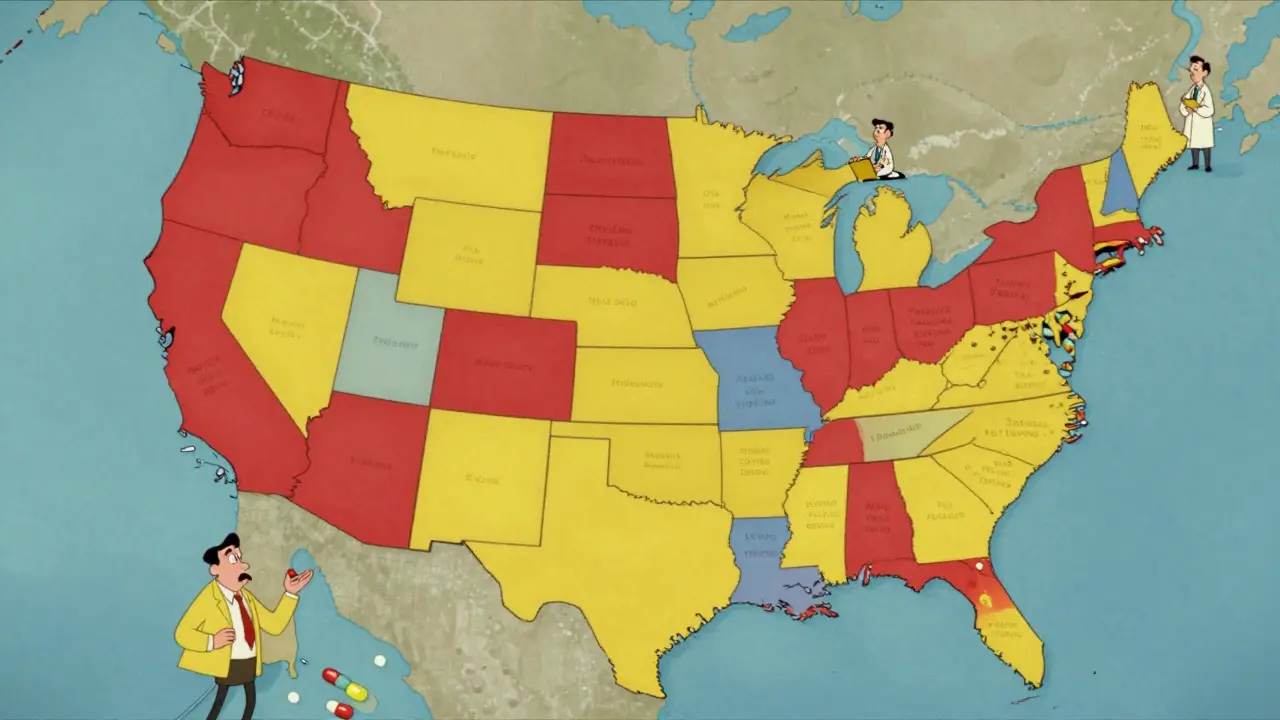
The biggest difference between states is whether substitution is required or allowed. As of 2023, 19 states - including California, New York, and Texas - have laws that say pharmacists shall substitute when a generic is available. In these states, unless the doctor writes "Do Not Substitute" or "Dispense as Written," the pharmacist must give the generic.
The other 31 states and Washington, D.C., allow substitution but don’t require it. Pharmacists in these places can choose whether to swap the drug, often based on pharmacy policy, patient preference, or their own judgment. Four of these states - Alaska, Delaware, Maine, and New Hampshire - require pharmacies to post signs telling patients substitution is possible. It sounds simple, but it adds another layer of complexity.
One surprising twist? Oklahoma is the only state that prohibits substitution unless the prescriber or the insurance company specifically allows it. This means even if the drug is FDA-approved for substitution, the pharmacist can’t switch it without written permission from the doctor or payer.
When Do You Need to Give Consent?
Some states go further than just letting pharmacists decide - they require your direct approval before any substitution happens. Seven states plus Washington, D.C., require explicit patient consent: Connecticut, Hawaii, Maine, Maryland, New Hampshire, Vermont, and West Virginia.
In Hawaii, for example, substitution of antiepileptic drugs is banned unless both the doctor and the patient give written consent. That’s because these drugs have a narrow therapeutic index - meaning even small changes in blood levels can cause seizures or toxicity. Other states with similar concerns, like Kentucky, maintain a list of drugs that can’t be substituted at all, including warfarin and levothyroxine.
On the flip side, 31 states plus D.C. require pharmacists to notify you after substitution - usually by marking the prescription label or handing you a printed notice. But that doesn’t mean you can refuse. If you don’t notice the notice, you might not even realize your medication changed.
Liability and Legal Risks for Pharmacists
Pharmacists aren’t just following rules - they’re also protecting themselves. In 24 states, including Alabama, Arizona, Illinois, Massachusetts, Missouri, Nebraska, New Mexico, Oregon, and Rhode Island, there are no clear legal protections for pharmacists who substitute generics. That means if a patient has a bad reaction, the pharmacist could be sued, even if they followed FDA guidelines.
This fear has real consequences. A 2022 study in the American Journal of Managed Care found that in states without liability protections, generic use dropped by 12.7% compared to states with clear legal safeguards. Pharmacists in these areas often delay or avoid substitution, especially for high-risk drugs like blood thinners or seizure medications.
One Walgreens pharmacist in a Reddit AMA described the chaos of working across state lines: "I have to constantly check which state’s rules apply when filling prescriptions for patients who live near state borders - it’s a nightmare for workflow efficiency." Independent pharmacists spend 15-30 minutes a day just managing substitution paperwork, according to the National Community Pharmacists Association.
Biologics and Biosimilars: A New Layer of Complexity
It’s not just about pills anymore. Biologic drugs - like Humira, Enbrel, or insulin - are complex proteins made from living cells. Their cheaper versions are called biosimilars, and they’re not the same as regular generics. The FDA has a separate approval process for them, and substitution rules are even stricter.
Forty-five states have tighter rules for biosimilars than for regular generics. Nine states (including Alabama, Illinois, and Massachusetts) require patient notification for biosimilars but not for regular generics. Six states that require generic substitution (like Florida and Indiana) treat biosimilars as optional - meaning even if a generic is mandatory, the biosimilar can’t be swapped in without extra permission.
All 48 states plus D.C. require pharmacists to notify the prescribing doctor within 2-7 days after substituting a biosimilar. But a 2022 survey by the National Psoriasis Foundation found that 42% of patients didn’t even know their biologic had been switched. Many assumed their insurance just lowered the cost - not realizing the drug itself changed.
How This Affects You as a Patient
If you’re on a chronic medication - say, for high blood pressure, diabetes, or epilepsy - a switch to a generic might be seamless. But if you’re on a drug with a narrow therapeutic index, even a small change can be risky. You might not notice any difference, but your body might.
Here’s what you can do:
- Ask your pharmacist: "Is this a generic? Was it switched from my usual brand?"
- Check your prescription label. If it says "substitution made," you’re being notified.
- If you’re in a state that requires consent, say no if you’re unsure.
- Keep a list of your medications - including brand names - and share it with every provider.
- Don’t assume your insurance plan’s preferred drug is the best one for you.
Medicaid programs in 42 states have mandatory generic substitution with lower copays for generics. That’s why generic use in Medicaid is 89.3%, compared to 86.1% in private insurance. But that doesn’t mean you’re getting the best outcome - just the cheapest one.
What’s Changing in 2024?
The system is under pressure. The Congressional Budget Office estimates that without standardization, the U.S. will waste $4.7 billion annually by 2030 on unnecessary brand-name prescriptions. In response, 27 states are actively reviewing their substitution laws in 2023-2024.
Some are moving toward simplification. A 2023 study in Health Affairs found that states that eliminated patient consent requirements for most drugs saw generic use jump by 6.8 percentage points - and up to 11.2% in states that removed consent entirely.
The FDA’s 2022 update to the Orange Book added new "interchangeability" ratings for complex generics, prompting 18 states to re-evaluate their rules. Meanwhile, 12 states introduced the "State Harmonization of Generic Substitution Act" - a proposal to create uniform rules across state lines.
Electronic health record systems like Epic now have built-in "State Substitution Rules Engines" that auto-apply the correct rules based on pharmacy location. That’s helped cut substitution errors by 37%, according to Epic’s 2021 audit.
Final Takeaways
Generic substitution laws are not one-size-fits-all. They’re a patchwork of 51 different systems, each with its own rules, exceptions, and hidden traps. The goal is to save money - and it works. But at what cost? Confusion, delays, and sometimes, risk.
As a patient, you have more power than you think. You can ask questions. You can refuse a substitution. You can demand to know what’s in your bottle. And if you’re on a critical medication - especially one with a narrow therapeutic index - you should always know whether your drug has been switched.
The future of drug pricing depends on whether we can simplify these laws. Until then, knowing your state’s rules might just save you money - or even your health.
Can a pharmacist substitute my brand-name drug without telling me?
In most states, yes - but only if the law allows substitution and the doctor didn’t prohibit it. Thirty-one states plus Washington, D.C., require pharmacists to notify you after substitution, usually via a label or printed notice. But seven states plus D.C. require your explicit consent before any change. If you’re in one of those states and weren’t asked, the pharmacist broke the law.
Are generic drugs really as good as brand-name drugs?
For most medications, yes. The FDA requires generics to have the same active ingredient, strength, dosage form, and route of administration as the brand. They must also meet the same quality standards. The FDA’s Orange Book rates them for therapeutic equivalence - "A" means they’re interchangeable. But for drugs with a narrow therapeutic index - like warfarin, levothyroxine, or seizure meds - even tiny differences can matter. That’s why some states restrict substitution for these.
Why do some states ban substitution for certain drugs?
Drugs with a narrow therapeutic index have a very small window between an effective dose and a toxic one. Small differences in how a generic is absorbed can cause serious side effects - seizures, bleeding, or organ damage. States like Kentucky, Hawaii, and Massachusetts list these drugs as non-substitutable. Examples include antiepileptic drugs, blood thinners, and thyroid medications. The American Epilepsy Society supports these restrictions based on patient safety data.
What should I do if I notice my medication looks different?
Don’t assume it’s a mistake. Ask your pharmacist: "Is this a generic? Was this switched from my usual brand?" Check the label for terms like "substitution made" or "dispensed as generic." If you’re on a critical medication, especially one for epilepsy, heart disease, or mental health, don’t take it until you’re sure it’s safe. You have the right to refuse substitution and request the brand.
Can my doctor stop substitution from happening?
Yes. Every state allows prescribers to write "Do Not Substitute" or "Dispense as Written" on the prescription. This overrides state substitution laws. Some doctors do this routinely for high-risk medications. Others do it only if the patient has had a bad reaction in the past. If you’re unsure, ask your doctor whether they’ve placed this restriction on your prescriptions.
Bryan Woody
So let me get this straight - we’ve got 51 different rulebooks for what’s essentially the same pill? And pharmacists are expected to memorize them all like some kind of pharmacy ninja? I’ve seen people get confused over which side of the street to park on, and now we’re asking them to track whether Maine requires consent but Vermont just sends a postcard? This isn’t healthcare - it’s a bureaucratic obstacle course designed by someone who hated their job. And don’t even get me started on biosimilars. We’re treating them like they’re made of unicorn tears when they’re just fancy generics with a PR team.
Chris Dwyer
Honestly I didn’t even know this stuff existed until I got a different-looking pill last month. Thought I was going crazy. Called my pharmacist and they were super chill about it - explained everything, showed me the label, even gave me a little pamphlet. Turns out my state lets them swap unless I say no. I’m all for saving money, but I wish more people knew this stuff. A quick chat with your pharmacist can save you stress, cash, and maybe even a trip to the ER. Seriously - ask questions. No shame in it.
Timothy Olcott
FEDERAL GOVT IS STEALING OUR MEDS 🤬💊 The big pharma lobby owns every state law. They want you to think generics are fine but they’re just testing them on us like lab rats. I read somewhere that 40% of generics have different fillers - that’s not science, that’s CORPORATE GREED. My blood pressure med changed color and I felt like I was being gaslit. I’m switching to cash pay and buying from Canada now. #pharmaracket
Desiree LaPointe
Oh sweet mercy. Another post that reads like a state legislature’s afterthought. Let’s not pretend this is about patient safety - it’s about insurance companies shoving generics down our throats while charging us $12 for a bottle of aspirin. And don’t get me started on the ‘notify after’ states. That’s not transparency - that’s a passive-aggressive middle finger. If you’re going to swap my medication, you better ask me first, or I’ll be writing to my senator in cursive with a fountain pen. I have standards.
Jackie Tucker
It’s fascinating how we’ve managed to turn something as simple as pill-swapping into a Kafkaesque nightmare of state-by-state micro-regulations. The irony? The people who benefit most from generics - low-income, elderly, chronically ill - are the least equipped to navigate this labyrinth. We don’t need more laws. We need a single national standard. But of course, that would require coordination, empathy, and a functioning federal government - three things we collectively lost in 2016.
Thomas Jensen
You think this is bad? Wait till you find out your biologic was swapped and your insurance didn’t even tell your doctor. I had a panic attack because my insulin pen looked different. Turns out the pharmacy switched it without telling anyone. I’m lucky I caught it. But what about the 90% who don’t? They’re just… trusting. And that’s how people die. This isn’t about money. It’s about control. And someone’s lying.
matthew runcie
I’ve been on the same med for 12 years. Last year my pharmacist swapped it without a word. I didn’t notice until I checked the bottle. No side effects, no issues. Saved me $40 a month. I’m not mad. I’m grateful. Just wish more people knew they could ask. It’s not rocket science. Just talk to your pharmacist. They’re not robots.
shannon kozee
If your script says 'Dispense as Written' - it means don't swap. Always check. Also, if your pill looks different, ask. It’s your right. No drama needed.
trudale hampton
I work in a pharmacy in Ohio. We have permissive substitution. I love when patients say 'just give me the generic' - saves time, saves money, everyone wins. But I hate when someone comes in mad because their pill is a different color. I get it - it’s weird. But the science is solid. I always explain it. Most people chill out once they know. It’s not magic. It’s chemistry.
Shaun Wakashige
generic = cheaper = better? lol 🤡 I’d rather pay more and know it’s the same one my grandma took. My body remembers the brand. You think that’s dumb? Try switching your antidepressant and see how 'scientific' you feel then.
Paul Cuccurullo
The structural complexity of pharmaceutical substitution laws across the United States represents a profound failure of intergovernmental coordination. While economic efficiency is laudable, the erosion of patient autonomy through passive notification protocols constitutes a quiet violation of informed consent principles. One cannot help but wonder whether the reduction in drug costs is being purchased at the expense of the very integrity of the physician-patient relationship.
Solomon Kindie
The whole system is rigged. You think states care about you? Nah. They care about insurance premiums. And pharmacists? They’re just middlemen who don’t want to get sued. So they do what’s easiest. Meanwhile, you’re the guinea pig. And don’t even get me started on the orange book - it’s a joke. Half those ratings are based on studies funded by the same companies that make the brand. It’s all smoke and mirrors. We’re not patients. We’re revenue streams.
Natali Shevchenko
I’ve been thinking about this a lot lately. The idea that a pill - something so small, so seemingly insignificant - can carry so much weight. Not just pharmacological weight, but legal, emotional, economic weight. It’s a tiny capsule of power. Who controls it? Who decides? Who gets to know? And why do we accept that our bodies are subject to bureaucratic whims? We don’t question the color of our coffee, but we’re expected to swallow a change in medication without a word? There’s something deeply unsettling about that. It’s not just about drugs. It’s about trust. And we’re running out.