
Imagine opening your medicine cabinet only to find out the pills you've been taking for months are suddenly deemed dangerous. For millions of people, this isn't a hypothetical scenario-it's a reality triggered by generic drug recalls. When a medication is pulled from the shelves, it's rarely a random decision. It is usually the result of a specific failure in the manufacturing chain, a labeling mistake, or a newly discovered side effect that makes the risk of taking the drug outweigh the benefit.
The system designed to keep us safe relies heavily on a mix of government oversight and company honesty. While we often think of the FDA (U.S. Food and Drug Administration) as the "drug police" that shuts down factories, the truth is that about 98% of recalls are voluntary. This means companies usually spot the problem themselves and report it before the government forces their hand. But what exactly happens behind the scenes to trigger these alerts, and how do you know if your medication is actually a risk?
The Three Levels of Danger: Understanding Recall Classes
Not every recall is a crisis. The FDA categorizes recalls based on how likely the product is to cause actual harm. Knowing the class helps you understand if you need to stop your medication immediately or if the issue is more of a bureaucratic error.
| Recall Class | Risk Level | Typical Trigger | Example Scenario |
|---|---|---|---|
| Class I | Critical | Reasonable probability of serious health issues or death | Potassium chloride mislabeled as a lower dose, causing overdose |
| Class II | Moderate | Temporary or reversible health effects | Manufacturing violations (CGMP) at a production plant |
| Class III | Low | Unlikely to cause health consequences | Minor labeling errors or packaging defects |
In 2024 alone, the FDA documented 347 recalls. A staggering 87% of these fell into Class I or Class II, meaning the vast majority of alerts are issued for issues that could actually hurt someone. If you see a Class I alert, the risk is immediate and severe. A Class III alert might just mean the font on the bottle is too small or the expiration date is slightly off.
What Actually Triggers a Recall?
Recalls don't happen because of a "bad feeling." They are triggered by measurable deviations from strict standards known as CGMP (Current Good Manufacturing Practice). These are the gold-standard rules for how drugs must be made, tested, and stored.
The most common triggers include:
- Sterility Lapses: This is the biggest culprit, accounting for 37% of recalls over the last decade. When a sterile environment-like a lab where injectable drugs are made-gets contaminated with bacteria or fungi, the batch is compromised.
- Particulate Matter: Around 12% of recalls happen because tiny shards of glass, metal, or plastic end up in the medication.
- Labeling Errors: Roughly 9% of cases involve the wrong drug name or the wrong dosage instructions on the bottle. While this sounds minor, a dose that is twice as strong as labeled can be fatal.
- API Potency: In about 7% of cases, the Active Pharmaceutical Ingredient (API) is either too strong or too weak, meaning the medicine won't work as intended.
To keep these things in check, the FDA looks for very specific numbers. For instance, in a "Grade A" sterile environment, they expect fewer than 10 colony-forming units (CFU) of microbes per cubic meter of air. If a particle counter detects too many contaminants at the 0.5-micron level, that's a red flag that could trigger a full-scale investigation and subsequent recall.
The "Blind Spot": Foreign Manufacturing Risks
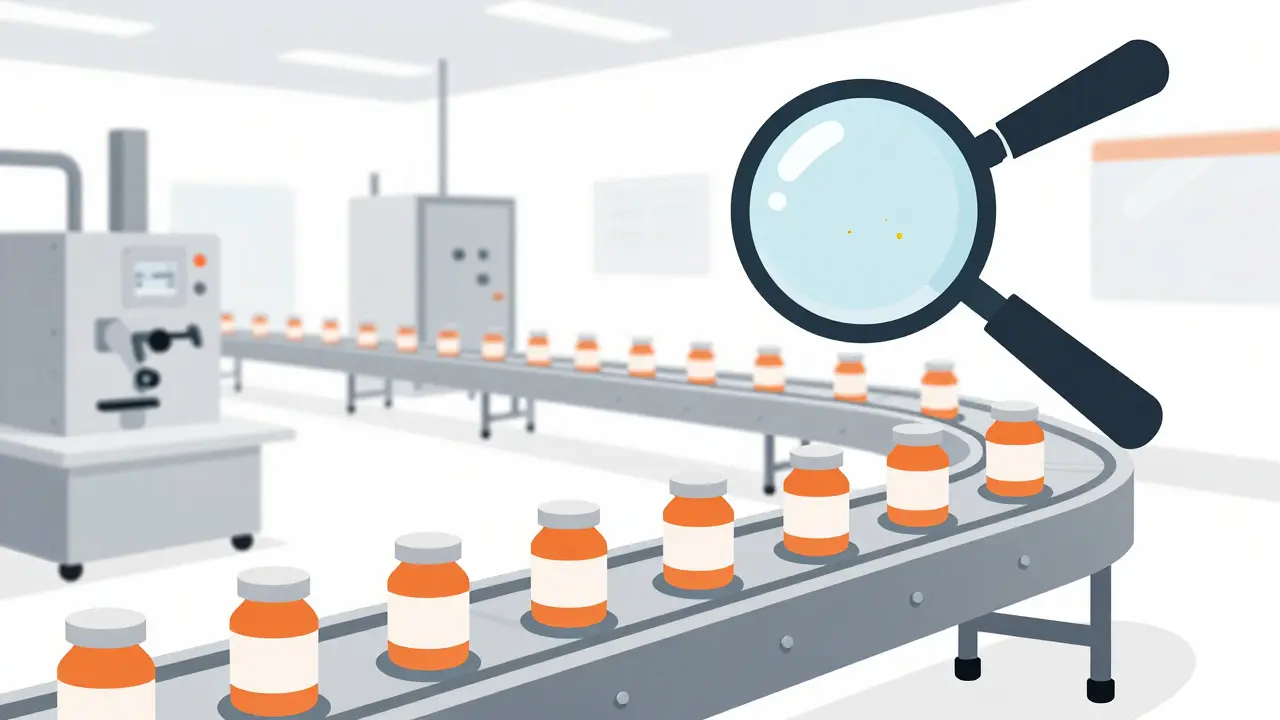
Here is where the system gets complicated. A huge chunk of our generic drugs-about 80% of the raw ingredients-comes from India and China. While these countries have scaled up production massively, the oversight hasn't always kept pace. This creates a dangerous gap in safety.
Domestic factories in the U.S. are inspected roughly every 1.8 years. In contrast, foreign facilities might only see an FDA inspector once every 4.6 years. This means a factory could be violating safety protocols for years before anyone from the FDA actually walks through the door. We saw this clearly with Glenmark Pharmaceuticals, where problems at their Indian facilities were exposed by journalists before the FDA stepped in after a four-year gap in inspections.
Because the U.S. system relies on voluntary reporting, there is often a lag. On average, it takes about 42 days from the moment a quality issue is detected until the public gets a notification. In the European Union, where the system is more mandatory and less "collaborative," that window is shrunk to about 18 days. In the world of medicine, 24 extra days of taking a contaminated drug can be the difference between a minor scare and a hospital visit.
How Patients and Doctors Handle the Chaos
When a recall hits the news, the reaction is often panic. A survey by AARP found that 78% of adults would stop taking their medication immediately after a recall notice. While this seems safe, it can actually be dangerous. If you're taking a critical heart medication or an anti-seizure drug, stopping cold turkey without a doctor's guidance can cause a medical emergency far worse than the recall itself.
Pharmacists are on the front lines of this anxiety. Many report that managing patient fear is one of the hardest parts of the job. For a pharmacist, a recall isn't just an alert; it's a logistical nightmare. They have to cross-reference lot numbers (the specific batch ID on your bottle) and hunt down patients who may have already used the medication. Unfortunately, the communication isn't always great-only about 12% of patients report receiving direct notices about recalls, leaving most to find out via social media or the news.
The Future: AI and Blockchain to the Rescue?
The industry is trying to move away from the "find it and fix it" model toward a "predict it and prevent it" approach. The FDA is currently investing $47 million into AI-powered predictive analytics. The goal is to spot patterns in manufacturing data-like a slight dip in temperature in a storage unit-that suggest a batch might fail before the drug even leaves the factory.
Another shift is the rise of Blockchain in the supply chain. By 2025, blockchain usage grew to 18% among manufacturers. Instead of spending days digging through paper records to find which pharmacy got a bad batch of pills, blockchain allows for near-instant tracking. This could reduce the time it takes to identify affected products from several days to just a few hours.
We are also seeing a push toward "continuous manufacturing." Instead of making drugs in giant batches (where one mistake ruins thousands of bottles), this method produces medicine in a constant flow. Early FDA data shows that this technology has led to a 22% drop in sterility-related recalls. It's a move toward a future where the human error that triggers these alerts is designed out of the system entirely.
Should I stop taking my medication immediately if I see a recall notice?
No, not unless the recall notice explicitly tells you to do so or you are experiencing severe symptoms. For many chronic conditions, the risk of stopping a medication abruptly is higher than the risk posed by the recall. Always call your pharmacist or doctor first to determine if your specific lot number is affected and to get a safe replacement plan.
How can I check if my specific bottle is recalled?
Look for the "Lot Number" or "Batch Number" on the side of your medication bottle or the original packaging. You can then check this number against the FDA's searchable Enforcement Reports database or call your pharmacy. The pharmacy has a "do not purchase" list and can tell you instantly if your lot is flagged.
Why are generic drugs recalled more often than brand-name drugs?
It's not necessarily that generics are "worse," but the market is much larger and more fragmented. Generic manufacturers often operate on thinner margins and rely on a complex global supply chain. With so many different companies producing the same generic molecule, there are more opportunities for quality control lapses at various global sites.
What is the difference between a voluntary and a mandated recall?
A voluntary recall is initiated by the company themselves after discovering a problem. A mandated recall is when the FDA uses its legal authority to force a company to remove a product because the company refuses to do so. Interestingly, about 98% of drug recalls in the U.S. are voluntary.
What does "Class I" actually mean for my health?
Class I is the most serious. It means there is a reasonable probability that using the drug will cause serious adverse health consequences or death. Examples include the wrong drug being in the bottle or a potent dose being labeled as a low dose, which could lead to accidental overdose or untreated critical conditions.