
Tendon Rupture Risk Calculator
This tool helps you assess your personal risk of tendon rupture when taking fluoroquinolone antibiotics based on factors discussed in the article. Results are for informational purposes only and should not replace medical advice.
Your Risk Factors
Additional Factors
Your Risk Assessment
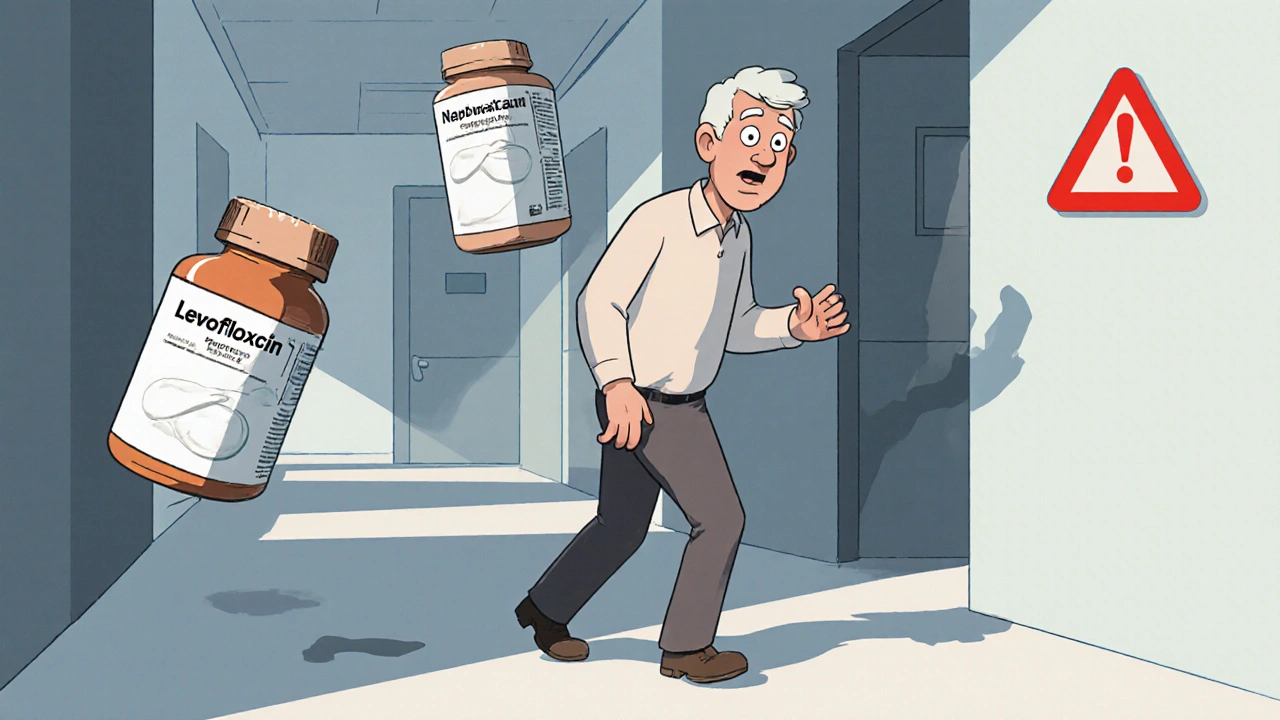
When you take an antibiotic like ciprofloxacin or levofloxacin for a urinary tract infection or sinus infection, you’re probably not thinking about your tendons. But if you’re also taking ibuprofen or naproxen for a sore knee or back pain, you might be adding a hidden risk-one that can turn a minor ache into a life-changing injury.
Fluoroquinolones Aren’t All the Same
Fluoroquinolones are a group of powerful antibiotics used for serious infections. Common ones include ciprofloxacin, levofloxacin, and moxifloxacin. But here’s the thing: they don’t all carry the same risk. Levofloxacin is the big red flag. Studies show it’s linked to a 120% higher chance of Achilles tendon rupture compared to people not taking it. Ciprofloxacin and moxifloxacin? Not so much. A 2022 Japanese study found no increased risk with moxifloxacin, and ciprofloxacin showed little to no rise in rupture rates in multiple analyses.The FDA says fluoroquinolones as a class raise tendon rupture risk by 3 to 4 times. But that’s an average. The real danger isn’t the whole group-it’s specific drugs, especially levofloxacin. And it hits fast. Half of all tendon problems start within the first week. Some people feel pain just 36 hours after their first pill. That’s not a slow burn. It’s a warning sign you can’t ignore.
Why Do These Antibiotics Hurt Tendons?
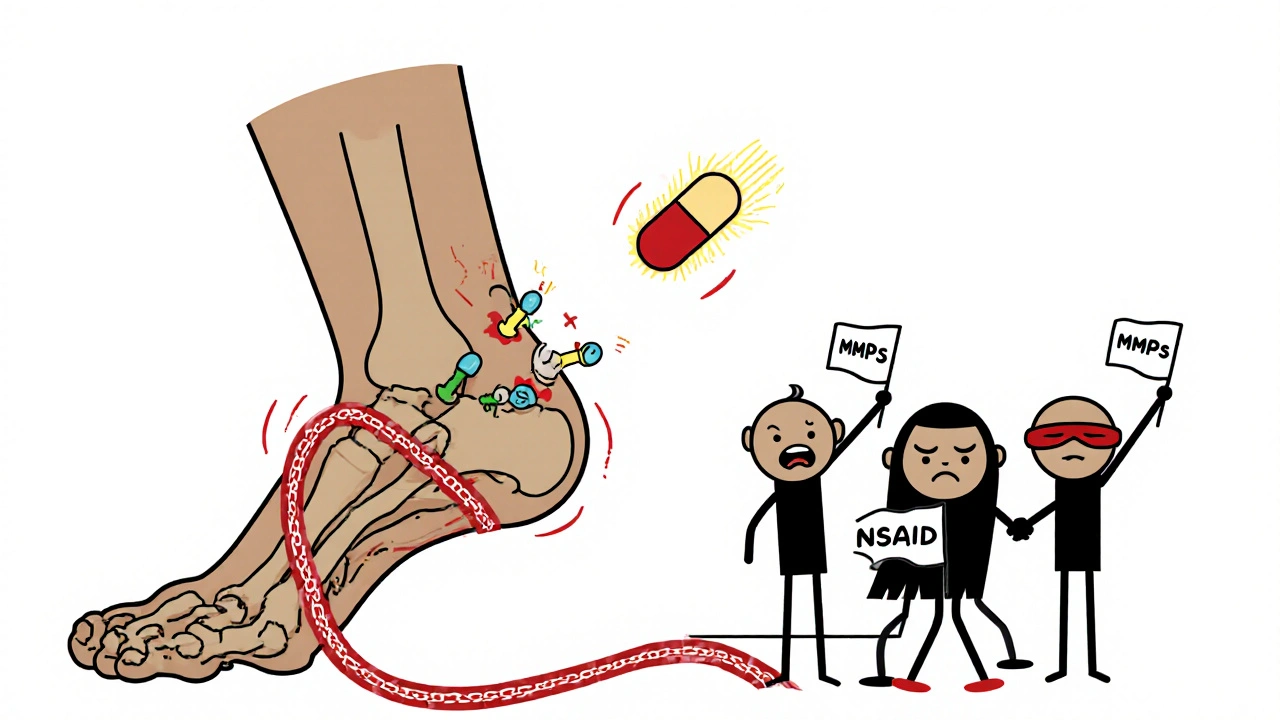
It’s not just inflammation. Fluoroquinolones mess with the actual structure of tendons. They trigger enzymes called matrix metalloproteinases (MMPs), which break down collagen-the main protein that keeps tendons strong. At the same time, they poison the tendon cells (tenocytes), making them die off faster. And they block new collagen from forming. So your tendon is being eaten away while the repair crew is on strike.The Achilles tendon takes the hardest hit-89.8% of cases. But shoulders, wrists, and hands can go too. What’s scary is that rupture doesn’t always come after pain. Sometimes, it just snaps. One man on a patient forum described taking levofloxacin for a chest infection. Three days later, he felt a pop in his heel while walking. No warning. No swelling. Just sudden, total rupture. He needed surgery and six months of rehab.
NSAIDs Don’t Make It Worse-But They Mask the Warning
Let’s clear up a myth: NSAIDs like ibuprofen, naproxen, or celecoxib don’t increase the actual risk of tendon rupture when taken with fluoroquinolones. That’s not what the science says. The FDA doesn’t warn against NSAIDs the way it warns against corticosteroids. But here’s the catch: NSAIDs hide the symptoms.If you’re taking naproxen for a headache or joint pain, and you start feeling a dull ache in your Achilles, you might think, “It’s just my arthritis flaring up.” You keep taking the NSAID, keep moving, and ignore the warning. By the time you realize it’s not just soreness-it’s tendonitis-the damage might already be advanced. That’s not the NSAID causing the rupture. It’s letting you miss the alarm.
One 2023 Reddit thread featured a user who took levofloxacin and naproxen together. He had mild heel pain on day four but kept running because the pain was “manageable.” By day nine, he couldn’t stand on his toes. Surgery followed. He didn’t know the NSAID was silencing the warning.
Who’s Most at Risk?
You’re not equally at risk if you’re 25 and healthy. But if you’re over 60, have kidney problems, or take steroids, your risk shoots up. People who’ve had organ transplants are also at higher risk. The numbers tell the story: those over 60 have nearly four times the chance of tendon issues compared to younger people.And it’s not just age. If you’ve had tendon problems before, or if you’re an athlete or someone who trains hard, your tendons are already under stress. Adding fluoroquinolones? That’s like pouring gasoline on a spark.
Even more surprising: people with diabetes or thyroid disease seem to be more vulnerable. Why? We’re still figuring it out. But it’s clear that your overall health plays a role-not just the drug.
What to Do If You’re Prescribed a Fluoroquinolone
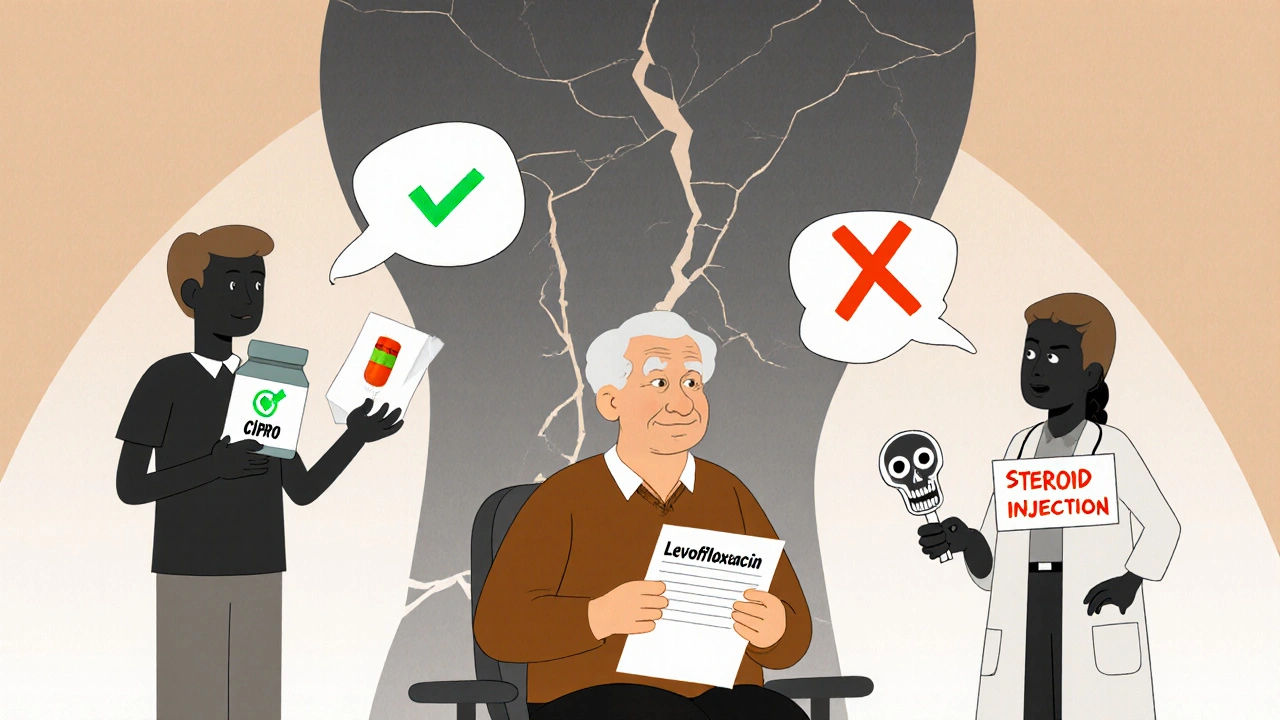
If your doctor says you need a fluoroquinolone, ask: “Is there a safer alternative?” For many common infections-like uncomplicated UTIs or bronchitis-amoxicillin, doxycycline, or nitrofurantoin work just as well and don’t touch your tendons.If you must take one, avoid levofloxacin if possible. Ask for ciprofloxacin or moxifloxacin instead. They’re not risk-free, but the data shows they’re significantly safer. And if you’re over 60 or have kidney disease, push back. Don’t accept it as the default.
Know the early signs: sudden pain, swelling, or stiffness in your heel, shoulder, or wrist. It might feel like a strain, but it’s not. Stop the antibiotic immediately. Don’t wait for the pain to get worse. Get the affected area immobilized. Ice it. Don’t massage it. And absolutely avoid corticosteroid injections-they’re a known trigger for rupture when combined with fluoroquinolones.
Why So Many People Still Get Hurt
Despite black-box warnings from the FDA since 2008, and updates in 2016, patient awareness is shockingly low. A 2021 survey found only 32% of people prescribed fluoroquinolones were told about tendon risks. That’s not just a gap in counseling-it’s a failure in communication.Doctors aren’t always trained to prioritize this warning. Many still see fluoroquinolones as go-to drugs for stubborn infections. But guidelines have changed. The European Medicines Agency now says fluoroquinolones should only be used when no other options exist. The CDC reports a 21% drop in prescriptions in the U.S. between 2016 and 2019-proof that awareness is growing, even if slowly.
And here’s something you won’t hear in drug ads: fluoroquinolone tendon damage can last years. Some people never fully recover. Chronic pain, weakness, and reduced mobility are real outcomes. One study followed patients for five years. Nearly 40% still had trouble with daily activities.
What’s Next?
Scientists are working on next-gen antibiotics that keep the power of fluoroquinolones but ditch the tendon damage. Two candidates, JNJ-Q2 and delafloxacin derivatives, are in early trials and show promise. But they’re years away.In the meantime, the message is simple: fluoroquinolones aren’t harmless. They’re powerful tools-but only when used carefully. Don’t let convenience override caution. If you’re on one, pay attention to your body. If you feel any unusual tendon pain, stop the drug and call your doctor. Don’t wait. Don’t assume it’s just soreness. And don’t let NSAIDs trick you into thinking it’s fine.
The goal isn’t to scare you off antibiotics. It’s to make sure you use them wisely. Because sometimes, the side effect you don’t know about is the one that changes your life.
Craig Hartel
Man, I had no idea NSAIDs could mask tendon pain like that. I’ve been popping ibuprofen like candy for my gym soreness, and last year I got prescribed cipro for a UTI. Lucky me-I only felt a little twinge in my heel for a day and wrote it off as ‘old man stiffness.’ If this post had popped up then, I might’ve avoided a whole mess. Thanks for the wake-up call.
Chris Kahanic
The distinction between fluoroquinolones is critical. Levofloxacin carries a significantly elevated risk profile compared to ciprofloxacin or moxifloxacin, as evidenced by multiple meta-analyses. The FDA’s class-wide warning obscures this nuance and may lead to inappropriate avoidance of safer alternatives within the class.
Geethu E
As a physiotherapist in Mumbai, I’ve seen this too many times. Elderly patients on cipro for UTIs, taking naproxen for knee pain, and then-snap-Achilles gone. They never connect the dots. I tell them: if you’re on antibiotics and your heel starts feeling weird, STOP MOVING. Ice. Rest. Don’t wait. NSAIDs are not your friend here. They’re the silent accomplice.
anant ram
Listen, people: if your doctor gives you levofloxacin without explaining the tendon risk, they’re not doing their job. And if you’re over 50, or diabetic, or have ever had tendonitis-ask for amoxicillin. Seriously. Amoxicillin. It’s cheaper, safer, and works fine for most infections. Don’t be a hero. Don’t say ‘I’ve taken it before.’ This isn’t a gamble. It’s a landmine. And NSAIDs? They’re the blindfold.
king tekken 6
you know what’s really scary? the fact that big pharma knew about this for decades and still pushed these drugs like they were miracle cures. i mean, come on. they got away with it because nobody reads the tiny print. and now we’re all just… walking around with broken tendons and no idea why. it’s not a side effect-it’s a cover-up. and the FDA? they’re just the janitors cleaning up the mess after the explosion.
DIVYA YADAV
This is just another Western medical scam. They push these dangerous antibiotics because they’re profitable. Meanwhile, in India, we’ve been using turmeric, neem, and ayurvedic treatments for infections for thousands of years-no tendon ruptures, no hospital bills, no lawsuits. Why do we still listen to these pharmaceutical giants? It’s cultural colonization disguised as science. The FDA doesn’t care about your tendons-they care about your credit card.
Kim Clapper
While I appreciate the clinical detail, I must emphasize the profound ethical failure of prescribing fluoroquinolones without explicit, documented patient consent regarding tendon rupture risk. The fact that 68% of patients remain uninformed constitutes a breach of the Hippocratic Oath. Furthermore, the normalization of NSAID co-prescription in this context reflects a systemic devaluation of patient autonomy and bodily integrity. This is not medicine. It is negligence dressed in white coats.
Bruce Hennen
Levofloxacin carries a 120% increased relative risk of Achilles rupture. Absolute risk remains low-approximately 0.2% in healthy adults under 60. The danger is real, but context matters. Misrepresenting this as a universal threat undermines informed decision-making. Ciprofloxacin’s risk is statistically negligible in most populations. Don’t conflate the drugs. Don’t panic. Educate.
Jake Ruhl
so like… what if the whole fluoroquinolone thing is just a distraction? what if the real problem is that we’re all just too stressed and our bodies are falling apart from bad sleep and sugar and sitting all day? like yeah the drug might be the trigger but what if the tendon was already a ticking time bomb? and what if the NSAID wasn’t hiding the pain but actually keeping you from having a breakdown? like… maybe the body just needs to rest and the drugs are just scapegoats? i mean… think about it.
Hannah Magera
This is so important. I’m a nurse and I’ve had patients come in after a rupture, completely shocked. I always ask if they’re on antibiotics or NSAIDs-but I don’t always get the chance. Maybe we need a simple checklist: ‘Are you taking any antibiotics? Any pain meds?’ right on the prescription form. Just two questions could save someone from surgery. Thank you for putting this out there.
Graham Moyer-Stratton
Levofloxacin bad. Cipro okay. NSAIDs lie. Stop running. Call your doctor. Done.
tom charlton
Thank you for this comprehensive and evidence-based summary. The distinction between relative and absolute risk, the clarification regarding NSAIDs as symptom-maskers rather than causative agents, and the emphasis on patient education are all critical components of responsible prescribing. I will be sharing this with my clinical team immediately. This is the kind of communication that bridges the gap between research and practice.