

Allergy Relief Duration Calculator
Find which antihistamine provides better symptom control for you
This tool compares the duration of allergy relief between desloratadine (Claritin-D active ingredient) and loratadine (Claritin). Based on your allergy symptoms and when you take your medication, we'll show how long you can expect relief.
Enter your information above to see how long relief lasts with each antihistamine.
When you’re stuck with runny nose, itchy eyes, or sneezing fits that won’t quit, choosing the right antihistamine matters. Two of the most common options are desloratadine and loratadine. Both are second-generation antihistamines, meaning they’re less likely to make you drowsy than older drugs like diphenhydramine. But they’re not the same. One is the active ingredient in Clarinex; the other is in Claritin. And while they’re related, their differences in potency, side effects, and dosing can make one a better fit for you than the other.
How Desloratadine and Loratadine Work
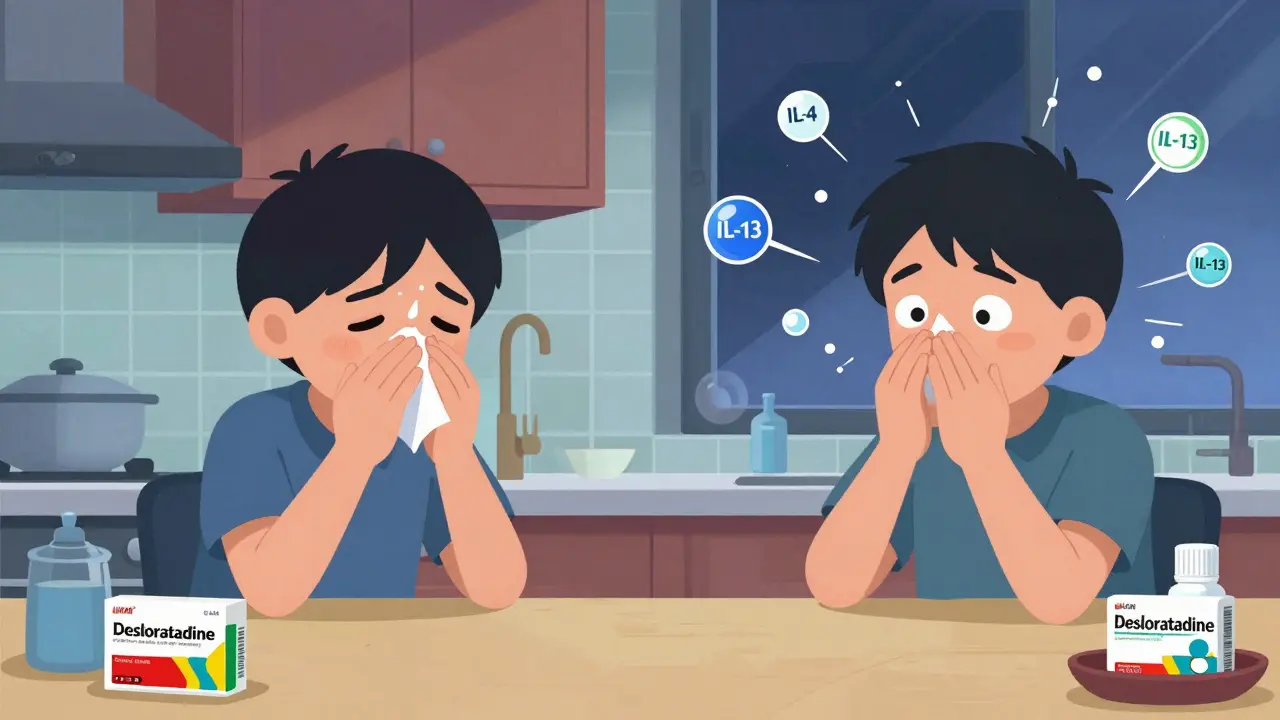
Loratadine is broken down by your liver into desloratadine - the exact compound that does the real work. That means desloratadine isn’t just a cousin of loratadine; it’s the finished product. This gives desloratadine a direct edge: it’s more potent. Studies show it binds more tightly to histamine receptors, blocking allergic reactions more effectively. It also has extra anti-inflammatory actions that loratadine doesn’t. Desloratadine reduces swelling by calming down eosinophils (a type of white blood cell involved in allergies) and blocking the release of cytokines like IL-4 and IL-13, which drive itching and nasal congestion.
Both drugs barely cross the blood-brain barrier, which is why they’re called non-sedating. In fact, they only occupy about 20% of brain H1 receptors, compared to 100% for first-gen antihistamines. That’s why you won’t feel like you’re drugged after taking them. But potency doesn’t just mean better results - it affects how long they last and how your body handles them.
Dosing: What You Need to Take
Here’s the simple part: both are taken once a day. But the amounts are different. For adults, the standard dose of loratadine is 10 mg. For desloratadine, it’s 5 mg. That’s because desloratadine is about twice as strong per milligram. You don’t need more to get the same - or better - effect.
Timing matters too. Loratadine hits peak levels in your blood in about 1 to 1.5 hours. Desloratadine takes longer - around 3 hours. But here’s the catch: desloratadine stays in your system much longer. Its half-life is 27 hours. That means it’s working steadily for a full day, even if you’re late taking it. Loratadine’s half-life is shorter, around 8 hours, so its effect can dip before 24 hours are up. For people with severe allergies, especially nasal congestion, that steady coverage makes a real difference.
For kids, the gap widens. Desloratadine is approved for children as young as 1 year old. Loratadine? Only for kids 2 and older. That’s important for parents of toddlers with seasonal allergies or chronic hives. Studies in children aged 2 to 5 showed desloratadine at 5 mg daily reached steady plasma levels of 7.8 ng/mL - higher than placebo levels of 5.1 ng/mL - with peak concentration at 2.3 hours. That’s solid, predictable dosing for little ones.
Side Effects: What You Might Experience
Both drugs are well tolerated. But they’re not identical when it comes to side effects. The most common ones - dry mouth, headache, and occasional drowsiness - show up in both. But the numbers tell a clearer story.
Desloratadine has fewer reports of drowsiness. Clinical trials show it has a lesser tendency to cause sleepiness than loratadine. In pediatric studies, irritability was reported in 6.9% of kids on desloratadine versus 5.6% on placebo. Diarrhea was slightly higher at 6.1% versus 2.4%. But these are still low rates. Crucially, desloratadine doesn’t affect heart rhythms - it doesn’t prolong QTc intervals, which lowers the risk of rare but serious arrhythmias. Loratadine has the same safety profile here.
Some online reviews say desloratadine causes more headaches. And yes, a few users on Drugs.com and Reddit reported that. But overall, desloratadine has a higher satisfaction rate: 7.2/10 from 843 reviews versus loratadine’s 6.3/10 from over 1,200. Why? Because users who switched from loratadine often say they noticed better control of itchy eyes and stuffy nose - symptoms that loratadine didn’t fully fix.
One myth to clear up: desloratadine doesn’t act faster. It takes longer to peak in your blood. But it lasts longer. And that’s what counts.

Who Benefits Most from Desloratadine?
If you have mild allergies that respond well to over-the-counter meds, loratadine is still a great, cheap option. It works. But if your allergies are moderate to severe - especially if you have nasal congestion, eye itching, or asthma along with your hay fever - desloratadine is often the better choice.
Experts like Dr. James T. Li at Mayo Clinic point out that desloratadine’s extra anti-inflammatory effects make it stand out. The European Academy of Allergy and Clinical Immunology gave it a 4.7 out of 5 for efficacy, compared to 4.2 for loratadine. The American Academy of Allergy, Asthma & Immunology even says desloratadine may be preferred when you need broader control beyond just blocking histamine.
It’s also the go-to for people who’ve had bariatric surgery. Desloratadine dissolves completely in the gut, even after weight-loss procedures. Loratadine? It doesn’t dissolve well post-surgery, which can mean it doesn’t get absorbed at all. That’s a critical difference for patients who’ve had gastric bypass.
And if you’re on other meds? Desloratadine is safer. It’s not broken down by the CYP3A4 liver enzyme, so it doesn’t interact badly with common drugs like ketoconazole, erythromycin, or fluoxetine. Loratadine can interact with those - not often, but enough to be a concern.
Cost and Availability
Loratadine is cheaper. A 30-day supply of generic loratadine costs $10-$25. Desloratadine? $25-$40. That’s why loratadine remains the most prescribed antihistamine in the U.S. - over 24 million prescriptions in 2023. Desloratadine trails behind at 9.3 million. But that gap is closing. Prescriptions for desloratadine are growing at 4.2% per year, while loratadine’s growth is only 1.8%. More doctors are starting to recommend it for patients who don’t get full relief from loratadine.
Insurance often covers both. But if you’re paying out of pocket, the price difference matters. Still, if you’re spending $15 a month on loratadine and still sneezing all day, switching to desloratadine might save you money in the long run - by cutting down on missed work, doctor visits, or extra allergy meds.
When to Switch from Loratadine to Desloratadine
The American College of Allergy, Asthma, and Immunology recommends trying desloratadine if you’ve used loratadine for 2-4 weeks and still have symptoms. That’s not a failure - it’s just biology. Your body might need the stronger, longer-lasting version.
There’s no need to taper. You can switch directly: stop your loratadine, start your desloratadine the next day. No extra side effects. Just better control.
And if you’re worried about drowsiness? Start at night for the first few days. Even though both drugs are non-sedating, your body might react differently at first. Most people adjust within a few days.
Final Take: It’s Not About Which Is Better - It’s About Which Is Right for You
Loratadine is the classic, affordable choice. It’s fine for mild allergies. But if you’re still struggling - if your eyes still itch, your nose is still stuffed, or you’re reaching for another pill midday - desloratadine is the upgrade you didn’t know you needed. It’s more potent, longer lasting, safer with other meds, and approved for younger kids. The side effects are minimal. The cost is higher, but the results often justify it.
There’s no one-size-fits-all. But if your allergies are more than a nuisance, desloratadine gives you more control - without the sleepiness.
Is desloratadine stronger than loratadine?
Yes, desloratadine is more potent. It’s the active metabolite of loratadine, meaning your body turns loratadine into desloratadine to work. Desloratadine binds more tightly to histamine receptors and has additional anti-inflammatory effects, making it more effective for nasal congestion, itchy eyes, and chronic hives.
Can I take desloratadine and loratadine together?
No. Since desloratadine is the active form of loratadine, taking both together doesn’t add benefit - it just increases your dose unnecessarily. Stick to one or the other. If one isn’t working, switch to the other after a few days, don’t combine them.
Which one causes less drowsiness?
Desloratadine has a lower chance of causing drowsiness than loratadine. Both are considered non-sedating because they barely cross into the brain. But clinical data shows desloratadine is better tolerated in this regard, with fewer reports of sleepiness in both adults and children.
Is desloratadine safe for children under 2?
Yes. Desloratadine is approved for children as young as 1 year old. Loratadine is only approved for children 2 years and older. This makes desloratadine the preferred option for toddlers with allergies or chronic urticaria.
Do I need to adjust the dose if I have kidney or liver problems?
No. As of the latest FDA labeling updates in August 2023, neither desloratadine nor loratadine requires dosage adjustments for mild to moderate kidney or liver impairment. Both are considered safe at standard doses for most patients, even with these conditions.
Why is desloratadine more expensive than loratadine?
Loratadine became generic in 2002, so it’s been available cheaply for over 20 years. Desloratadine went generic in 2013, so it’s still relatively newer in the generic market. Its more complex manufacturing and additional clinical benefits also contribute to the higher price. But many users find the improved symptom control justifies the cost.
Fabian Riewe
Desloratadine is the real MVP for chronic allergies. I switched from Claritin after 3 years of half-decent relief and honestly? My eyes stopped looking like I’d been crying through a sandstorm. The 27-hour half-life means I can forget to take it at 9am and still be fine at 11pm. No more 3pm sneezing fits. Also, my kid’s hives cleared up faster on desloratadine - he’s 18 months and this stuff works when nothing else did.
Side note: the price difference is real, but if you’re buying tissues, eye drops, and extra coffee to stay awake from allergy fatigue, you’re already spending more.
Don’t overthink it. If loratadine isn’t cutting it, just switch. No tapering. Just swap. Done.
Nicole K.
Why are people paying more for this? It’s just a fancy version of Claritin. My grandma took loratadine for 20 years and never had a problem. You don’t need ‘extra anti-inflammatory effects’ - just stop eating sugar and wash your face. It’s not rocket science.
Joe Kwon
As someone who’s been on both, I’ll say this: desloratadine’s cytokine modulation (IL-4/IL-13 inhibition) is the hidden advantage. It’s not just H1 blockade - it’s dampening the entire Th2 cascade. That’s why it crushes nasal congestion where loratadine falters. Clinically, it’s a Class A anti-inflammatory with minimal CNS penetration. If you’re prescribing or self-prescribing, this is the pharmacokinetic sweet spot.
Also, the CYP3A4 independence? Huge for polypharmacy patients. I’ve seen 3 cases where ketoconazole + loratadine caused QT prolongation. Desloratadine? Zero issues. This isn’t marketing - it’s molecular logic.
Sharleen Luciano
How do people not know this already? Desloratadine is objectively superior. The fact that you’re still on loratadine means you either haven’t tried it, or you’re clinging to brand loyalty like it’s a religious artifact. The European Academy gave it a 4.7/5. The American Academy says it’s preferred for ‘broader control.’ You’re not ‘saving money’ - you’re paying in misery. And don’t even get me started on the bariatric patients who can’t absorb loratadine. It’s not even a debate.
Himanshu Singh
i use desloratadine since 2yrs. its good. my nose not stuffy like before. but i think loratadine is fine for mild. i live in india, its hard to find desloratadine here, so i take loratadine when i can't get the other. but when i get it? i never go back. 5mg = magic. :)
Alex Ronald
For anyone wondering about dosing in kids - the 5mg daily dose in toddlers (1–5 yrs) hits steady-state plasma levels around 7.8 ng/mL. That’s solid. The pharmacokinetics are predictable, and the safety profile in pediatric trials is cleaner than loratadine’s. Also, no QTc prolongation risk. If your pediatrician says ‘wait until 2,’ ask them why - the FDA label says 1+. This isn’t off-label - it’s evidence-based.
Henriette Barrows
I switched last spring after my allergies got worse. I was skeptical - I thought it was just a rebrand. But after 4 days, I noticed I wasn’t rubbing my eyes every 10 minutes. My husband said I stopped sneezing during breakfast. I didn’t even realize how much I was suffering until it was gone.
Also, I took it at night the first few days just in case. Didn’t need to. But it’s nice to know you can if you’re nervous. No drowsiness. No weirdness. Just… peace.
Jim Rice
Stop hyping this. Everyone’s acting like desloratadine is a miracle drug. It’s not. It’s the same molecule your liver already makes from loratadine. You’re paying $40 for your body to do what it’s supposed to do. And if you’re getting ‘better’ results, it’s placebo. Or maybe you’re just drinking more water now. Don’t fall for pharma marketing.
Lisa Dore
Just wanted to say - if you’re reading this and you’ve been stuck on loratadine for years, don’t feel bad. I was you. I thought I was ‘allergic to life.’ Then I tried desloratadine. Now I can go outside without a box of tissues. I even hugged my neighbor last week - without sneezing. It’s not just medicine. It’s reclaiming your life.
Also - if you’re on meds for other stuff? Talk to your pharmacist. Desloratadine plays nice. Loratadine? Not always.
Greg Quinn
It’s funny how we treat meds like they’re moral choices. ‘You’re lazy if you use the expensive one.’ ‘You’re gullible if you switch.’ But biology doesn’t care about your budget or your ideology. If your body needs the stronger, longer-acting, non-interacting version - why fight it? Loratadine isn’t ‘pure’ or ‘simple.’ It’s just the first version. Desloratadine is the optimized one. Like upgrading from dial-up to fiber. You don’t call it ‘wasteful’ - you call it progress.
And if cost is the barrier? Ask for samples. Talk to your doctor. Insurance often covers it. Don’t suffer because someone told you ‘cheap is better.’ Sometimes, better is cheaper - in the long run.
Amy Cannon
As a long-term allergy sufferer and someone who’s traveled extensively across Asia and Europe, I’ve seen how different cultures approach antihistamines. In Japan, desloratadine is first-line for pediatric rhinitis. In Germany, it’s preferred in asthma-allergy comorbidity protocols. Even in India, where loratadine dominates due to cost, the trend is shifting toward desloratadine in urban clinics.
And yes, I misspelled ‘desloratadine’ three times while typing this. I’m not a doctor. But I am a person who has spent 12 years trying to breathe through a stuffy nose. I can tell you - desloratadine doesn’t just treat symptoms. It restores normalcy. And that’s worth more than a $15 bottle.
Also, I just took mine. And I’m typing this without a Kleenex in hand. That’s not marketing. That’s biology.