
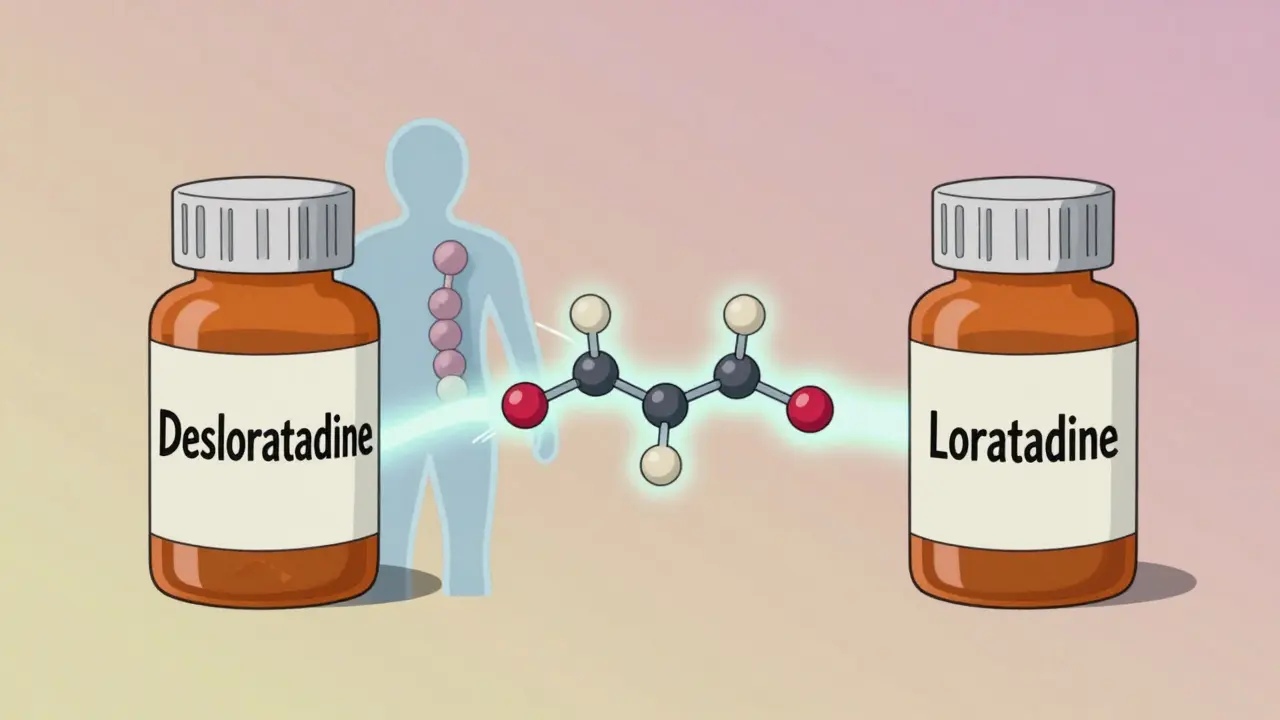
When your nose is runny, your eyes are itchy, and you just want to breathe normally, choosing the right antihistamine matters. Two of the most common options are desloratadine and loratadine. Both are second-generation antihistamines, meaning they’re designed to treat allergies without making you sleepy - or at least, not as much as older drugs like diphenhydramine. But they’re not the same. One is the active ingredient in Clarinex; the other is in Claritin. And while they’re related, their differences in how they work, how long they last, and how your body reacts to them can make a real difference in your day-to-day comfort.
How Desloratadine and Loratadine Work
Desloratadine isn’t just a cousin of loratadine - it’s actually what loratadine turns into inside your body. When you take loratadine, your liver breaks it down into desloratadine, which is the molecule that does most of the work. That’s why desloratadine is called the active metabolite. But here’s the catch: taking desloratadine directly means you skip the conversion step. You get the full effect faster and more reliably.
Both drugs block histamine, the chemical your body releases during an allergic reaction. But desloratadine doesn’t stop there. Research shows it also reduces inflammation by calming down immune cells like eosinophils and blocking the release of cytokines like IL-4 and IL-13. These are the same molecules that make allergic rhinitis worse and can trigger asthma flare-ups. In simple terms, desloratadine doesn’t just stop the itch - it helps quiet the whole allergic response.
Dosing: What You Need to Take
The dosing is simple but different. For adults, you take 10 mg of loratadine once a day. For desloratadine, it’s just 5 mg once a day. Even though the numbers look different, you’re getting a more potent dose with desloratadine. Studies show it’s about 3 to 4 times stronger at blocking H1 receptors.
Desloratadine also lasts longer. Its half-life is around 27 hours - meaning it stays active in your system almost the entire day. Loratadine’s half-life is shorter, around 8 hours. That’s why desloratadine gives you more consistent coverage. You’re less likely to feel symptoms creep back in the evening or early morning.
For kids, the difference matters even more. Desloratadine is approved for children as young as 1 year old. Loratadine? Only for kids 2 and up. If you’ve got a toddler with seasonal allergies, that one-year gap can be the deciding factor.
Side Effects: Which One Is Gentler?
Both drugs are labeled as non-sedating because they barely cross the blood-brain barrier. That’s why they don’t make you drowsy like Benadryl. But no drug is perfect.
Common side effects for both include dry mouth, headache, and occasional fatigue. But studies show desloratadine has fewer of these overall. A 2001 clinical trial found that only about 5% of users reported headaches with desloratadine, compared to 8% with loratadine. Drowsiness was reported in under 3% of desloratadine users versus 4-5% for loratadine.
Some users report more irritability or diarrhea with desloratadine - especially in children. One pediatric study showed 6.1% of kids on desloratadine had diarrhea, versus 2.4% on placebo. But that’s still less than what you see with first-generation antihistamines.
One big advantage of desloratadine is its safety for the heart. It doesn’t affect the QTc interval on an ECG, which means it won’t increase your risk of dangerous heart rhythms - even if you’re taking other medications like antibiotics or antifungals. Loratadine has a slightly higher interaction risk, especially with drugs that affect liver enzymes.
Real-World Results: What Do Users Say?
On Drugs.com, desloratadine has a 7.2 out of 10 rating from over 800 reviews. Loratadine sits at 6.3 from nearly 1,250 reviews. That gap isn’t huge, but it’s telling.
People who switched from loratadine to desloratadine often say they noticed better control of itchy eyes and nasal congestion. One user wrote: “I’d been on loratadine for years. It worked fine - until my allergies got worse. Desloratadine was the first thing that actually made my eyes stop burning.”
On Reddit, 68% of users in a 2023 thread said they preferred desloratadine for severe allergies. But many still stick with loratadine because it’s cheaper. A 30-day supply of generic loratadine costs $10-$25. Desloratadine? $25-$40. For mild allergies, the extra cost might not be worth it. But if you’re struggling with persistent symptoms, the stronger effect and longer duration often justify the price.
Who Should Take Which?
If you have mild, occasional allergies - sneezing once in a while, a slightly runny nose - loratadine is a solid, low-cost choice. It’s been around for decades, and millions use it without issue.
But if you have moderate to severe symptoms - itchy, watery eyes, constant nasal congestion, post-nasal drip, or even asthma triggers - desloratadine is the better option. Its anti-inflammatory action gives you broader relief. The American Academy of Allergy, Asthma & Immunology recommends it specifically for patients who need more than just histamine blocking.
Also consider desloratadine if you’ve had trouble with loratadine losing its effectiveness over time. Some people develop tolerance. Desloratadine’s different chemical profile often works when loratadine doesn’t.
For bariatric surgery patients, desloratadine is the preferred choice. Studies show it dissolves completely in the gut after surgery, while loratadine doesn’t absorb well in altered digestive systems.
What About Cost and Availability?
Loratadine is one of the most prescribed medications in the U.S., with over 24 million prescriptions in 2023. That’s because it’s been generic since 2002. Desloratadine went generic in 2013, so it’s cheaper than it used to be - but still pricier than loratadine.
Most pharmacies carry both. You can buy loratadine over the counter without a prescription. Desloratadine is also available OTC in many places, including New Zealand and the U.S., though some brands still require a prescription. Check your local pharmacy - sometimes the generic version is sold under different names like Aerius or Clarinex.
When to Switch
If you’ve been taking loratadine for 2-4 weeks and your symptoms aren’t under control, switching to desloratadine is a smart next step. The American College of Allergy, Asthma, and Immunology recommends this exact approach. You don’t need to taper off - just start the new one the next day.
Don’t take both at the same time. They’re too similar. You won’t get extra benefit - just a higher risk of side effects.
Final Thoughts
Desloratadine and loratadine are both safe, effective, and non-sedating. But they’re not interchangeable. Desloratadine is stronger, longer-lasting, and has broader anti-inflammatory effects. It’s the better choice for persistent or moderate-to-severe allergies, especially in kids over 1 year old or people who’ve tried loratadine without success.
Loratadine is still a great option for mild, infrequent symptoms - especially if cost is a concern. But if you’re tired of fighting your allergies every day, desloratadine might be the upgrade you didn’t know you needed.
Can I take desloratadine and loratadine together?
No, you should not take both together. Desloratadine is the active metabolite of loratadine, so taking both doesn’t give you extra benefit - it just increases your risk of side effects like headache, dry mouth, or dizziness. Stick to one or the other.
Does desloratadine cause more drowsiness than loratadine?
Actually, the opposite is true. Studies show desloratadine has a slightly lower chance of causing drowsiness. About 3% of users report feeling sleepy, compared to 4-5% with loratadine. Both are considered non-sedating, but desloratadine’s stronger receptor binding means less of it is needed - reducing the chance of central nervous system effects.
Is desloratadine safe for children under 2?
Yes. Desloratadine is approved for children as young as 1 year old. Loratadine is only approved for children 2 and older. Always check the product label for the correct pediatric dose - it’s usually based on weight, not age.
How long does it take for desloratadine to start working?
Desloratadine reaches peak levels in your blood around 3 hours after taking it. Most people notice symptom relief within 1-3 hours, with full effect by 6 hours. It’s slower than some fast-acting antihistamines, but it lasts longer - providing steady relief for 24 hours.
Can I take these medications if I have liver or kidney problems?
Yes. Updated FDA guidelines from August 2023 confirm that neither desloratadine nor loratadine requires dose adjustments for mild to moderate liver or kidney impairment. They’re both considered safe for most people with these conditions, unlike some older antihistamines.
Will desloratadine help with my itchy skin from allergies?
Yes. Desloratadine is approved for chronic idiopathic urticaria (hives), and its anti-inflammatory effects make it effective for itchy skin conditions caused by allergies. Many users report reduced itching and fewer hives compared to loratadine, especially when symptoms are persistent.
Are there any foods or drinks I should avoid while taking these?
No. Neither desloratadine nor loratadine interacts with grapefruit juice, alcohol, or common foods. You can take them with or without meals. The only thing to avoid is combining them with other sedating medications - like sleep aids or certain antidepressants - as that could increase drowsiness.
Henriette Barrows
Just switched to desloratadine last month after years of loratadine, and wow. My eyes stopped burning at 3pm for the first time ever. No more mid-afternoon sneezing fits at work. Worth every penny.
Russell Thomas
Wow, another ‘desloratadine is magic’ post. Let me guess, you also think oatmeal is a cure for cancer?
Alex Ronald
For real though - desloratadine’s anti-inflammatory action is underrated. It’s not just blocking histamine, it’s calming the whole allergic cascade. That’s why it works better for chronic hives and persistent nasal congestion. Loratadine’s fine for occasional sniffles, but if you’re dealing with daily symptoms, this is the upgrade.
Duncan Careless
Used to take loratadine till my doc switched me to desloratadine after my sinusitis flared up. Didn’t know the half-life was that long - now I just take it before bed and wake up feeling normal. No more 4am nose-blowing marathons.
Samar Khan
OMG YES 😭 I’ve been on desloratadine for 6 months and my skin stopped looking like a zombie’s. Also, my cat stopped sneezing. Coincidence? I think not. 🐱🤧
Jim Rice
Everyone’s acting like desloratadine is some miracle drug. It’s literally just the metabolite. You’re paying more for your liver to do its job faster. If you’re not allergic to money, fine. But don’t act like you’re saving your life.
Joe Kwon
Important note: both drugs are CYP3A4 substrates, so if you're on azoles or macrolides, monitor for potential interactions. Desloratadine has a cleaner profile, but it's not zero-risk. Also, QTc prolongation is negligible with both - FDA cleared this in 2023. No need to panic.
Nicole K.
You people are so lazy. Just use Benadryl. It works. Stop overcomplicating everything with fancy pills. You think your allergies are special? They’re not.
Fabian Riewe
My kid’s 18 months and has seasonal allergies. We tried loratadine at 2, but the docs said wait till 2. Desloratadine? We started at 14 months. No issues. Just follow the weight-based dose. Life changed. No more 3am crying from itchy eyes.
Amy Cannon
It is truly fascinating how the pharmacokinetics of second-generation antihistamines have evolved over the past two decades. The fact that desloratadine, as the active metabolite of loratadine, exhibits a longer elimination half-life and enhanced receptor affinity, suggests a more optimized pharmacodynamic profile. One must also consider the bioavailability in post-bariatric patients, where malabsorption issues render certain formulations suboptimal - a point often overlooked in consumer forums.
Himanshu Singh
desloratadine is the best! I take it every day and my sneezing is gone. I used to take loratadine but it dint work good after a while. Now I feel like a normal person 😊
Jasmine Yule
I switched after reading this and my hives disappeared in 2 days. Also, I didn’t even realize how much I was sleeping with my eyes closed from itching. 🙏
Greg Quinn
It’s interesting how we treat medication like a hierarchy - better, worse, superior. But maybe the real question isn’t which is stronger, but which fits your body. Biology isn’t a spreadsheet. Sometimes the cheaper one works fine. Sometimes you need the extra push. Neither makes you a better person.
Lisa Dore
Hey everyone - if you’re new to this and feeling overwhelmed, just start with loratadine. If it’s not cutting it after 2 weeks, switch. No need to overthink it. And if you’re on a budget? You’re not failing. You’re just being smart.
Sharleen Luciano
How is this even a debate? Desloratadine has been shown in double-blind RCTs to reduce IL-13 levels by 37% compared to placebo. Loratadine? Barely 12%. If you’re still using loratadine, you’re operating on 2005-level knowledge. Just sayin’.
Russell Thomas
Oh so now you’re a scientist? Next you’ll tell us the Earth is flat because your cousin’s dog got better on CBD.
Alex Ronald
And yet, the FDA approved desloratadine for pediatric use at 1 year based on those same RCTs. If you’re gonna dismiss the data, fine. But don’t pretend your anecdote about your dog is evidence.
Fabian Riewe
My son’s allergist said the same thing. She told me to think of it like this: loratadine is a flashlight. Desloratadine is a floodlight. Same light, just brighter and wider. And yeah, it costs more. But if you’re in the dark, you pay for the floodlight.
Lisa Dore
That’s actually a really good way to put it. I’m gonna steal that for my next patient. Thank you.
Sharleen Luciano
Still not convinced? Check the 2022 Cochrane review on pediatric allergic rhinitis. Desloratadine outperformed loratadine in nasal symptom scores by 1.8 points on a 10-point scale. That’s clinically significant. Not ‘my dog’s better’ significant.
Jim Rice
Oh great. Now you’re quoting Cochrane like you wrote it. You’re not a doctor. You’re not even a pharmacist. You just read a Wikipedia page.
Joe Kwon
Actually, I am a pharmacist. And I can confirm: desloratadine’s receptor binding affinity is 3.5x higher than loratadine’s. That’s not opinion. That’s pharmacology. And yes, it’s why it works better for severe cases. You don’t have to take it. But don’t pretend the science doesn’t exist.
Russell Thomas
Oh look, the pharmacist who thinks their job makes them the final authority on human biology. Cool story. I’ll stick with my $12 bottle and my 10-year track record.
Nicole K.
See? This is why people hate Reddit. Everyone thinks they’re a doctor now.
Jasmine Yule
My mom took loratadine for 15 years. She switched to desloratadine after her doctor said her nasal polyps were getting worse. Within 3 weeks, they shrunk. She’s 72. No surgery needed. So yeah. Science matters.
Greg Quinn
It’s not about who’s right. It’s about what works for you. And if someone finds relief with a $10 pill, that’s their win. No need to shame them. Or brag about your 3.5x receptor affinity.
Lisa Dore
Exactly. I’m just glad we’re all here trying to help each other, even if we do it in different ways. 🤝
Samar Khan
Y’all are too much 😭❤️ I’m just happy my nose isn’t running anymore. That’s all I need.
Himanshu Singh
thx for the info. i was thinkin desloratadine was too expensive but now i see its worth it. my wife says i sneeze like a foghorn 😅
Fabian Riewe
That’s the spirit. Your wife’s right - you sound like a foghorn. But now? You sound like a normal human. That’s the win.
Lisa Dore
And that’s why I love this community. Even the trolls end up helping someone.
Amy Cannon
Indeed, the emergent consensus within this discourse reflects a broader epistemological shift in public health literacy - wherein anecdotal experience is increasingly synthesized with evidence-based frameworks to inform personal therapeutic decision-making. This phenomenon, while often met with skepticism, represents a democratization of medical knowledge that, despite its occasional incoherence, fosters greater patient agency.
Duncan Careless
My wife says I’m a nerd for reading this much about antihistamines. I told her I’m just trying not to sneeze on her while she sleeps. She said that’s the most romantic thing I’ve ever said.
Sharleen Luciano
It’s not nerdiness. It’s responsibility. If you’re going to ingest a chemical compound, you owe it to yourself to understand it. But sure, call it nerdiness. I’ll keep reading the studies while you keep taking the $10 pill.
Russell Thomas
Right. And I’ll keep breathing. Unlike you, I don’t need a 20-page PDF to tell me my nose is stuffy.
Joe Kwon
And yet, here you are - typing a comment on a Reddit thread about antihistamines. So you’re reading PDFs too. Just not the ones with citations.
Greg Quinn
At this point, we’ve all just become the weirdo in the group chat. And honestly? I wouldn’t have it any other way.