
You might be surprised to learn that the medication in your prescription bottle could be identical to the brand-name drug you're used to - but sold under a different label. This is the reality of authorized generics. These drugs are made by the same company that produces the brand-name version, but they're sold without the brand name. Let's break down what this means for you as a patient.
Authorized generics are medications produced by the brand-name manufacturer but marketed under a generic label. According to the FDA, they are "a listed drug... marketed with labeling or packaging that differs from the listed drug" (21 CFR 314.3). Unlike traditional generics, authorized generics are exact copies of the brand-name drug in every way - including active and inactive ingredients.How authorized generics differ from brand and traditional generics
Not all generic drugs are created equal. Understanding the differences between brand-name drugs, authorized generics, and traditional generics can help you make informed choices about your medication.
| Aspect | Brand-Name Drug | Authorized Generic | Traditional Generic |
|---|---|---|---|
| Manufacturer | Original brand company | Brand company or subsidiary | Independent generic manufacturer |
| Approval Process | New Drug Application (NDA) | Uses brand's existing NDA | Abbreviated New Drug Application (ANDA) |
| Active Ingredients | Exact same as authorized generic | Identical to brand | Same active ingredient, but may differ in inactive ingredients |
| Labeling | Brand name on label | Generic label, no brand name | Generic label with chemical name |
| Price | Higher | Lower than brand, similar to traditional generics | Lowest cost option |
When you pick up a prescription, the pill's appearance might change depending on which version you get. Authorized generics look different from the brand-name drug but are chemically identical. Traditional generics might have different inactive ingredients, which can affect the pill's color or shape. But authorized generics? They're the real deal - same formula, same effects, just without the brand name.
Why do brand companies make authorized generics?
When a brand-name drug's patent expires, generic manufacturers can enter the market. But here's the twist: the original company might launch its own authorized generic. Why? It all comes down to the Hatch-Waxman Act of 1984. This law gave the first generic company 180 days of exclusive sales after a patent challenge. However, brand companies found a way to compete during this period by producing their own authorized generics.
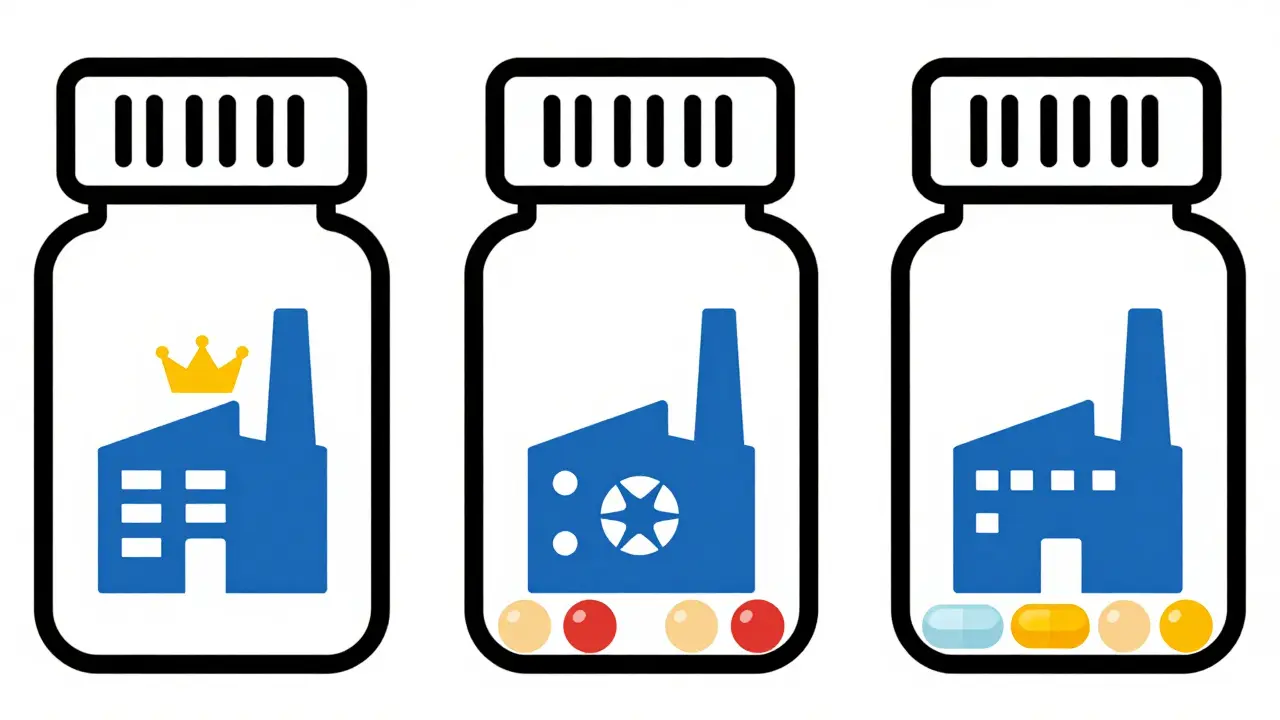
For example, Pfizer uses its subsidiary Greenstone to market authorized generics. Similarly, Procter & Gamble operates through Prasco. By doing this, brand manufacturers can capture part of the generic market while still making a profit. It's a smart business move - but it sometimes creates tension with traditional generic companies who expected that 180-day exclusivity.
What patients should know about authorized generics
As a patient, you might not even realize you're taking an authorized generic. The pill could look different - maybe a different color or shape - but it's the exact same medicine as the brand-name drug. Your pharmacist might not always flag it as an authorized generic since these drugs don't appear in the Orange Book, which lists approved generic drugs.
Pharmacists often need to check other sources to confirm if a generic is authorized. If you notice your medication looks different but works the same, that's likely an authorized generic. The U.S. Food and Drug Administration (FDA) confirms these are therapeutically equivalent to the brand-name drug. So no need to worry about effectiveness or safety - it's the same medicine.
Common misconceptions about authorized generics
Many people confuse authorized generics with "branded generics." Here's the key difference: branded generics are traditional generics that have a proprietary name (like "XYZ-10"), while authorized generics are made by the brand company itself. For instance, if a brand company sells a generic version of its drug under a different name, that's a branded generic. But authorized generics are sold with no brand name at all - they're the exact same product as the brand, just labeled differently.
Another common mistake is thinking authorized generics are lower quality. That's not true. They're held to the same standards as the brand-name drug. The U.S. Food and Drug Administration (FDA) requires that authorized generics match the brand in every way. The only difference is the label.
Regulatory oversight and future outlook
The U.S. Food and Drug Administration (FDA) keeps a separate list of authorized generics. This helps pharmacists and healthcare providers identify them since they don't show up in the Orange Book. The FDA also requires manufacturers to notify them when launching an authorized generic, but no additional approval is needed - it's all under the brand's existing New Drug Application (NDA).
As more drugs lose patent protection, authorized generics will likely become more common. Industry experts predict this strategy will continue to be a key part of the pharmaceutical market. However, some argue that authorized generics undermine the Hatch-Waxman Act's intent by reducing incentives for traditional generic companies to challenge patents. For now, the FDA continues to regulate them as a legitimate market category.
What's the difference between authorized generics and traditional generics?
Authorized generics are made by the brand-name manufacturer and are identical to the brand in every way - same active and inactive ingredients. Traditional generics are made by separate companies and only need to have the same active ingredient. They might differ in inactive ingredients, which can affect the pill's appearance. Authorized generics don't require separate FDA approval, while traditional generics go through the Abbreviated New Drug Application (ANDA) process.
Why don't authorized generics appear in the Orange Book?
The Orange Book lists drugs approved under the Abbreviated New Drug Application (ANDA) process. Authorized generics operate under the brand's New Drug Application (NDA), not an ANDA. Because of this regulatory distinction, they're not included in the Orange Book. Instead, the FDA maintains a separate list for authorized generics to help pharmacists identify them.
Can authorized generics be less effective than brand-name drugs?
No. Authorized generics are exact copies of the brand-name drug. The FDA requires them to have identical active and inactive ingredients, ensuring the same effectiveness and safety. Any difference in appearance (like color or shape) is purely cosmetic and doesn't affect the drug's performance.
How do I know if I'm getting an authorized generic?
Ask your pharmacist. Since authorized generics aren't listed in the Orange Book, pharmacists may need to check other sources. If the pill looks different from the brand-name version you're used to but the pharmacy says it's the same drug, it's likely an authorized generic. You can also check the label - authorized generics will have the generic name without any brand name.
Are authorized generics cheaper than brand-name drugs?
Yes. Authorized generics are typically priced lower than brand-name drugs and often at the same price as traditional generics. They offer a cost-effective alternative without sacrificing quality. However, pricing can vary depending on the pharmacy and insurance coverage.
Kieran Griffiths
Authorized generics are a fascinating aspect of the pharmaceutical industry. They're essentially the exact same medication as the brand-name drug, produced by the same company but sold under a generic label. This means you're getting the same active ingredients, same efficacy, and same safety profile. The only difference is the packaging and labeling. It's a smart move by the manufacturers to offer a lower-cost option while still maintaining quality. Many people don't realize they're taking an authorized generic because the pill might look different, but it's chemically identical. Pharmacists often need to check specific sources since these don't appear in the Orange Book. The FDA confirms they're therapeutically equivalent. This is important for patients who want to save money without compromising on treatment. Some traditional generic manufacturers get upset because the brand company is entering the generic market themselves. However, it's a legitimate strategy under the Hatch-Waxman Act. Understanding this can help patients make informed choices. It's also worth noting that authorized generics are usually priced lower than brand-name drugs but similar to traditional generics. So, if your prescription looks different but works the same, it's probably an authorized generic. No need to worry about effectiveness-it's the real deal. Just check with your pharmacist if you're unsure.
Lisa Scott
Authorized generics are just a marketing ploy to keep prices high.
Tehya Wilson
Authorized generics are manufactured by the original brand company but marketed under a generic label. This regulatory distinction means they are identical in composition but lack the brand name. The FDA confirms their therapeutic equivalence. However, their exclusion from the Orange Book complicates identification. Pharmacists must verify through alternative sources. This lack of transparency may confuse patients. The Hatch-Waxman Act's intentions may be undermined by this practice. Traditional generic manufacturers face unfair competition. The pharmaceutical industry's profit motives overshadow patient welfare. This situation requires clearer regulatory oversight. Patients deserve transparent information about their medications. The current system lacks sufficient accountability. It is imperative to address these issues promptly. Without proper regulation, consumer trust is eroded. The FDA should enforce stricter labeling requirements to avoid confusion.
jan civil
Authorized generics are identical to brand-name drugs. Same ingredients. Same effects. Made by the same company. Just labeled differently. Pharmacists need to check sources to confirm. FDA considers them therapeutically equivalent. Patients shouldn't worry about effectiveness. The difference is only in packaging. Traditional generics may have different inactive ingredients. Authorized generics are a good option for cost savings. Always ask your pharmacist for clarification.
Kate Gile
Great point! Authorized generics really are the same as brand-name drugs. It's so important for patients to know this. They're just as effective and safe. The only difference is the label. This can save you money without sacrificing quality. Pharmacists should make sure to inform patients when they're getting an authorized generic. It's a win-win for everyone. More affordable options without compromising health. Always check with your pharmacist to be sure. Knowledge is power when it comes to your health.
Gregory Rodriguez
Oh sure, let's all pretend that the drug in your bottle is 'the same' as the brand name. Because clearly, the FDA doesn't care about anything. What's next? A 'different label' for the same exact thing? Brilliant move by Big Pharma. Now you can pay less for the exact same medicine but with a boring label. How revolutionary. I mean, who wouldn't want to take a pill that looks completely different but does exactly the same thing? It's like getting a new car with a different paint job but same engine. Wow, such innovation. Thanks for the clarification, I guess.
Johanna Pan
Authorized generics are made by the brand company but sold under a generic label. They have the same active and inactive ingredients as the brand. However, they are not listed in the Orange Book, which can be confusing for pharmacists. The FDA says they are theraputically equivalent, but I still have doubts. Some people think they're lower quality, but that's not true. It's important to know what you're taking. Maybe the pharma companies are trying to trick us. I've had issues with generics before. Always check with your pharmacist. This whole system seems a bit shady. The government should regulate this better. Patients deserve better information. I don't trust the system.
Jenna Elliott
Authorized generics are a threat to American pharma. They let foreign companies undercut us. We need to protect our domestic manufacturers. This is why we need stronger regulations. The FDA should not allow this practice. It's a disgrace to the industry. Patients deserve the best, not cheap knockoffs. The government must act now. This is unacceptable.
Elliot Alejo
Authorized generics are a cost-effective alternative without sacrificing quality. They're identical to brand-name drugs in every way. It's important for patients to know this. Pharmacists should clearly label them. The FDA's oversight ensures safety. This is a win for consumers. We should encourage transparency in labeling. Trusting the system is key. Always verify with your healthcare provider. This is a positive development in healthcare.
lance black
Same drug. Different label. Works fine.