
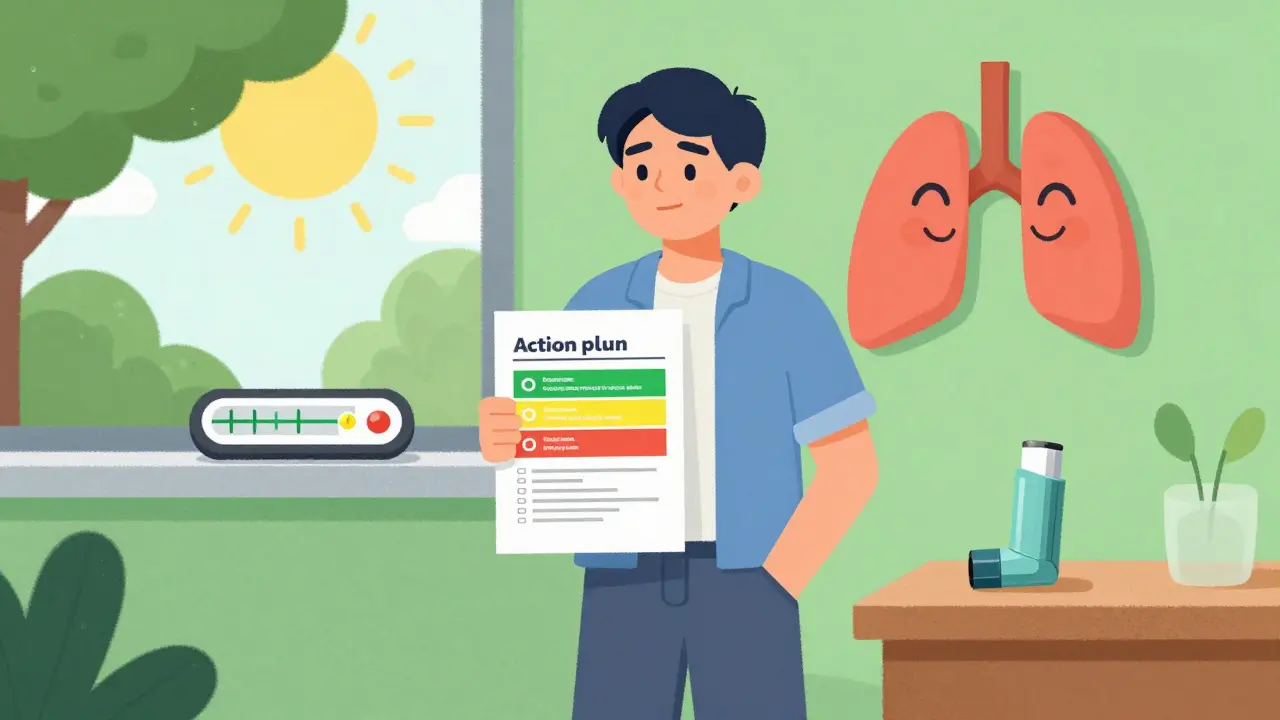
When your asthma feels like a ticking time bomb, knowing what to do before it goes off can save your life. An asthma action plan isn’t just another piece of paper your doctor hands you-it’s your personal roadmap to staying in control, day after day. It tells you exactly what to do when you’re feeling fine, when things start to slip, and when you need to call for help. And if you’re not using one, you’re flying blind.
What Exactly Is an Asthma Action Plan?
An asthma action plan is a written, color-coded guide created with your doctor that breaks down your asthma management into three clear zones: green, yellow, and red. Think of it like a traffic light for your lungs. Green means go-your asthma is under control. Yellow means slow down-your symptoms are getting worse. Red means stop-this is an emergency. Each zone has specific instructions for your medications, symptoms to watch for, and when to act. This isn’t a one-size-fits-all document. Your plan is built around your body, your triggers, and your daily routine. It includes your personal best peak flow number (the highest reading you can consistently get when you’re feeling well), which medications to take and when, and who to call if things spiral. According to the National Heart, Lung, and Blood Institute, people who follow a written action plan cut their emergency room visits by up to 70%.The Three Zones: Green, Yellow, Red
Every asthma action plan uses the same three-zone system. Here’s what each one means in real terms.Green Zone: You’re in Control
This is your goal. In the green zone, you have no coughing, wheezing, or shortness of breath. You sleep through the night. You can run, play, work, or exercise without stopping. Your peak flow readings are 80-100% of your personal best. Your instructions here are simple: keep doing what you’re doing. Take your daily controller medication-usually an inhaled corticosteroid like fluticasone (Flovent) or budesonide (Pulmicort)-exactly as prescribed. Don’t skip doses just because you feel good. That’s how you stay in green.Yellow Zone: Warning Signs
This is where most people panic-or worse, ignore it. The yellow zone means your asthma is getting worse. You might notice:- Coughing more, especially at night
- Wheezing or chest tightness during daily activities
- Needing your rescue inhaler more than twice a week
- Peak flow readings between 50-79% of your personal best
- Take your rescue inhaler (like albuterol) as directed-usually 2-4 puffs every 4-6 hours
- Keep taking your daily controller meds
- Monitor symptoms every hour
- Call your doctor if you don’t improve within 24 hours
Red Zone: Emergency Mode
This is your body’s last warning before a serious attack. Red zone signs include:- Severe shortness of breath-even at rest
- Peak flow below 50% of your personal best
- Inability to speak in full sentences
- Lips or fingernails turning blue
- No improvement after using your rescue inhaler
How to Build Your Own Plan
You can’t build a good plan alone. You need your doctor’s input. But you can prepare. Step 1: Know your personal best peak flow Peak flow meters are cheap, handheld devices that measure how fast you can blow air out of your lungs. Your personal best is the highest number you can get when you’re feeling completely well. To find it, take readings twice a day for 2-4 weeks during a stable period. Record the highest number from each day. That’s your personal best. Write it on your plan. If your doctor hasn’t helped you establish this, ask for it. Without it, your plan is just guesswork. Step 2: List your triggers What makes your asthma worse? Pollen? Cold air? Smoke? Stress? Pets? List them clearly on your plan. This helps you avoid them and lets others (teachers, coworkers, friends) know what to watch for. Step 3: Write down your meds Be specific. Don’t just write “inhaler.” Write:- Controller: Fluticasone 110 mcg, 2 puffs every morning
- Rescue: Albuterol 90 mcg, 2 puffs as needed, max 8 puffs/day

Why Most People Fail With Their Plans
You might have a plan. But if you’re not using it, it’s useless. Here’s why most people don’t stick with it:- They never got their personal best-so they don’t know what 50% or 80% means.
- They forget where they put it-63% of patients say having a plan boosts confidence, but 41% admit they can’t find it when they need it.
- They think they’re fine-living in the yellow zone for months because they’ve normalized symptoms.
- They don’t update it-your plan should change if your asthma changes. Seasonal allergies? New medication? Weight gain? Talk to your doctor every 6 months.
Digital Tools and New Advances
Technology is making asthma plans smarter. Smart inhalers like Propeller Health track when and where you use your rescue inhaler. If you’re using it more than twice a week, the app flags it and reminds you to check your plan. The Asthma and Allergy Foundation of America’s free app lets you log symptoms, triggers, and peak flow readings-then auto-generates a printable plan. In 2023, the NHLBI updated their digital templates to sync with these apps. A 2022 study found that patients using smart inhalers improved their plan adherence by 35%. Future versions may even predict your next flare-up using weather data, pollen counts, and your symptom history. But no app replaces a plan you understand. The core three-zone system still works because it’s simple, visual, and fast. In a panic, you don’t need a complex algorithm-you need to know: green, yellow, red.
Special Considerations
For kids: Share the plan with teachers, school nurses, and after-school caregivers. Schools in the U.S. are legally required to keep a copy under Section 504 of the Rehabilitation Act. Make sure your child knows what to do if they feel symptoms at school. For older adults: Memory and coordination can make inhalers harder to use. Ask your doctor about spacers or nebulizers. Some older patients need 2-3 extra visits to fully understand their plan. For colorblind users: If you can’t distinguish green, yellow, and red, ask for a modified plan. Some organizations offer versions with patterns-stripes, dots, or symbols-instead of colors.Your Next Steps
If you don’t have a plan:- Call your doctor and ask for one.
- Ask them to help you find your personal best peak flow.
- Write down your triggers and medications clearly.
- Print two copies-one for you, one for someone else.
- Review it every time you see your doctor.
- Take it out.
- Check your peak flow number-is it still accurate?
- Are your triggers still the same?
- Have your meds changed?
Do I really need an asthma action plan if I only have mild symptoms?
Yes. Even mild asthma can turn dangerous quickly. Many people who end up in the ER thought their symptoms were "just a little bad." An action plan helps you catch changes early-before they become emergencies. The National Heart, Lung, and Blood Institute recommends a plan for every person with asthma, no matter how mild.
What if my doctor won’t give me a plan?
You have the right to one. Ask directly: "Can we create a written asthma action plan based on the NHLBI guidelines?" If they refuse or seem dismissive, consider seeking a second opinion from an allergist or pulmonologist. Most guidelines require action plans as standard care.
How often should I update my asthma action plan?
At least once a year, or anytime your asthma changes. If you start a new medication, have a flare-up, move to a new city with different allergens, or notice your rescue inhaler use increasing, schedule a review. Seasonal changes-like spring pollen or winter cold air-often require adjustments.
Can I use an asthma action plan if I don’t have a peak flow meter?
Yes, but it’s less precise. If you don’t have a peak flow meter, your plan should focus on symptoms: when you start coughing, wheezing, or waking up at night. Use those signs to trigger your yellow zone actions. Still, getting a meter is strongly recommended-it’s the most objective way to track your asthma.
Is an asthma action plan only for children?
No. While pediatric practices are more likely to provide them, adults benefit just as much. In fact, adults are less likely to have one-only 52% of adult primary care practices routinely give them out, compared to 78% of pediatric offices. But asthma doesn’t stop at age 18. Adults with asthma are at higher risk of severe attacks and hospitalization, making a plan even more critical.
Cassie Tynan
So let me get this straight - we’re telling people to carry a laminated traffic light for their lungs like it’s a fucking survival guide for a zombie apocalypse? And somehow this isn’t the most ridiculous thing about modern medicine? I love it. Keep the inhaler handy, the plan in your wallet, and your dignity somewhere in between. 🤷♀️
Rory Corrigan
Green = chill
Yellow = panic but don’t panic
Red = call 911 and pray to the asthma gods
Also, your peak flow meter is basically your asthma’s Fitbit. If you don’t track it, you’re just guessing. 😅
Roshan Aryal
This is what happens when Western medicine turns everything into a corporate checklist. In India, we just know when our lungs are failing - no color codes, no apps, no laminated paper. We use nebulizers, ginger tea, and silence. This plan is a luxury for people who’ve forgotten how to listen to their own bodies. You don’t need a chart to know when you’re suffocating.
Uzoamaka Nwankpa
I’ve had asthma since I was 5. I’ve had 3 ER visits. I’ve had doctors who didn’t believe me. I’ve had plans that got lost in my bag. I’ve cried in parking lots because I couldn’t breathe and no one understood. And now you want me to laminate it? Like it’s a restaurant menu? I’m tired. I’m so tired.
Oluwapelumi Yakubu
Let’s be real - this plan is genius but only if you’re not broke, not illiterate, and not living in a country where inhalers cost more than your monthly phone bill. The system works beautifully… for people who already have privilege. For the rest of us? We pray, we improvise, and we hope the coughing doesn’t wake the landlord. Still, props for the effort. 🙏
Terri Gladden
ok so i just found my asthma plan from 2018 in my purse under a receipt for gummy bears and a used tampon and i think my peak flow number is wrong bc i was sick that week and also my doctor is now in prison for embezzlement so like… do i just wing it? also can i use my cat as a spacer? 🐱 #asthmastruggles
Jennifer Glass
I’ve been using my plan for two years now and it’s changed my life. I used to think wheezing after climbing stairs was normal. Turns out it’s not. My personal best peak flow was 420 - I didn’t know that until I actually tracked it. Now I catch flares before they escalate. It’s not glamorous, but it’s effective. Just take the 10 minutes to make one. Your future self will high-five you.
Joseph Snow
Who funded this article? The pharmaceutical industry? The peak flow meter market? The laminated paper industry? It’s suspicious how conveniently this plan requires specific devices, medications, and frequent doctor visits. Meanwhile, the real solution - cleaner air, fewer allergens, better housing - is never mentioned. This isn’t empowerment. It’s a profit-driven distraction.
John Wilmerding
As a certified asthma educator with over 15 years of clinical experience, I can confirm that adherence to a personalized asthma action plan reduces hospitalizations by 68-72% across all age groups, as validated by multiple peer-reviewed studies including those published in the Journal of Allergy and Clinical Immunology. The color-coded system is not arbitrary; it is based on evidence-based thresholds established by the Global Initiative for Asthma (GINA) and the National Heart, Lung, and Blood Institute (NHLBI). For patients who lack access to peak flow meters, symptom-based triggers are acceptable, though objective monitoring remains the gold standard. I strongly encourage all patients to request this document at every annual review - it is a right, not a privilege.
Peyton Feuer
just got my plan from my doc last week and i laminated it bc i’m that guy now. also put it in my phone notes. my roommate thought i was being dramatic until i used it last week when i got a cold and caught it before it got bad. honestly? it’s weirdly empowering. like having a cheat code for your body. 🤓
Siobhan Goggin
I never thought I’d say this, but thank you for writing this. My sister has asthma and I used to panic every time she coughed. Now I know what green, yellow, and red mean. I even printed one for her school. She says she feels safer. That’s all I ever wanted.
Jay Tejada
Man, in Mumbai, we just use a handkerchief and a prayer. But honestly? This plan makes sense. I’ve seen friends ignore yellow zone signs until they’re in red. Then they’re in the hospital for a week. This isn’t about gadgets - it’s about awareness. If you’re reading this and you’ve been coughing for months? Stop normalizing it. Your lungs aren’t broken. You’re just ignoring them.
Allen Ye
The asthma action plan is more than a medical document - it is a philosophical artifact of modern self-governance. In an age where the body is increasingly mediated by data, by metrics, by quantified selves, the action plan becomes a ritual of agency. It transforms the passive sufferer into the active steward of their own physiology. The green-yellow-red framework is not merely clinical; it is mythic - a tripartite cosmology of breath, warning, and transcendence. We are not just managing asthma. We are negotiating our mortality with laminated paper and a handheld device. And perhaps, in that act, we reclaim something sacred: the right to breathe, intentionally, on our own terms.
mark etang
According to the American Thoracic Society’s 2023 Clinical Practice Guidelines, the implementation of a structured, physician-coordinated Asthma Action Plan constitutes a Level A Recommendation for all patients diagnosed with persistent asthma, regardless of symptom severity. Failure to provide such a plan constitutes a deviation from the standard of care and may expose practitioners to liability under the doctrine of informed consent. This document is not optional. It is mandatory. Please ensure your provider complies.