

Many older adults take medications every day to manage conditions like allergies, overactive bladder, depression, or sleep problems. But what if some of these everyday pills are quietly harming their memory and thinking? That’s the reality of anticholinergic burden - the hidden toll that certain common drugs take on the aging brain.
What Exactly Is Anticholinergic Burden?
Anticholinergic burden isn’t one drug. It’s the combined effect of multiple medications that block acetylcholine, a brain chemical essential for memory, attention, and learning. When this chemical gets blocked, brain signals slow down. In younger people, the brain often compensates. But as we age, that ability fades - and the damage becomes visible. The most widely used tool to measure this burden is the Anticholinergic Cognitive Burden (ACB) scale. It rates drugs from Level 1 (mild) to Level 3 (strong). A person taking two Level 2 drugs and one Level 3 drug might have an ACB score of 7. That’s not just a number - it’s a red flag. Research shows that even a score of 3 or higher over time increases dementia risk. A 2015 study found that people who took strong anticholinergics for three years or more had a 54% higher chance of developing dementia than those who used them for less than three months.Which Medications Are the Biggest Culprits?
You might be surprised to learn how many common prescriptions and even over-the-counter pills carry this risk.- First-generation antihistamines: Diphenhydramine (Benadryl, Tylenol PM, Advil PM) - used for allergies or sleep. These are the most common offenders, making up nearly 18% of high-burden prescriptions in older adults.
- Overactive bladder drugs: Oxybutynin (Ditropan), tolterodine, and solifenacin. These help with frequent urination but cross into the brain easily, disrupting memory circuits.
- Tricyclic antidepressants: Amitriptyline and nortriptyline. While effective for depression and nerve pain, they’re strong anticholinergics. Newer antidepressants like SSRIs (sertraline, escitalopram) are safer alternatives.
- Anti-nausea and motion sickness drugs: Dimenhydrinate (Dramamine) and promethazine. These are often given without thinking about brain effects.
- Some Parkinson’s and epilepsy drugs: Certain anticholinergics are still prescribed for tremors or seizures, despite better options now available.
How Do These Drugs Actually Damage the Brain?
It’s not just about feeling drowsy. Anticholinergics target M1 muscarinic receptors, which are packed in the hippocampus and frontal cortex - the very areas responsible for forming new memories and making decisions. Brain scans from the 2016 JAMA Neurology study showed that older adults taking medium-to-high anticholinergic drugs had 4% less glucose use in the temporal lobe - the same region that lights up in early Alzheimer’s. That’s not a coincidence. Another study tracked brain shrinkage over three years and found that anticholinergic users lost brain volume at a rate 0.24% faster per year than non-users. Think of it like a traffic jam in the brain. Acetylcholine is the signal that keeps neurons talking. When drugs block it, messages get lost. Executive function - planning, multitasking, problem-solving - takes the biggest hit. Episodic memory - remembering what you had for breakfast or where you put your keys - also declines noticeably. Processing speed? Less affected. That’s why confusion and forgetfulness show up long before slow walking or balance issues.
Real Stories: When Stopping the Drug Made a Difference
Behind every statistic is a person. On AgingCare.com, a caregiver named Jen wrote: “My mom was confused all the time. She forgot names, got lost in her own house. We thought it was early dementia. Then we found out she’d been on oxybutynin for five years. We stopped it. Within two weeks, she was back to herself. Her doctor didn’t even know it could do this.” The FDA’s adverse event database recorded over 1,200 cognitive-related reports from seniors between 2018 and 2022. The top symptoms? Confusion (38.7%), memory loss (29.4%), and sudden delirium (18.2%). Many of these cases were avoidable. In a 2021 survey of 312 older adults, 41% said they would have chosen a different treatment if they’d known the risks. That’s not just about informed consent - it’s about dignity.How Long Does It Take to Recover?
One of the most hopeful parts of this story? The brain can bounce back - if the drug is stopped. The 2019 DICE trial followed 286 older adults who had their anticholinergic meds reduced. After 12 weeks, their Mini-Mental State Exam (MMSE) scores improved by 0.82 points on average. That might sound small, but for someone struggling to remember names or follow a conversation, it’s life-changing. Recovery isn’t instant. It usually takes 4 to 8 weeks for the brain to clear the drug and restore normal signaling. Some people notice improvements in days. Others need months. But the key is stopping - not just lowering the dose.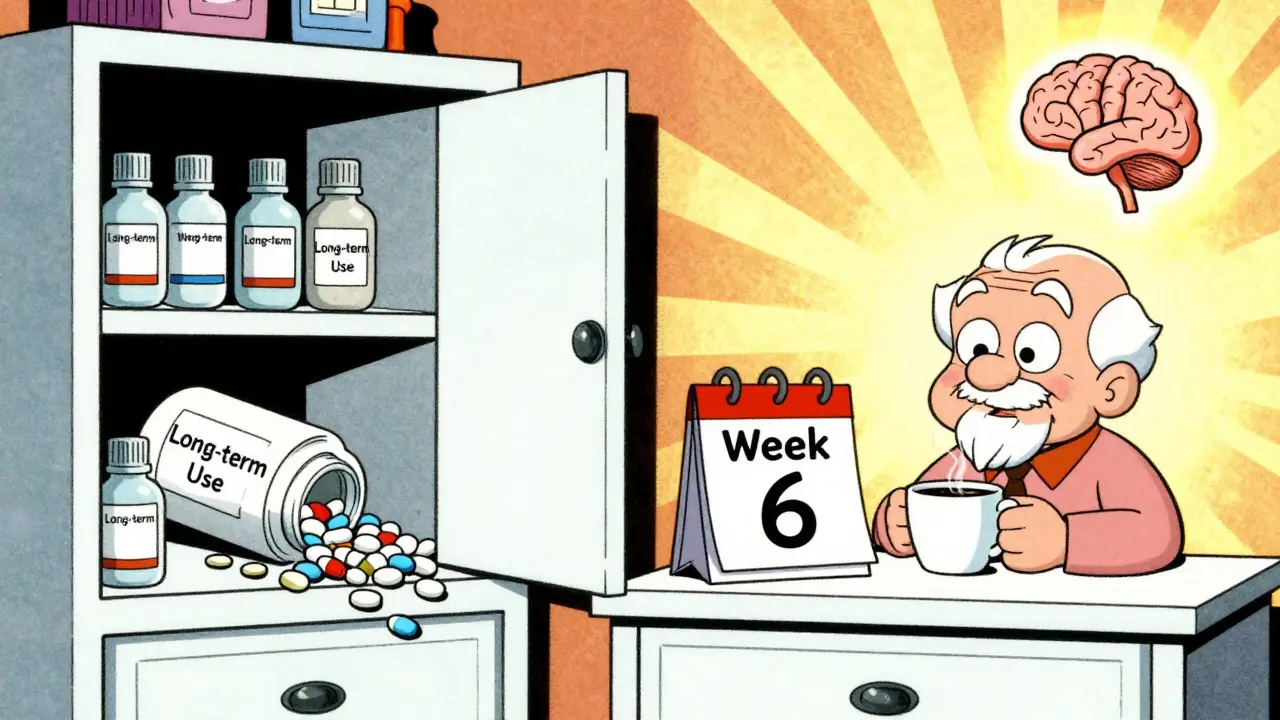
Why Do Doctors Keep Prescribing These Drugs?
It’s not that doctors don’t know. They do. But the system makes it hard to change. A 2021 survey of over 1,200 family doctors found that 37% felt they didn’t have enough time during appointments to review all medications. The average review takes 23 minutes - longer than most visits. Many don’t use tools like the ACB scale. Others assume the patient “needs” the drug for sleep or bladder control. Even when flagged, deprescribing doesn’t always happen. A 2022 study found that only 38.7% of nursing home residents with high anticholinergic scores had their meds reviewed within three months. The pharmaceutical industry is slowly responding. Johnson & Johnson pulled long-acting oxybutynin in 2021. Pfizer pushed solifenacin, which doesn’t cross into the brain as easily. The FDA now requires updated warning labels. But the change is slow.What Can You Do?
If you or a loved one is over 65 and taking any of these medications, here’s what to do:- Make a full list - include all prescriptions, OTCs, supplements, and sleep aids. Don’t forget patches and creams.
- Use the ACB Calculator - the American Geriatrics Society launched a free mobile app in 2024 that scores your meds instantly.
- Ask your doctor: “Is this drug necessary? Is there a non-anticholinergic alternative?”
- Don’t stop cold turkey - especially for antidepressants or bladder meds. Work with your provider to taper safely.
- Track changes - note memory, focus, confusion, or mood shifts after stopping or switching a drug.
It’s Not About Fear - It’s About Choice
This isn’t about vilifying medications. Many of these drugs help people sleep, manage pain, or stay dry. But when a safer option exists - and the brain is at risk - the choice becomes clear. Anticholinergic burden is one of the few modifiable risk factors for dementia that we can act on today. It doesn’t require expensive tests or radical lifestyle changes. Just a conversation. A list. A willingness to ask: “Could this be hurting more than helping?” The science is clear. The tools are here. The only thing missing is action.Can anticholinergic medications cause permanent brain damage?
There’s no evidence that anticholinergic medications cause permanent, irreversible brain damage in most cases. However, long-term use can accelerate brain shrinkage and reduce activity in memory-related areas, which may contribute to lasting cognitive decline - especially if not addressed. The good news is that many people see noticeable improvement in memory and thinking within weeks to months after stopping these drugs. Early intervention matters.
Are all antihistamines dangerous for seniors?
No. Only first-generation antihistamines like diphenhydramine (Benadryl) and chlorpheniramine have strong anticholinergic effects. Second-generation antihistamines like loratadine (Claritin), cetirizine (Zyrtec), and fexofenadine (Allegra) are much safer for older adults. They don’t cross the blood-brain barrier as easily and rarely cause confusion or memory problems.
Can I just lower the dose instead of stopping the drug?
Lowering the dose may reduce side effects slightly, but it won’t eliminate the risk. Studies show that even low doses taken for years can increase dementia risk. The real benefit comes from stopping or replacing the drug entirely. For example, switching from oxybutynin to mirabegron (Myrbetriq) for bladder control cuts anticholinergic burden to zero while maintaining effectiveness.
What are safe alternatives to amitriptyline for sleep or nerve pain?
For sleep: melatonin, cognitive behavioral therapy for insomnia (CBT-I), or low-dose trazodone (which has minimal anticholinergic effects). For nerve pain: gabapentin, pregabalin, or duloxetine. These options are just as effective and carry far less cognitive risk. Always work with your doctor to switch safely - never stop abruptly.
How do I know if my parent’s confusion is from meds or dementia?
Confusion from anticholinergic drugs often comes on suddenly or worsens after a new prescription. Dementia progresses slowly over months or years. If confusion appeared after starting a new medication - especially an antihistamine, bladder pill, or tricyclic antidepressant - try stopping it under medical supervision. Many seniors show clear improvement within weeks, which strongly suggests the meds were the cause, not dementia.
Is it safe to take anticholinergics occasionally, like for allergies or travel?
Occasional use - once or twice a year - is unlikely to cause lasting harm. But if someone is taking these drugs monthly or more, even for short periods, the risk adds up. For regular allergies, switch to non-sedating antihistamines. For motion sickness, try ginger or acupressure bands. Avoid using anticholinergics as a sleep aid - that’s the most dangerous pattern.
Where can I get my meds checked for anticholinergic burden?
Ask your pharmacist or primary care doctor to run your medication list through the ACB scale. The American Geriatrics Society offers a free mobile app called the ACB Calculator that does this instantly. You can also bring a full list to a geriatrician or medication therapy management (MTM) service, often covered by Medicare Part D.
Angela Stanton
OMG this is EVERYTHING. 🤯 I just found out my mom’s been on oxybutynin for 7 years and her ‘dementia’ was just anticholinergic fog. ACB score of 8. Like… how is this not a public health crisis? The FDA labels are buried under 12 layers of fine print. We need a black box warning on Benadryl like we did with opioids. #AnticholinergicWakeUpCall
Johanna Baxter
My grandma took diphenhydramine every night for 20 years and now she can’t remember my name. I’m not mad, I’m just disappointed in the medical system. They’re prescribing brain rot like it’s Advil. #RIPMemory
Jeffrey Hu
Let’s be clear - the ACB scale is useful but oversimplified. It doesn’t account for pharmacokinetic variability in elderly patients with reduced hepatic clearance. A Level 2 drug in a 65-year-old with CKD stage 3 is functionally a Level 3. Also, most studies don’t control for polypharmacy confounders like benzodiazepines or NSAIDs. The 54% dementia risk increase? Likely inflated. But yeah, still dangerous.
Jacob Paterson
Of course doctors keep prescribing this. They’re not evil - they’re exhausted. 12-minute visits. 20 meds on a list. No time to cross-reference. And patients? They’re like ‘Doc, I can’t sleep’ - and you give them the easiest fix. The system’s broken, not the prescribers. Also, your ‘non-anticholinergic’ alternatives? Try telling a 78-year-old with chronic pain that gabapentin is better than amitriptyline when the latter costs $4 and the former is $200 with insurance.
Patty Walters
i just used the acb calculator app - my dad’s list scored 5. he’s on benadryl, oxybutynin, and amitriptyline. i’m gonna take him to his doc next week. we’re switching to mirabegron and melatonin. he’s been so foggy lately… i didn’t realize it was meds. thank you for this post. 🙏
Phil Kemling
There’s a deeper layer here: we’ve outsourced cognitive responsibility to chemistry. We don’t want to sit with aging, with loss, with the quiet erosion of self - so we numb it. A pill for sleep. A pill for bladder. A pill for sadness. But the brain isn’t a machine with clogged pipes. It’s a living network. And when you choke off acetylcholine, you’re not just blocking a receptor - you’re silencing the voice of memory itself. The tragedy isn’t just the drugs. It’s that we’ve forgotten how to listen.
Catherine Scutt
People still take Benadryl to sleep? Like… what year is this? I’m 32 and I wouldn’t take that stuff. My grandma’s on it and she’s basically a zombie after dinner. If your sleep aid makes you forget your own birthday, maybe the problem isn’t sleep - it’s the solution.
Darren McGuff
As a pharmacist in Edinburgh, I’ve seen this daily. An 82-year-old woman comes in with 14 prescriptions - 6 of them anticholinergic. She’s confused, falls once a week. We deprescribe. Within 3 weeks, she’s walking without a cane, remembering her grandkids’ names. It’s not magic. It’s just… removing the fog. Why isn’t this standard practice? Because we treat symptoms, not systems.
Alicia Hasö
This is the most important post I’ve read this year. To every caregiver, every senior, every clinician: you have the power to change this. Make the list. Use the app. Ask the question. Your loved one’s memory isn’t just fading - it’s being stolen by a pill they never knew was dangerous. Don’t wait for dementia to be diagnosed. Prevent it before it starts. Your brain deserves better than a sleep aid that erases your life.