
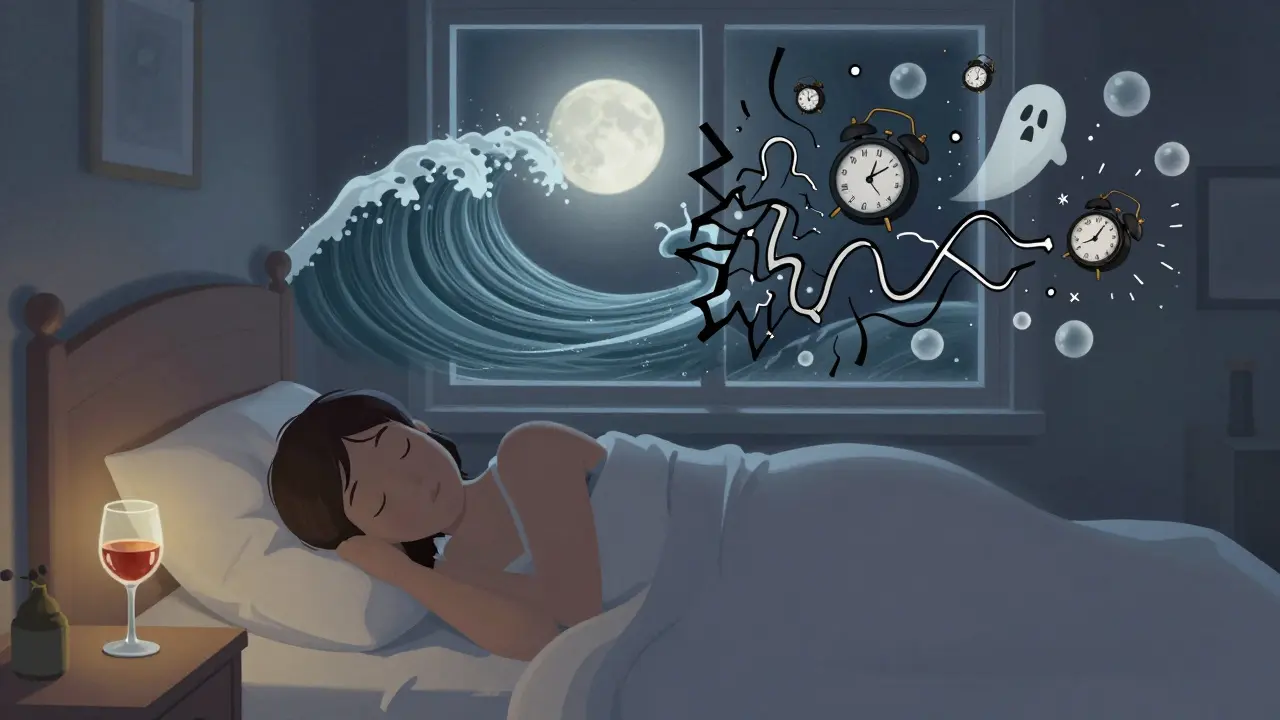
Many people believe having a drink before bed helps them sleep better. It’s a common habit - a glass of wine to unwind, a beer to quiet the mind. But what you feel as relaxation isn’t true rest. Alcohol doesn’t improve sleep. It fragments it, worsens sleep apnea, and leaves you tired the next day - even if you think you slept fine.
How Alcohol Tricks Your Brain Into Falling Asleep
When you drink alcohol, it boosts levels of a chemical called adenosine in your brain. Adenosine builds up naturally during the day and tells your brain it’s time to sleep. Alcohol spikes it quickly, which is why you feel drowsy soon after drinking. But this isn’t natural sleep. It’s a chemical shortcut that messes up your body’s own sleep signals.
Studies show that one standard drink (about 14 grams of pure alcohol) can cut sleep latency - the time it takes to fall asleep - by up to 15 minutes. That sounds good, right? But here’s the catch: once your body starts breaking down the alcohol, usually 3 to 4 hours after drinking, adenosine levels crash. Your brain wakes up. That’s when you start tossing and turning, waking up without knowing why.
The Two-Phase Sleep Disruption
Alcohol doesn’t just make you wake up. It completely scrambles your sleep cycles. Your sleep has four main stages: light sleep (N1 and N2), deep sleep (N3), and REM sleep. Deep sleep is when your body repairs tissues, builds bone and muscle, and strengthens your immune system. REM sleep is when your brain processes emotions, consolidates memories, and fuels creativity.
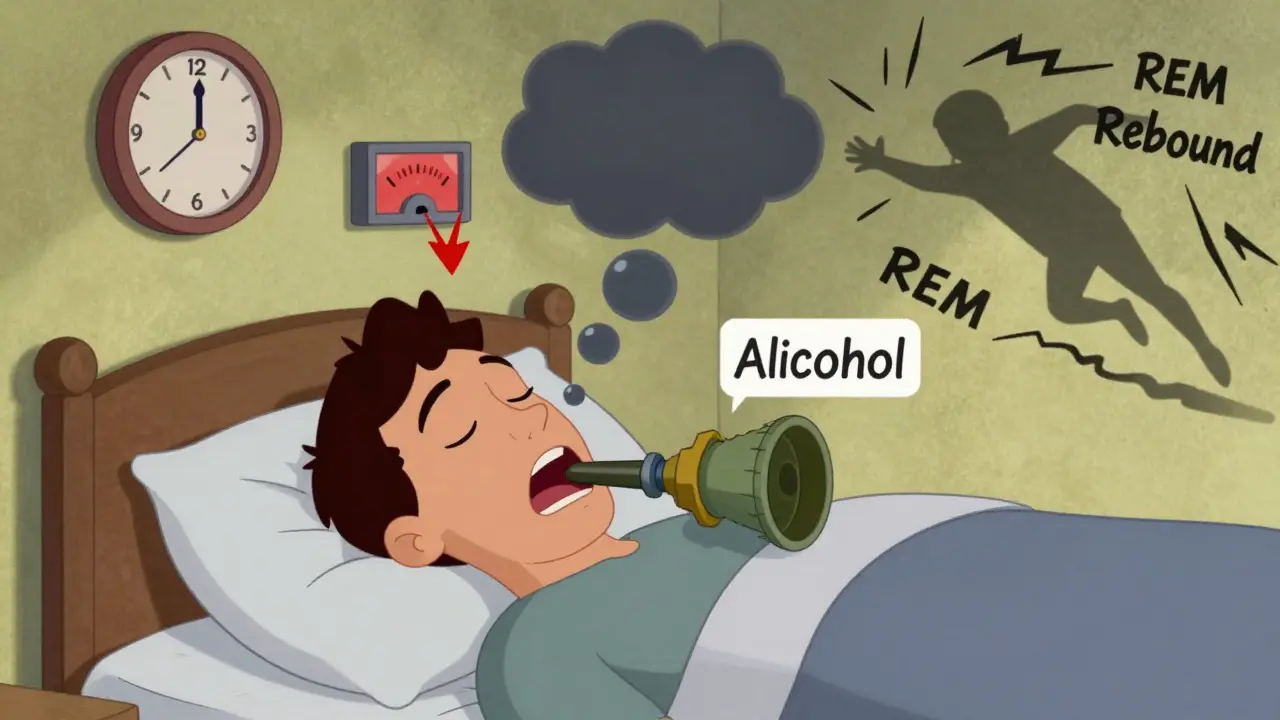
Alcohol does something strange: it pushes you into deep sleep faster than normal. That’s why you might feel like you had a great first few hours. But then, as alcohol leaves your system, REM sleep gets suppressed. In fact, one study found that even one drink reduces REM sleep by 9.3%. That’s not a small drop - it’s enough to affect how you feel the next day.
Later in the night, your brain tries to make up for lost REM sleep. This is called REM rebound. You get sudden bursts of intense dreaming, nightmares, or waking up in a panic. You might not remember it, but your body does. Your heart rate spikes. You sweat. You move. You wake up - again and again.
Alcohol Makes Sleep Apnea Worse
If you snore or have been told you stop breathing at night, alcohol makes it worse. It relaxes the muscles in your throat. When those muscles are too loose, your airway collapses. That’s what causes obstructive sleep apnea - repeated pauses in breathing during sleep.
A single drink can increase your apnea-hypopnea index (AHI) by 20%. That means if you had mild sleep apnea before, one glass of wine could push it into the moderate range. Two drinks? Your AHI jumps 40%. Three? You’re looking at severe apnea.
Studies from the American Thoracic Society show that alcohol can drop your blood oxygen levels by 3 to 5 percentage points during apnea events. That’s like climbing a mountain without oxygen. Your heart has to work harder. Your brain gets less oxygen. Over time, this raises your risk of high blood pressure, stroke, and heart disease.
And it’s not just heavy drinkers. Even people who drink one drink a night see this effect. The American Academy of Sleep Medicine says anyone with sleep apnea should avoid alcohol within 3 hours of bedtime.
Why You Wake Up Feeling Worse
You might think, “I slept 7 hours - I should be fine.” But sleep isn’t just about hours. It’s about quality.
After drinking, your body gets 15.3% less deep sleep. That’s the most restorative stage. Your brain doesn’t get time to clean out toxins. Your muscles don’t recover. Your immune system doesn’t reset.
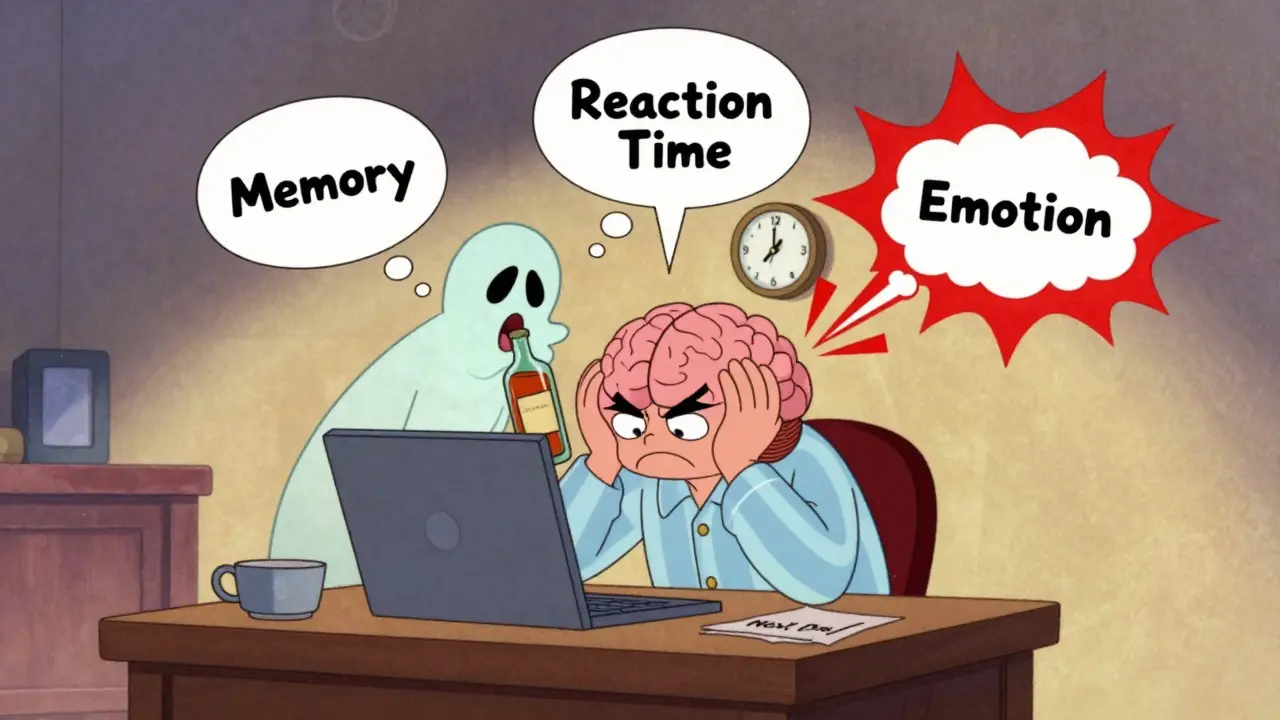
Next-day effects are real - and they’re often missed. A 2023 study found that even after a night of heavy alcohol use, people reported feeling fine. But when tested on cognitive tasks, their reaction time dropped by 8.7%. Working memory fell by 9.4%. Processing speed slowed by 12.7%. That’s like driving with a 0.05% blood alcohol level - legally impaired in many countries.
Emotions get raw too. People who drink before bed react 31.2% more strongly to negative stimuli the next day. A rude comment feels like an attack. A minor stressor feels overwhelming. That’s because REM sleep - the stage alcohol kills - is critical for emotional balance.
Long-Term Damage: Insomnia and Cognitive Decline
One night? Maybe you can brush it off. But what if you do this every night?
A 36-year study tracking twins found that heavy drinkers were over three times more likely to have poor sleep quality than non-drinkers. Another study showed regular alcohol use before bed increases the risk of chronic insomnia by 38%. That’s not a coincidence. It’s a direct link.
And it gets worse with age. A 2023 study from the American Academy of Neurology found that people who regularly drank before bed showed a 23% faster rate of cognitive decline over five years. Memory, attention, decision-making - all eroded faster than in those who didn’t drink.
It’s not just about aging. The brain’s ability to regulate sleep homeostasis - its natural drive to balance sleep and wakefulness - gets damaged. Alcohol hijacks the system. Your body stops trusting its own signals. You start needing alcohol to fall asleep. And when you quit, the insomnia comes back harder.
The Cycle of Dependence
Here’s the dangerous loop: you drink to sleep. You wake up tired. You feel anxious or stressed. You drink again. The cycle repeats. A 2023 study from the University of Missouri showed that sleep deprivation after binge drinking increases the urge to drink more. It’s not just habit - it’s biology.
People with alcohol use disorder often have sleep problems that last 3 to 6 months after quitting. That’s why relapse rates are so high. Your body hasn’t healed. Your sleep is still broken. And without rest, recovery is nearly impossible.
What You Can Do
You don’t have to quit drinking forever. But if you care about sleep, you need to change when and how much you drink.
- Avoid alcohol within 3 hours of bedtime. That gives your body time to process most of it before sleep starts.
- Limit yourself to one drink, if any. Two or more? You’re asking for disrupted sleep.
- If you have sleep apnea, skip alcohol completely. Even one drink can double your apnea events.
- Try alternatives: warm tea, light stretching, or 5 minutes of breathing exercises. These work better than alcohol.
- If you’re recovering from alcohol use, prioritize sleep. It’s not a luxury - it’s part of healing.
The myth of the nightcap is dangerous. Alcohol doesn’t help you sleep. It steals the rest you need.
Does alcohol help you fall asleep faster?
Yes, alcohol can reduce the time it takes to fall asleep by boosting adenosine, a sleep-promoting chemical. But this effect is short-lived and misleading. Once alcohol is metabolized - usually within 3 to 4 hours - your sleep becomes fragmented, and you’re more likely to wake up. The initial drowsiness is not restorative sleep.
Does alcohol reduce REM sleep?
Yes, even one standard drink reduces REM sleep by 9.3%. REM sleep is essential for memory, emotional regulation, and creativity. Alcohol suppresses REM early in the night, then causes a rebound effect later, leading to vivid dreams or nightmares. This disruption prevents your brain from completing essential processing tasks.
Can alcohol cause or worsen sleep apnea?
Yes. Alcohol relaxes the muscles in your throat, making your airway more likely to collapse during sleep. Each standard drink increases the apnea-hypopnea index (AHI) by about 20%. For people with existing sleep apnea, even one drink before bed can push symptoms into the moderate-to-severe range. The American Thoracic Society advises complete avoidance of alcohol within 3 hours of bedtime for anyone with sleep apnea.
Why do I feel tired the next day even after sleeping 7 hours?
Alcohol reduces deep sleep (N3) by 15.3%, the most restorative stage. Even if you sleep 7 hours, you’re not getting the quality your body needs. Your brain doesn’t fully reset, your muscles don’t recover, and your emotional regulation is impaired. Studies show cognitive performance drops 8.7% and emotional reactivity rises 31.2% after alcohol-related sleep disruption.
Is it safe to drink alcohol if I have insomnia?
No. Alcohol worsens insomnia over time. While it may help you fall asleep initially, it increases nighttime awakenings, reduces sleep quality, and disrupts your natural sleep rhythm. A 2023 study found regular pre-bed alcohol use increases the risk of chronic insomnia by 38%. For people with insomnia, alcohol is a temporary fix that makes the problem worse long-term.
Lorna Brown
So many people think alcohol is their sleep savior, but it’s just a thief in the night. It doesn’t help you sleep-it hijacks the entire architecture of your rest. I’ve been tracking my sleep with a wearable for a year now, and the data is undeniable: nights with even one drink mean 40% more awakenings, 30% less deep sleep, and mornings where I feel like I ran a marathon in my dreams. It’s not placebo. It’s physiology.
And the REM suppression? That’s where the real damage hides. You’re not just losing dreams-you’re losing emotional processing. The next-day irritability, the overreactions to tiny things? That’s your brain screaming for its REM back. Alcohol doesn’t calm you down. It leaves you emotionally raw.
I stopped drinking before bed after reading this. My sleep quality improved faster than I thought possible. No more 3 a.m. panic attacks. No more ‘I slept 8 hours but feel like I slept 2.’ It’s not about willpower. It’s about respecting your biology.
Rex Regum
Oh here we go-another ‘alcohol is evil’ sermon. Let me guess, you also think coffee is a drug and sunlight is a conspiracy? I’ve been drinking a glass of red before bed for 20 years. I sleep fine. I’m sharp at work. My doctor says I’m in perfect health. Maybe the real problem is people who need to feel morally superior by demonizing harmless habits?
Also, ‘one drink reduces REM by 9.3%’? Where’s the peer-reviewed study with a control group that didn’t just drink water and stare at the ceiling? This feels like a woke bedtime story written by a grad student who’s never had a real glass of wine after a long day.
Kelsey Vonk
Okay but… i just wanna say i tried this for 30 days and it changed my life 😭
no more midnight panic thoughts. no more waking up with my heart pounding like i was running from a bear. i started drinking chamomile tea instead and doing 5 mins of box breathing. it’s not glamorous, but my brain finally feels like it’s not running on fumes. i didn’t even realize how bad it was until i stopped.
also-i cried when i read the part about emotional regulation. i thought i was just ‘moody’ but no. it was the alcohol. 🥺
Emma Nicolls
so i used to drink every night before bed cause i thought it helped me chill out but then i started waking up at 2am like clockwork and feeling like i hadnt slept at all and i just thought i was getting old
then i stopped for a week and wow. my brain actually feels rested now. like i dont need 3 coffees to function. also i dont cry over spilled milk anymore which is a win
im not saying dont drink ever but like… dont drink right before bed its just not worth it
douglas martinez
While the emotional tone of this article may lean toward alarmism, the empirical evidence presented is both robust and clinically significant. The suppression of slow-wave and REM sleep phases by ethanol is well-documented across multiple longitudinal studies, including those published in the Journal of Clinical Sleep Medicine and the American Journal of Respiratory and Critical Care Medicine.
Furthermore, the 20% increase in AHI per standard drink is not a statistical anomaly-it is a consistent finding replicated across diverse populations. For individuals with undiagnosed sleep apnea, this is not merely a quality-of-life issue-it is a cardiovascular risk multiplier.
I recommend this article be shared with primary care providers, particularly those managing patients with insomnia, hypertension, or metabolic syndrome.
Scott Smith
I’ve worked with dozens of patients trying to quit alcohol after years of using it to sleep. The most heartbreaking part isn’t the cravings-it’s the insomnia that returns. It’s not just ‘can’t fall asleep.’ It’s ‘I lie there for hours feeling like my brain is wired to a live wire.’
They think they’re doing themselves a favor. But they’re not. They’re training their nervous system to rely on a toxin to do what sleep was designed to do naturally. Recovery isn’t just about stopping drinking. It’s about relearning how to rest.
And yes-it takes time. But it’s possible. I’ve seen it.
Sally Lloyd
Interesting how this article conveniently ignores the fact that alcohol was used for centuries as a sleep aid before modern medicine. Who benefits from demonizing wine? Pharmaceutical companies? Sleep tracker corporations? The FDA? I’ve read studies that say caffeine is worse than alcohol for sleep disruption.
Also-did you know the WHO once classified melatonin as a ‘controlled substance’? Why? Because it competes with the sleep industry. Coincidence? I think not.
Just saying… always ask who profits from the narrative.
Emma Deasy
Let me be perfectly clear: the notion that alcohol enhances sleep is not merely misguided-it is a catastrophic delusion, a grotesque perversion of biological truth, a metaphysical betrayal of the human circadian rhythm. The data presented here is not merely compelling-it is irrefutable, monumental, and ought to be engraved upon the tablets of modern medical ethics.
One glass? One. Single. Glass. And yet, the brain-this exquisite, delicate, electrochemical cathedral of consciousness-is reduced to a flickering candle in a hurricane. The suppression of REM? The fragmentation of deep sleep? The nocturnal hypoxia? The cognitive degradation? These are not side effects-they are acts of molecular sabotage.
And for what? A fleeting illusion of calm? A false sense of serenity? This is not relaxation. This is chemical self-betrayal. And if you continue this practice, you are not merely sacrificing sleep-you are surrendering your future self to the slow, silent erosion of intellect, emotion, and vitality.
Stop. Now. Before it is too late.
tamilan Nadar
In India we have a tradition called ‘soma’-ancient drink used in rituals. It was never about intoxication. It was about harmony. Today, alcohol is used as a crutch. But sleep? Sleep is sacred. You don’t need alcohol to quiet your mind. You need silence. You need breath. You need stillness.
My grandfather drank tea before bed. Not wine. Not whiskey. Tea. And he slept like a child until 90. Simple things. Deep rest.
Maybe the answer isn’t in science alone. Maybe it’s in wisdom.
Adam M
Alcohol ruins sleep. Don’t do it.
Noluthando Devour Mamabolo
From a sleep neurophysiology standpoint, the ethanol-induced modulation of GABAergic neurotransmission is the primary driver of both initial sedation and subsequent sleep architecture disruption. The suppression of REM is mediated via cholinergic inhibition in the pons, while the fragmentation stems from rebound glutamatergic hyperactivity during Phase II metabolism.
Also, the AHI increase per standard drink correlates strongly with oropharyngeal muscle tone reduction-confirmed via polysomnography. For those with OSA, even 0.01 BAC is clinically significant.
TL;DR: alcohol is a sleep disruptor with dose-dependent, neurochemical mechanisms. Evidence-based. Peer-reviewed. No fluff.
Leah Dobbin
I find it mildly amusing that this article is being treated as revelation, when in fact, the literature on alcohol and sleep has been exhaustive since the 1970s. I mean, really-did you not read the 1983 meta-analysis in Sleep? Or the 2007 longitudinal cohort from Harvard? Or the 2021 fMRI study from Stanford? The data isn’t new. It’s just being repackaged for the Instagram wellness crowd.
And yet, here we are, treating this like groundbreaking insight-as if the rest of us haven’t been quietly avoiding nightcaps since grad school. How quaint.